

Medicare Advantage denial rates Selecting a health insurance plan has always required some speculation about how the insurer will actually act when you require medical attention. The amount of guesswork has significantly decreased. As Medicare’s open enrollment season draws near, insurers are now legally obligated to disclose the precise frequency with which they reject prior authorization requests for the first time ever. The first full year of that data is now available to the public.
New Medicare Prior Authorization Transparency Rules Explained
Medicare Advantage organizations, Medicaid managed care plans, CHIP programs, and ACA marketplace insurers are required by a federal rule known as CMS-0057-F, which was finalized in January 2024, to publish standardized prior authorization metrics annually. The initial reports, which covered all of 2025, had to be submitted by March 31, 2026. They included 12 distinct data points, such as approval and denial rates, the frequency of appeals of denials, the success rate of those appeals, and the actual time it takes to make a decision. Approximately 92% of required plans had released their numbers as of late July 2026.
What Medicare Advantage Denial Rates Actually Show
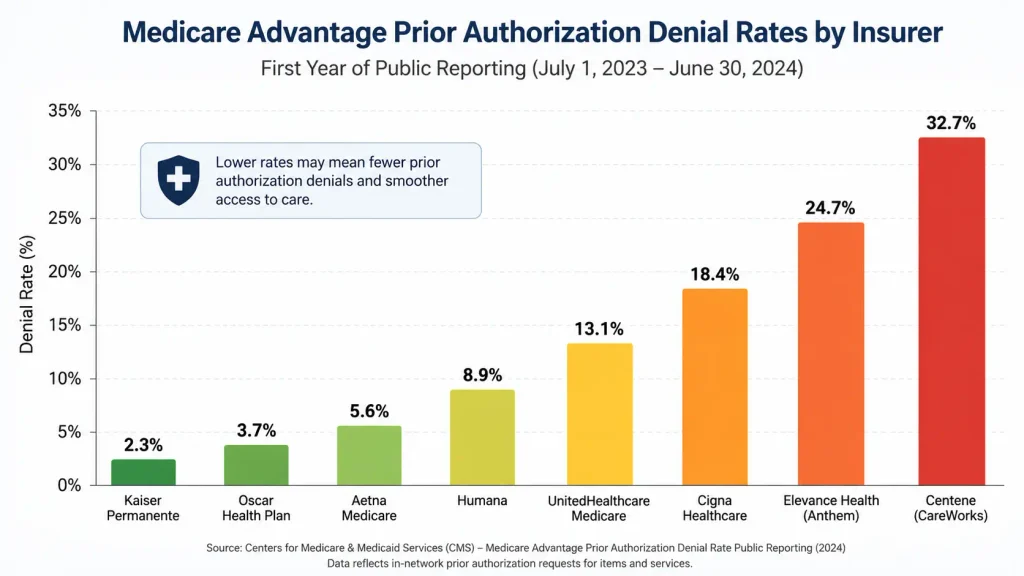
Most people would be surprised to learn how much different insurers are from one another. Denial rates for standard prior authorization requests among major Medicare Advantage insurers varied from 2.3 percent at the lowest to 32.7 percent at the highest, with plans covering comparable populations differing by more than ten times. The median for the entire program is closer to 7 to 9 percent. The median denial rates for Medicaid managed care, CHIP, and marketplace plans are typically higher, ranging from 12 to 14 percent, with some individual plans reporting rates higher than 27 percent.
Medicare Advantage denial rates For a real patient, the appeals data may be the most helpful component. Over half of appealed denials are overturned across all plans; some analyzes place the Medicare Advantage overturn rate above 80%. Nevertheless, only a small percentage of those who are rejected actually file an appeal; this percentage is typically estimated to be between 1 in 9 and roughly 7 percent of denials. To put it simply, most people who have a good chance of winning an appeal never file one.
How Fast Must Health Plans Make Prior Authorization Decisions?
CMS-0057-F tightened the deadline for plans to make decisions in addition to requiring disclosure. As of January 1, 2026, expedited requests must be decided within 72 hours, and standard prior authorization requests must be decided within 7 calendar days, as opposed to the previous standard of 14 days. Medicare Advantage, Medicaid managed care, Medicaid fee for service, and CHIP are all covered by this; however, ACA marketplace plans offered on the federal exchange are not, as they were not subject to this particular timing requirement. Additionally, instead of providing a general explanation for each denial, plans must now provide a specific reason.
Why Medicare Advantage Denial Rates Matter During Open Enrollment
This type of denial rate information has never been made public before people make their decision during Medicare’s annual open enrollment period, which runs from October 15 to December 7 every year. In the past, star ratings, premium costs, and covered services were available to someone comparing Medicare Advantage plans, but there was virtually no way to see how frequently a particular plan actually declined a doctor’s request for care. At least some of that gap has been filled.
How to Find Your Health Plan’s Prior Authorization Denial Rate
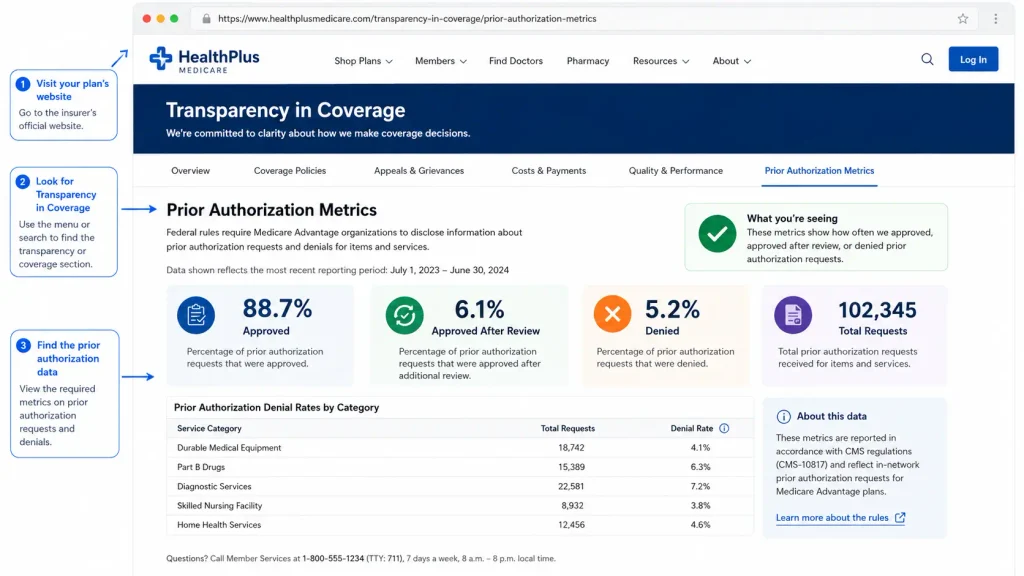
Medicare Advantage denial rates Prior authorization metrics must be posted by insurers on their own websites, usually in a section titled “transparency in coverage, prior authorization metrics, or interoperability disclosures.” Third-party websites have started gathering the data into searchable comparisons across insurers and plans because the filings are dispersed across individual insurer websites in a standardized but sometimes difficult to browse format. This can make cross-plan comparison significantly faster than checking each insurer separately.
A caution worth knowing
Medicare Advantage denial rates As of right now, no independent third party has audited this data, which is self-reported by insurers. That does not render it useless, but rather than viewing the numbers as an unreliable, independently verified figure, it is worthwhile to treat them as a solid starting point for comparison. Since this is the first year these disclosures have been made, consistency in how various plans define and report each metric is also still evolving.
How to Use Denial Rate Data When Choosing a Medicare Plan

What Medicare Advantage Denial Rates Actually Show
Checking a potential plan’s published denial and appeal overturn rate is now a real, accessible step if you or a family member is selecting a Medicare Advantage plan this fall. This was not feasible during previous enrollment seasons. Even though not many people currently take that step, if you have already had a prior authorization request denied, you should be aware that appealing has a real chance of success given how frequently denials are overturned once they are challenged.
FAQs
Where can I find my health plan’s prior authorization denial rate?
This information must be posted by insurers on their own websites, usually under a section on interoperability disclosures or transparency in coverage. Third-party websites have also gathered the information into searchable comparisons.
How much do denial rates actually vary between insurers?
Notably. Standard prior authorization requests were denied by 2.3 percent to 32.7 percent of major Medicare Advantage insurers in 2025.
Is it worth appealing a prior authorization denial?
In many cases, the data indicates that the answer is yes. Only a small percentage of denied patients currently file an appeal, despite the fact that over half of appealed denials are overturned across plans—some estimates for Medicare Advantage specifically exceed 80%.
Does this new rule apply to all health insurance plans?
Medicare Advantage, Medicaid managed care, CHIP, and ACA marketplace plans offered on the federal exchange are all covered. Commercial employer plans and stand-alone Medicare Part D plans are exempt.
How fast are insurers now required to decide on prior authorization requests?
Standard requests must be resolved within 7 calendar days starting on January 1, 2026, and expedited requests must be resolved within 72 hours; however, ACA marketplace plans are exempt from this particular deadline.
Is this denial rate data independently verified?
No. The numbers should be viewed as a helpful comparison tool rather than a fully verified guaranty because they are self-reported by insurers and have not yet undergone independent auditing.
Why does this data matter for Medicare open enrollment specifically?
This open enrollment period, which runs from October 15 to December 7, is the first time that denial rate transparency of this kind has ever been made public, providing enrollees with a new consideration in addition to premiums and star ratings.
What Medicare Advantage Denial Rates Actually Show
According to the latest transparency data, prior authorization results can differ greatly between health plans. Medicare Advantage insurers rejected about 12% of standard prior authorization requests overall, according to a recent analysis of the first publicly available data; denial rates were higher in some other insurance markets.
Customers should not assume that all health plans handle prior authorization requests in the same manner because individual plan-level rates can differ significantly.
Medicare Advantage denial rates Comparing a plan’s performance in terms of denial rates, appeal outcomes, provider networks, benefits, and out-of-pocket expenses is more helpful than just determining which plan has the lowest premium.
Nasdaq delisting rules for small-cap investors
what the debasement trade means for investors