
US Treasury Buys Yen For the first time since 2011, the US Treasury purchases yen. This week, a startling allegation that Washington “sold euros to buy yen” in a historic intervention has quickly gone viral on social media. According to the posts, this one action indicates that a violent global unwind of the yen carry trade is already underway, which is “worse than 2008.”
That assertion is partially accurate. It’s not entirely confirmed. Additionally, some of it is pure conjecture masquerading as certainty.
Here’s what actually transpired, the nature of the Japanese yen carry trade, the reasons behind traders’ anxiety, and the opinions of economists regarding the possibility of a wider unwind.
What Started the Discussion?
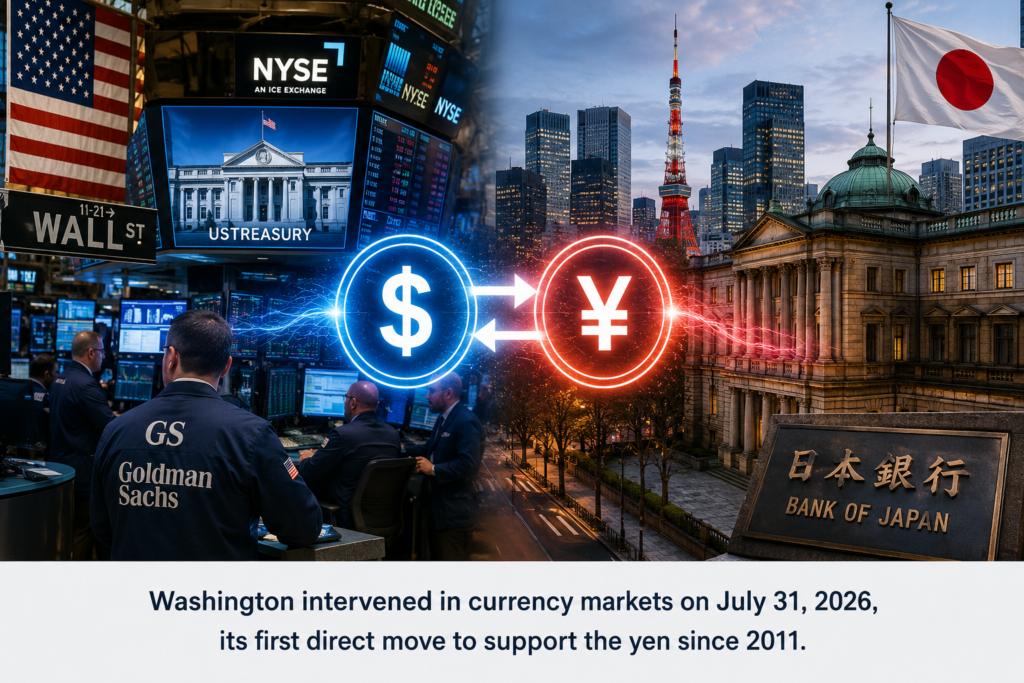
The Financial Times revealed on Friday, July 31, 2026, that the Federal Reserve Bank of New York had sold euros to purchase Japanese yen on behalf of the US Treasury. According to people familiar with the situation quoted by the FT and subsequently verified by Reuters, Bloomberg, CNBC, and Nikkei Asia, the trades were carried out through Goldman Sachs and Morgan Stanley.
For the first time in over ten years, Washington took direct action to support the yen. When it joined other G7 countries to stabilize markets following Japan’s earthquake and tsunami disaster in 2011, the US last intervened to support the currency.
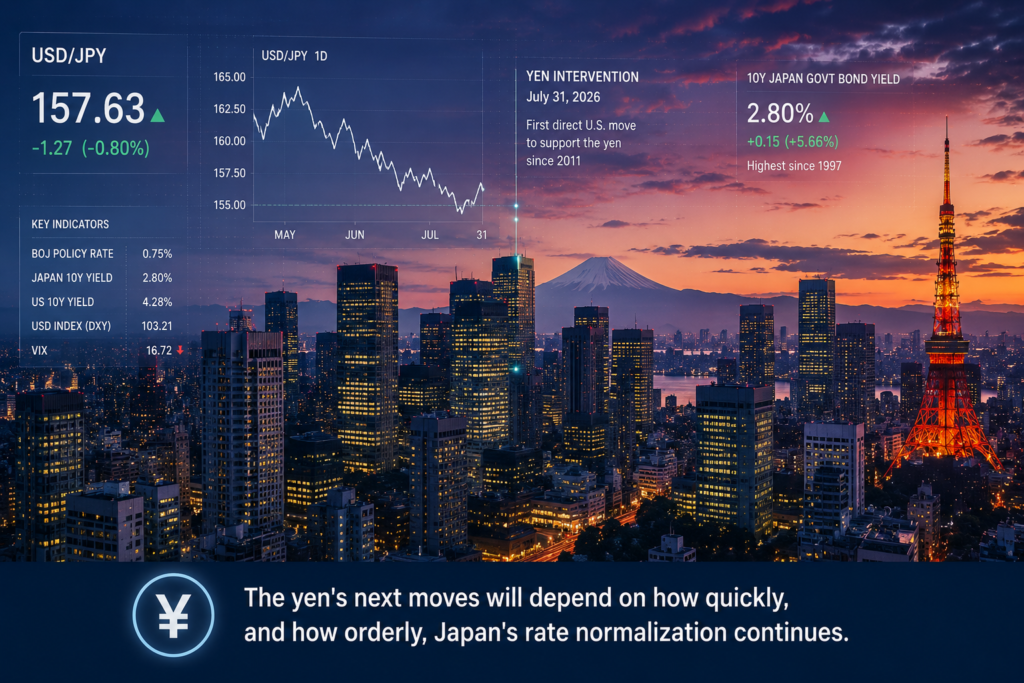
Here, the background is important. The dollar had risen to almost ¥164, its lowest level against the US dollar since the mid-1980s, while the yen had been declining for weeks. Just one day prior, Japan reportedly sold nearly $59 billion to purchase yen as part of its independent intervention. During a cabinet meeting at Camp David, a widely shared Reuters photo even featured a notepad in front of Treasury Secretary Scott Bessent with the handwritten message, “Buy Japanese Yen (JPY) $5 to $10 billion.
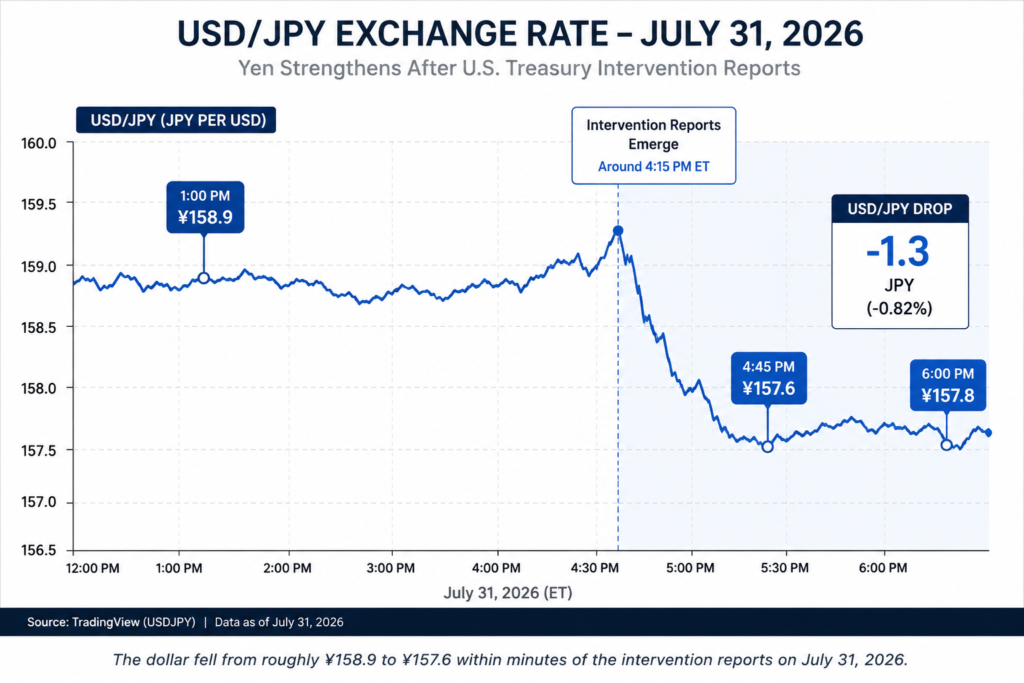
: In a matter of minutes during Friday’s late afternoon trading, the dollar fell from roughly ¥158.9 to roughly ¥157.6 in response to the reports. A joint strategy to stabilize the currency and deter speculative bets against it may be announced by Japan and the US as early as next week, according to Kyodo News.
Thus, the intervention is genuine and thoroughly documented. Everything that was added to the viral post is much less settled.
What Is the Japanese Yen Carry Trade?
It is helpful to comprehend the trade behind one currency intervention in order to comprehend why it caused such a commotion.
Japan maintained interest rates close to zero for almost thirty years, while other major economies increased theirs. The yen carry trade, one of the most well-liked tactics in international finance, was made possible by that gap.
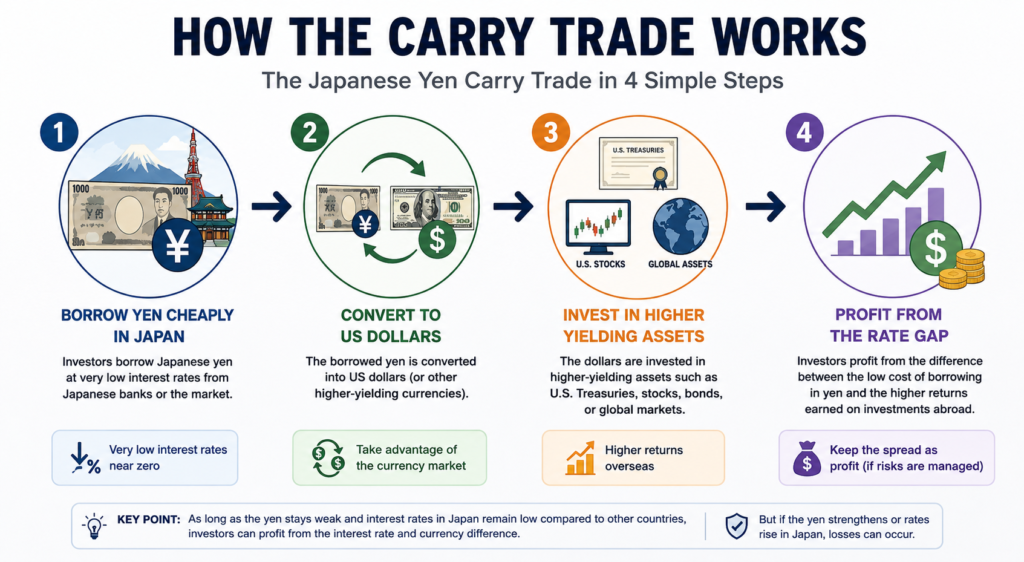
In simple terms, this is how it operates:
In Japan, an investor takes out a yen loan at a very low interest rate.
They exchange that yen for another currency, typically US dollars.
The funds are invested abroad in higher-yielding securities such as US Treasury bonds, tech stocks, and emerging market bonds.
It has been used for years by institutional investors, hedge funds, and even some individual traders. The yen carry trade has grown to be one of the silent forces supporting liquidity in markets well outside of Japan due to the massive amounts involved, which are frequently described as trillions of dollars in outstanding positions worldwide.
Why Is Everyone Talking About a “Reverse Carry Trade”?
US Treasury Buys Yen : When the circumstances that made the initial trade profitable begin to fade, a reverse carry trade unwind occurs.
That is precisely what has been happening in Japan over the last few years, albeit slowly rather than suddenly:
The Bank of Japan has been gradually increasing interest rates; in December 2025, it raised its policy rate to 0.75%, and more increases are anticipated through 2026. • The yield on Japan’s 10-year government bonds has increased to about 2.8%, the highest since 1997. • The incentive to send money overseas has decreased since Japanese investors can now earn more at home, in yen, without taking on currency risk. • Japan has also been selling US Treasury bonds, reportedly selling nearly $30 billion in the first quarter of 2026 alone—the fastest rate of sales in four years.
The math behind the carry trade becomes less appealing when rate differentials narrow like this. Investors who borrowed yen to finance positions overseas may begin to unwind those transactions by selling the foreign-purchased assets and repurchasing yen to cover their loan obligations. Rising yen, decreasing carry advantage, and more unwinding are all possible outcomes of the process because the yen gets stronger as more people buy it back.
This has been likened by analysts to a snowball effect. It’s not always abrupt, but once it picks up speed, it can move quickly and affect unrelated markets, as demonstrated in August 2024 when a smaller yen-driven unwind momentarily caused a sharp, transient selloff in US and international equities.
Did the United States Really Intervene?
Yes, more than one independent source—rather than just one viral post—confirms this.
What has been confirmed:
On July 31, 2026, the New York Fed sold euros to purchase yen on behalf of the US Treasury. • Morgan Stanley and Goldman Sachs carried out the transactions. • Since 2011, this was the first yen support operation led by the United States. • Days before the US intervened, Japan had independently intervened in the market. • After the reports, the yen saw a slight increase in value relative to the dollar.
What has not been confirmed:
the precise quantity of yen that the US Treasury bought. The £5 to $10 billion” note on Bessent’s notepad has not been formally verified as the true transaction size, and the FT’s report did not provide a specific amount. • An official statement from Morgan Stanley, the New York Fed, or the Treasury. Requests for comment outside of business hours had not received a response from any of these parties as of the reporting. Goldman Sachs refrained from commenting. • Any assertion that this intervention demonstrates the existence of a large-scale, active reverse carry trade unwind.
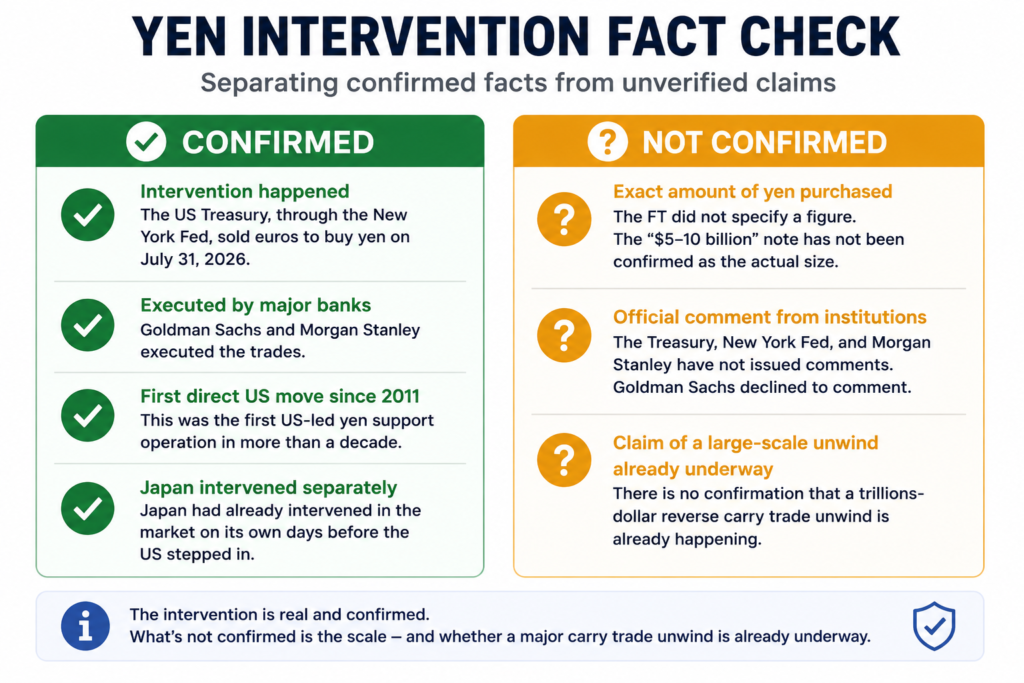
Put differently, there is actual structural pressure. The viral post asserts that “trillions in cheap yen funded bets” are going to be “violently crushed,” but a one-day currency intervention confirming that pressure is not the same as confirming that “the risk of a yen carry trade unwind in 2026 does exist but has not yet fully materialized.” The market is in a delicate pre-transition stage right now.
Market research on the 2026 yen carry trade’s interest rate and liquidity risks
Why US Treasury Buys Yen Matters?
Compared to the social media version of events, financial analysts and strategists following this story have typically adopted a more composed tone.
Key findings from a recent analysis include:
According to Advisor Perspectives, rather than being an indication of an impending crisis, Japan’s rising yields may be a sign of a healthy normalization of its economy following decades of extremely loose policy. They believe that if Japan’s policy shift remains orderly, a gradual, well-managed unwind is achievable. The August 2024 incident has been cited by other analysts, including those at Wellington Management, as evidence that even a small, single BOJ rate decision can have an impact on unrelated markets, especially momentum-driven US tech stocks, due to the close integration of carry trade flows into global liquidity. According to StoneX strategist James Stanley, “a break in that pair’s trend can cascade across multiple currency pairs than staying contained to Japan,” since the USD/JPY pair is at the core of broader dollar positioning.
The consensus among these more sober assessments is that the unwind risk is genuine and building, but it is being described as a gradual repricing process tied to interest rate normalization, not a single confirmed event that has already been triggered by one Friday intervention.
Potential Market Impact
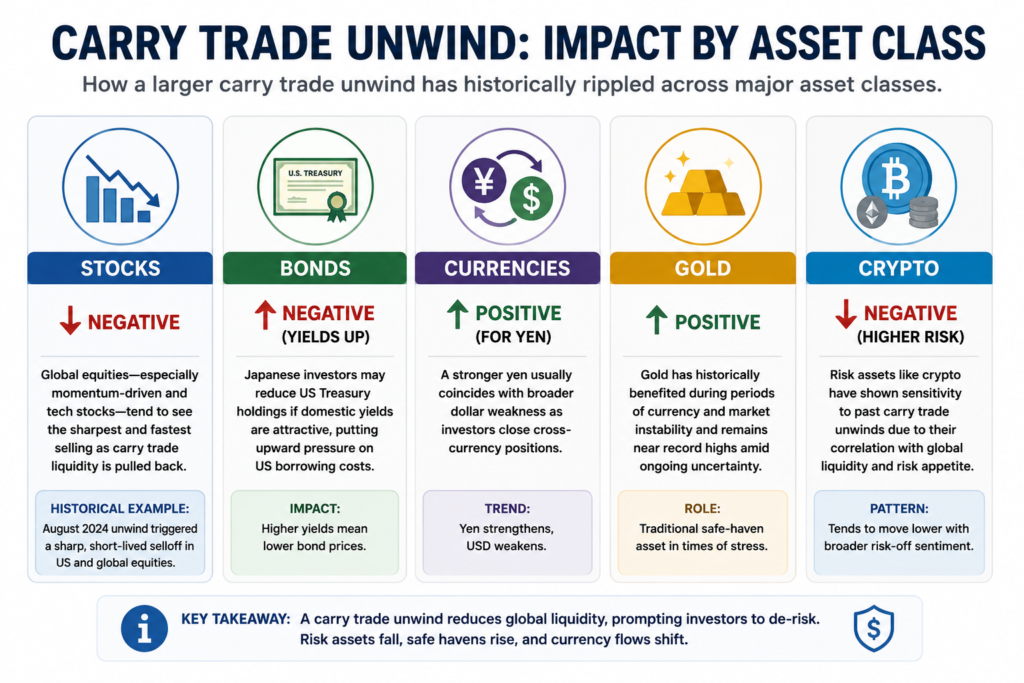
If a larger scale carry trade unwind were to accelerate, here is how different asset classes are typically expected to react, based on historical carry trade unwinds and current analyst commentary:
• Stocks: Global equities, and US momentum driven tech names in particular, tend to see the sharpest and fastest selling, since a large share of carry trade proceeds have historically flowed into these assets. • Bonds: Japanese investors, including pension funds and insurers, may continue reducing their US Treasury holdings if domestic yields stay attractive, which could put upward pressure on US borrowing costs. • Currencies: A stronger yen tends to coincide with broad dollar weakness against other major currencies, since unwinding often involves closing multiple cross currency positions at once. • Gold: Gold has historically benefited during periods of currency and market instability, and some analysts note it remains near record highs amid ongoing uncertainty. • Crypto: Risk assets including cryptocurrencies have shown sensitivity to past carry trade unwinds, given their correlation with broader risk appetite and liquidity conditions.
It’s worth stressing that these are general patterns drawn from past episodes, including August 2024’s brief but sharp selloff, not predictions of what will happen this time. The scale, speed, and duration of any future unwind remain unknown.
Why Investors Should Stay Calm
The rapid spread of a claim such as “the US is now acting as the Bank of Japan” is understandable. It resonates with genuine concerns about market fragility and has a dramatic sound. However, there are a few things to consider:
- Currency interventions are a common tool used in policy. They have previously been employed by the US and Japan, including as recently as 2011 and 2022, without causing worldwide financial crises.
- A confirmed market collapse is not the same as a one-day intervention. It is not a forecast, but rather a reaction to currency weakness.
- The current environment is described by analysts closely monitoring the carry trade as a “sensitive” or “transitional” phase; this language reflects real risk but does not guarantee a crash.
- One should be skeptical of comparisons to 2008. In contrast to a currency-driven unwind of leveraged trades, that crisis resulted from a collapse in the US housing and banking system.
All of this does not imply that investors should disregard the narrative. It implies that the responsible course of action is to disentangle the verified facts—a genuine US intervention for the first time in ten years—from the speculative narrative that surrounds them.None of this means investors should ignore the story. It means the responsible approach is to separate the confirmed facts, a real, first in a decade US intervention, from the speculative framing built around it.
Key Takeaways
On July 31, 2026, the US Treasury made its first direct yen support move since 2011 by selling euros to purchase yen. • Japan reportedly spent nearly $59 billion in separate interventions in the preceding days. • Japan’s historically low interest rates served as the foundation for the decades-old yen carry trade strategy. • A reverse unwind can put pressure on global risk assets when rate gaps close and investors rush to repurchase yen. • Japan’s decreased US Treasury holdings and increasing bond yields are real, confirmed indicators of a changing environment. • The evidence currently available does not support claims that this particular intervention “proves” a large-scale unwind is already in progress. • Mainstream economic analysis does not support speculative comparisons to the 2008 financial crisis.
Conclusion
The big story here is that, for the first time in more than ten years, Washington intervened in the currency markets to support the yen, cooperating with Tokyo when the Japanese currency hit multi-decade lows against the US dollar. That is a significant and noteworthy change in policy.
The more dramatic version that is making the rounds online, according to which this one move verifies a runaway reverse carry trade unwind on par with or worse than 2008, is not proven. Analysts who closely monitor this claim that the structural pressures underlying a possible unwind are real and gradually increasing. However, “building gradually” and “already collapsing” are quite different assertions, and confusing them would be detrimental to readers.
US Treasury Buys Yen : Watching official data, following reporting from reputable financial outlets, and treating viral framing—no matter how concerning—as a starting point for inquiries rather than a definitive judgment are all wise decisions, as is the case with most rapidly evolving financial stories.
FAQs
Was Japanese yen actually purchased by the US Treasury? Indeed. The Federal Reserve Bank of New York sold euros to purchase yen on behalf of the Treasury on July 31, 2026, through Goldman Sachs and Morgan Stanley, according to numerous sources, including the Financial Times, Reuters, Bloomberg, and CNBC.
Is this the first instance of US intervention in favor of the yen? Since 2011, when Washington joined other G7 countries to assist in stabilizing the yen following Japan’s earthquake and tsunami, this is the first direct US-led intervention.
To put it simply, what is the yen carry trade? Investors use this strategy to borrow money in yen at low interest rates in Japan, convert it, and then invest it in higher-yielding assets overseas.
What is an unwind of a reverse carry trade? It occurs when investors who borrowed yen are forced to repurchase it and sell their overseas holdings, typically due to an increase in Japanese interest rates that makes holding the trade riskier or less profitable.
Does this intervention indicate that a significant market crash is imminent? No. It attests to the actions taken by US and Japanese authorities to support a depreciating currency. On its own, it does not prove that a market crash or widespread carry trade unwind has already begun.
What impact might a carry trade unwind have on stock markets? Since a significant amount of carry trade proceeds have gone into momentum-driven and tech-heavy US stocks, these assets have historically been the most vulnerable to unwinds. One recent instance of this pattern is the August 2024 episode.
Is this similar to the financial crisis of 2008? The majority of economists disagree. The collapse of the US banking and housing systems was the primary cause of the 2008 crisis. Although both can have an impact on international markets, a currency-driven carry trade unwind is a distinct kind of risk.
What should regular investors do at this time? Avoid making significant portfolio decisions based on unverified crash predictions, adhere to verified reporting rather than viral claims, and recognize that currency interventions are a common policy tool.
[…] US Treasury Buys Yen for the First Time in Over a Decade […]
[…] Treasury bond buybacks explained […]
[…] Treasury bond buybacks explained […]