
You’ve encountered what’s known as the “private credit liquidity crunch” if you’ve read headlines this year about Blackstone, Blue Owl, or Apollo “gating” investors, limiting withdrawals, or freezing redemption. It sounds concerning, and there are aspects of it that are actually worth considering. However, a lot of the coverage conflates two very different things: funds that are having trouble making withdrawals quickly enough and loans that are actually failing. The simplest way to misunderstand what’s truly going on is to confuse those two distinct issues.
This guide explains what private credit is, what a liquidity crunch is in this context, how the current situation came to be, and what it means if you or your advisor have funds in one of these funds.
Before we begin, a brief note. What’s happening and why are explained in this article. It’s not investment advice, and whether or not private credit should be included in your portfolio depends on your personal objectives, time horizon, and risk tolerance. Instead of making a decision solely on the basis of one article, you should speak with a licensed financial advisor.

What private credit actually is
Lending that takes place outside of the conventional banking system is known as private credit. A company borrows directly from a fund, an asset manager like Blackstone, Apollo, Ares, or Blue Owl, which pools investor capital and lends it out, typically to mid-sized businesses that banks have stopped financing since the 2008 financial crisis, rather than borrowing from a bank or issuing bonds on the open market.
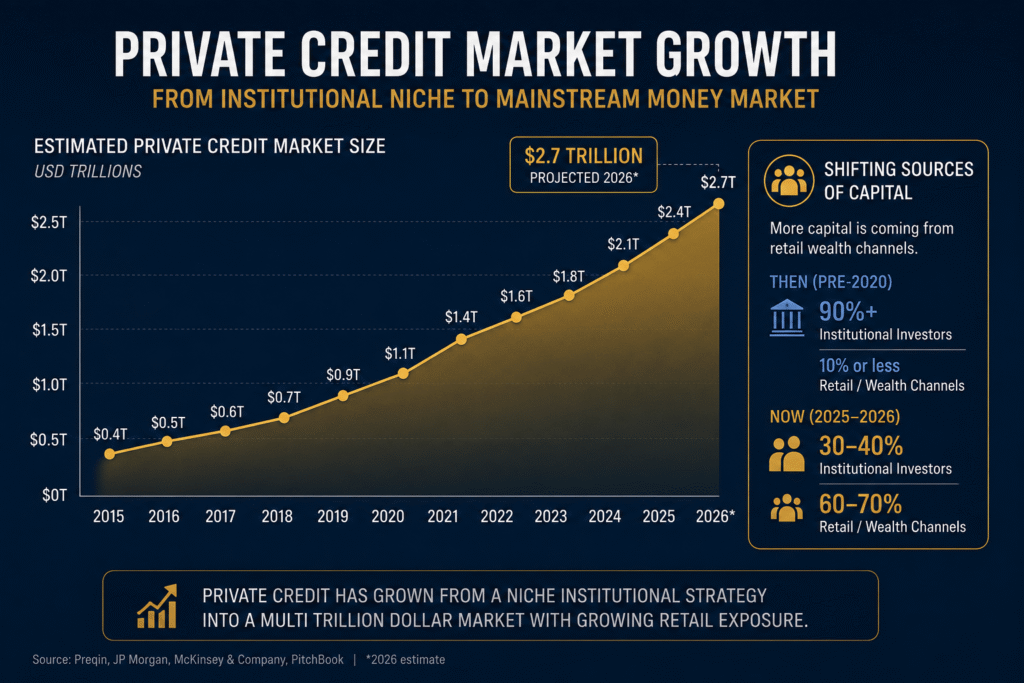
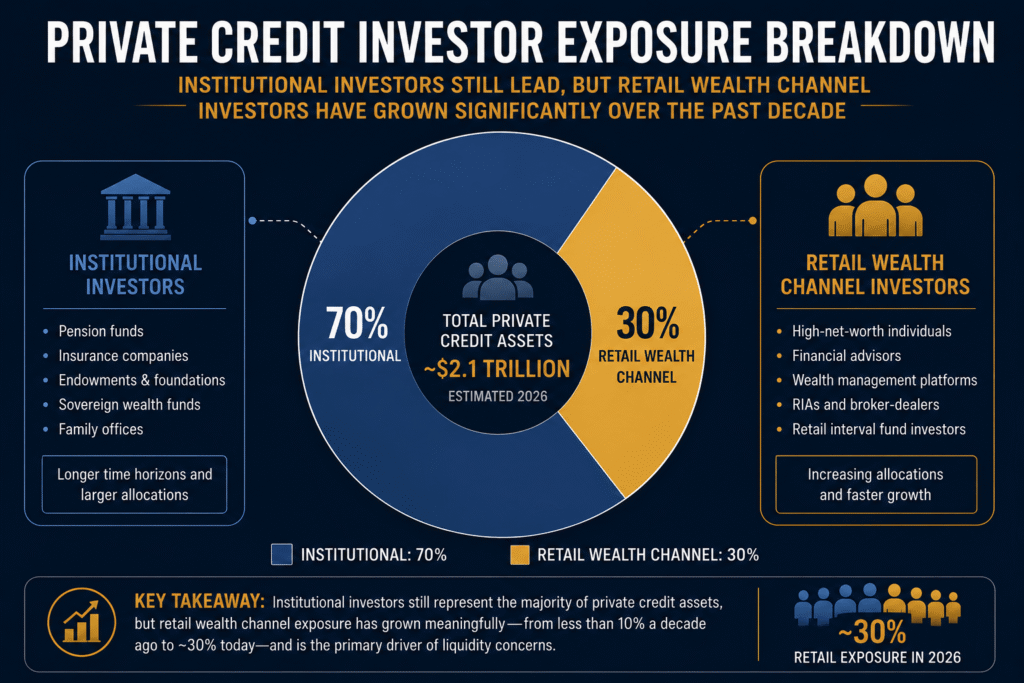
This was essentially an institutional game for a long time, with endowments, insurance companies, and pension funds locking up money for years in exchange for yields higher than those of public bonds. In order to make this asset class accessible to individual investors through their financial advisors, asset managers created new fund structures over the past ten years, primarily non-traded business development companies and interval funds. The fact that funds that were previously only held by institutions are now found in a sizable number of retail brokerage accounts is what matters most to average investors.
Why private credit grew so fast
This growth was driven by a few factors. Following 2008, banks were subject to stricter capital regulations and withdrew from riskier corporate lending. In 2022 and 2023, interest rates increased significantly, which attracted yield-hungry investors to private credit’s floating rate loans. Additionally, wealth management companies desired a product that provided their retail clients with returns akin to those of an institution. The total private credit market is estimated to be between $1.5 trillion and $2 trillion by 2026, depending on what is counted. Broader addressable estimates that include asset-backed financing are significantly higher.
What “liquidity crunch” actually means here
How the stock market works?The private credit liquidity crunch, explained for regular investors
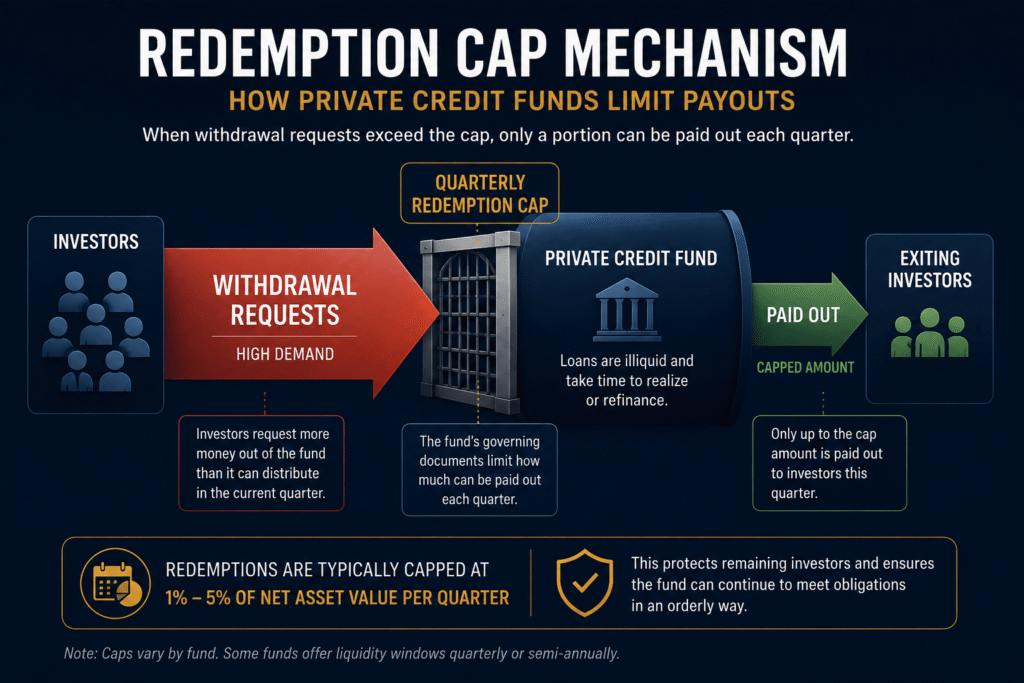
This is where people get confused. Private credit’s lack of liquidity does not always indicate that the underlying loans are failing. It indicates that investors are requesting larger withdrawals than the fund is structurally permitted to make all at once.
This is the reason for the gap. Loans to businesses that usually take years to mature or refinance are held by private credit funds. Unlike stocks, those loans cannot be sold immediately. Therefore, withdrawal limits are built into funds designed for retail investors, primarily interval funds and non-traded BDCs. These limits are typically set at 5% of net asset value per quarter, though they are occasionally extended a little higher during slower times. It’s not a bug; that structure is intentional. In order to handle an influx of withdrawal requests, it prevents the fund from being compelled to dump loans at fire sale prices.
When requested withdrawals exceed that cap significantly for several consecutive quarters, the issue arises. When that occurs, the line of investors waiting to withdraw their funds doesn’t get shorter; instead, it gets longer. A person who thought they could access their money fairly quickly may find themselves waiting much longer than they anticipated.
How this actually unfolded in 2025 and 2026
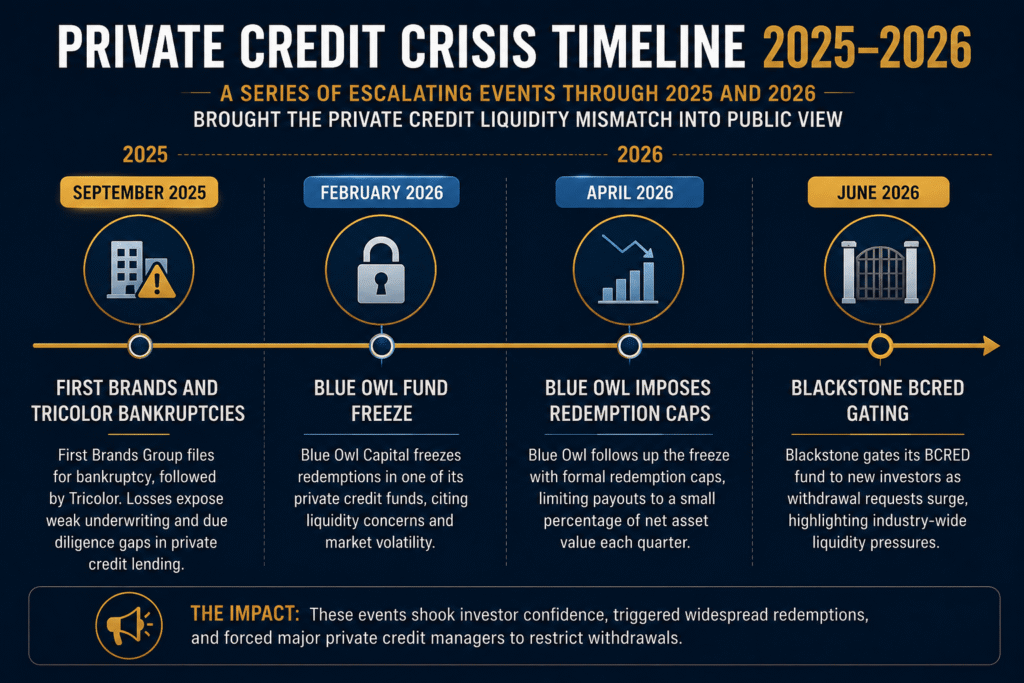
When auto parts manufacturer First Brands Group and subprime auto lender Tricolor Holdings, two businesses supported by private credit, filed for bankruptcy in September 2025, the warning signs began. Although neither collapse was significant enough to endanger the private credit market as a whole on its own, they both brought up unsettling issues regarding underwriting practices and the amount of risk that had covertly accumulated in some areas of the industry.
Redemption requests started to rise steadily after that. According to data gathered by industry researchers, redemption requests at major non-traded BDCs increased dramatically from quarter to quarter into early 2026, far exceeding the typical quarterly caps used by the majority of funds. Blue Owl started to wind down one of its funds in February 2026 after permanently freezing redemptions. Due to redemption requests exceeding the funds’ capacity, Blue Owl capped withdrawals on two other major funds at just 5% by April. Since loans to software borrowers make up a sizable portion of private credit portfolios and some of those loans began to decline, worries about AI’s effect on software company valuations added another layer of pressure.
When Blackstone gated redemptions on BCRED, its flagship and largest private credit fund, for the first time in the fund’s history in June 2026, it garnered the most attention. In just the second quarter, investors had demanded billions of dollars. Even though Blackstone’s own leadership insisted that the underlying loan quality remained strong, the news shook confidence throughout the industry. Blackstone only paid out a small portion of what was requested, in accordance with the fund’s contractual cap.
Redemption gates versus defaults, an important distinction
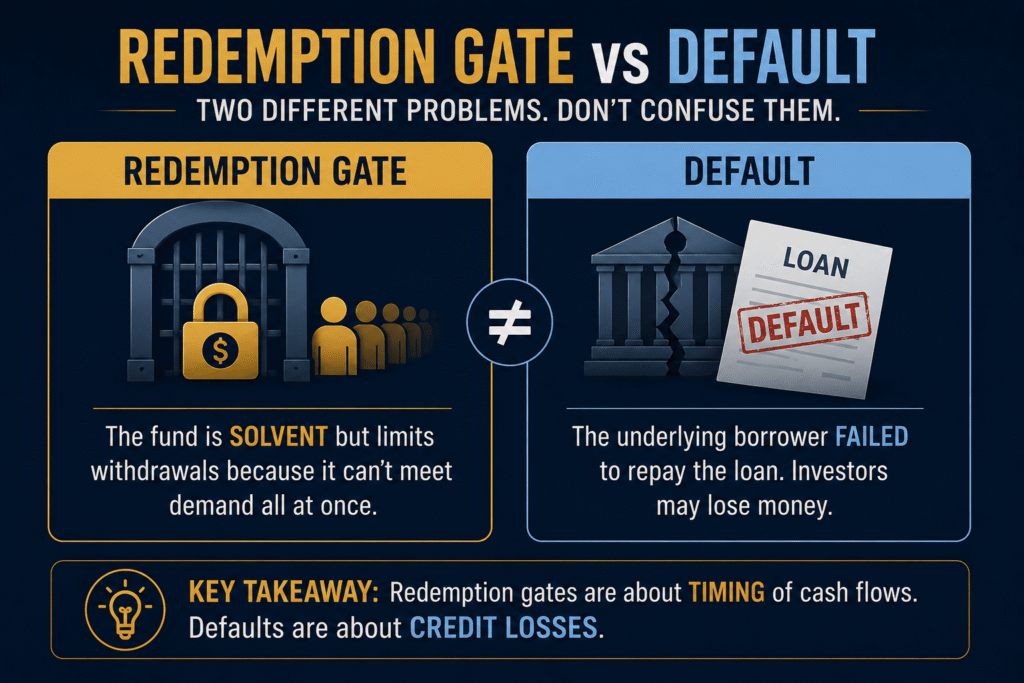
If the headlines about this subject are making you anxious, this is the most crucial thing to comprehend.
One tool for managing liquidity is a redemption gate. Based on guidelines incorporated into the fund’s structure from the start, it sets a cap on the amount of money that a fund will distribute to investors who wish to withdraw. A default occurs when a business does not repay a loan. A fund may encounter heavy gating even though its underlying loans are operating as anticipated; these are distinct issues with various causes.
| Concept | What it actually signals | What it does not necessarily mean |
| Redemption gate or cap | Investor demand to exit exceeds the fund’s built in payout limit for that period | That the loans in the portfolio are deteriorating |
| Rising redemption requests | Shifting investor sentiment, often driven by headlines, rate expectations, or a desire to reallocate | Confirmation of credit quality problems |
| Loan default | A borrower has failed to make a required payment | That the entire fund or asset class is in trouble |
| NAV markdown | A manager has reduced the stated value of specific holdings | Automatically a systemic issue, markdowns can be isolated to specific loans or sectors |
However, this distinction does not mean that the entire story should be dismissed. A persistent discrepancy between investors’ withdrawal requests and available funds does indicate a real issue: many investors were unaware of how illiquid these products were, and once confidence is shaken, it often feeds on itself. The pattern has been likened by some media to a slow-motion bank run, in which news of other investors attempting to pull out encourages additional investors to do the same, regardless of the true state of the loans underneath.
Fund structures compared
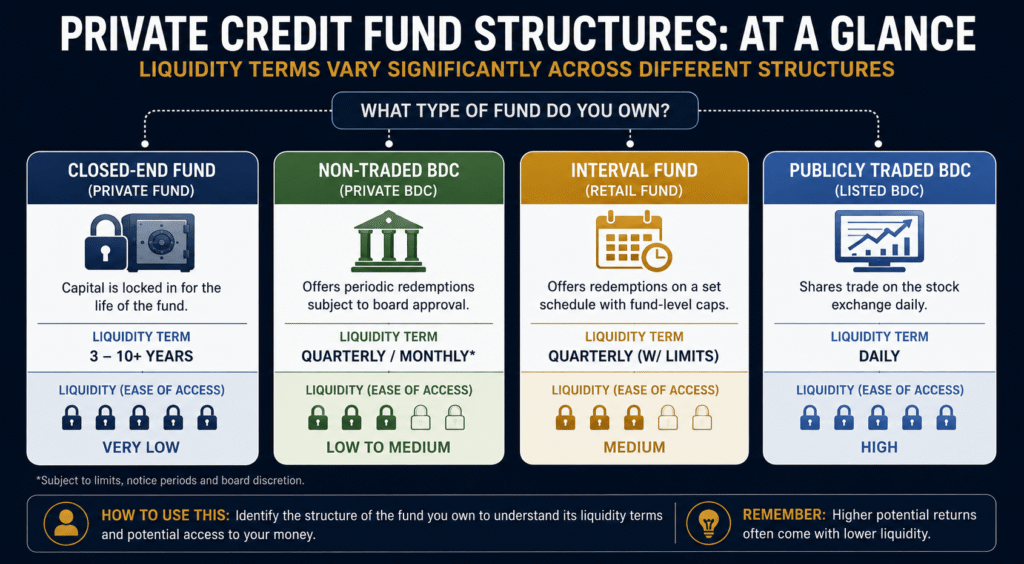
Not all private credit vehicles work the same way, and the structure matters enormously for how a liquidity crunch plays out.
| Structure | Typical liquidity terms | Who it’s built for |
| Traditional closed end private fund | Capital locked up for the fund’s full term, often seven to ten years, no early redemptions | Institutional investors, pensions, endowments |
| Non traded BDC | Periodic tender offers, usually quarterly, boards can approve gating below the stated cap | Retail and high net worth investors through advisors |
| Interval fund | Contractually required to repurchase shares up to a set percentage each quarter, generally cannot suspend this the way a BDC can | Retail investors seeking a defined, if limited, exit window |
| Publicly traded BDC | Shares trade on an exchange like a stock, full daily liquidity, but share price can trade well below NAV | Any investor with a brokerage account |
The most important lesson is that “semi liquid” does not equate to liquid. It implies that there is a clear procedure for withdrawing funds, with actual boundaries, and those boundaries are precisely what are being tested at the moment.
Is this comparable to 2008, or to anything else
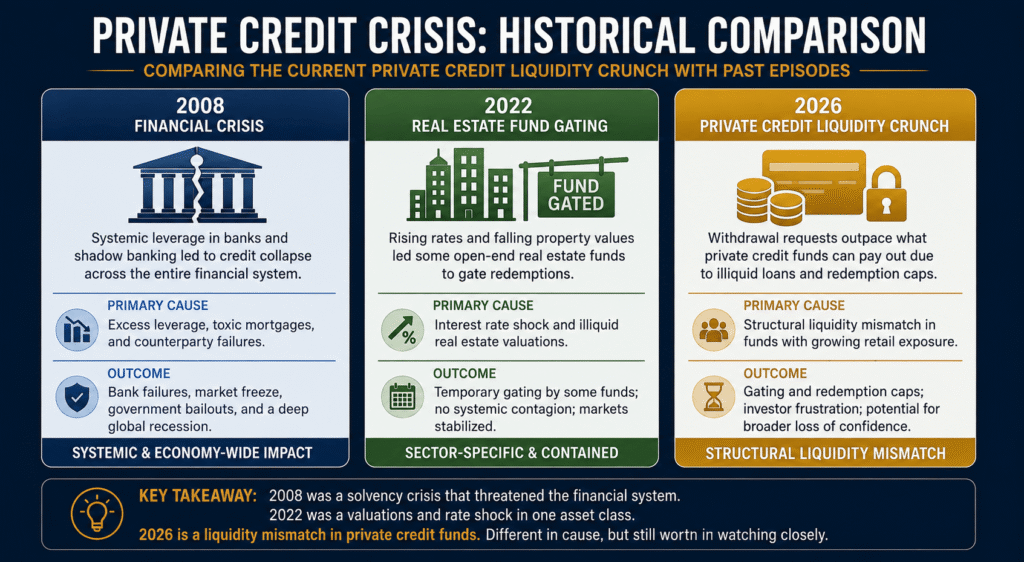
Since “credit crisis” headlines invite comparisons to 2008 that largely don’t hold up thus far, it’s important to be specific about the comparison. Widespread mortgage defaults, opaque securitized products, and a banking system that was dangerously overleveraged and interconnected were the main causes of losses during the 2008 financial crisis. Based on data through mid-2026, private credit is currently experiencing more of a sentiment and liquidity story than a wave of defaults. So far, default rates monitored by rating agencies have remained comparatively low, concentrated more among smaller, more leveraged borrowers than dispersed equally throughout the market.
A well-known 2022 incident involving a sizable, non-traded real estate income fund that gated redemptions in response to rising interest rates and a growing discrepancy between the fund’s declared valuations and what investors believed their shares were actually worth is a closer parallel. Investors who wanted out did have to wait much longer than they had anticipated, but the situation eventually stabilized without a wider collapse. Regulators are keeping a close eye on the question of whether private credit takes a similar course. In a report published in May 2026, the Financial Stability Board noted that private credit has not yet been put to the test during a significant economic downturn, leaving genuine uncertainty about
Who is actually affected right now
Most of the current wave of redemption requests is not being driven by institutional investors, pension funds, insurers, and endowments, who typically hold private credit inside long-term allocations with liquidity terms they understood going in. Wealth channel investors—those who have invested in these funds through a financial advisor in recent years—are under more intense pressure, frequently as part of a larger movement to include “alternative” investments in retail portfolios.
It’s interesting to note that some of the redemption pressure at large funds has favored offshore investors over domestic ones. This suggests that the response isn’t consistent across all investor types and may be due as much to regional factors, currency considerations, or variations in the product’s international marketing as it is to a judgment on the credit itself.
Beyond the general market volatility that headlines like this can occasionally cause in related sectors like BDC linked stocks and asset manager shares, this story probably has little direct impact on your finances right now if you don’t personally own shares in a non-traded BDC, an interval fund, or a private credit allocation inside a managed account.
What this means if you hold private credit funds
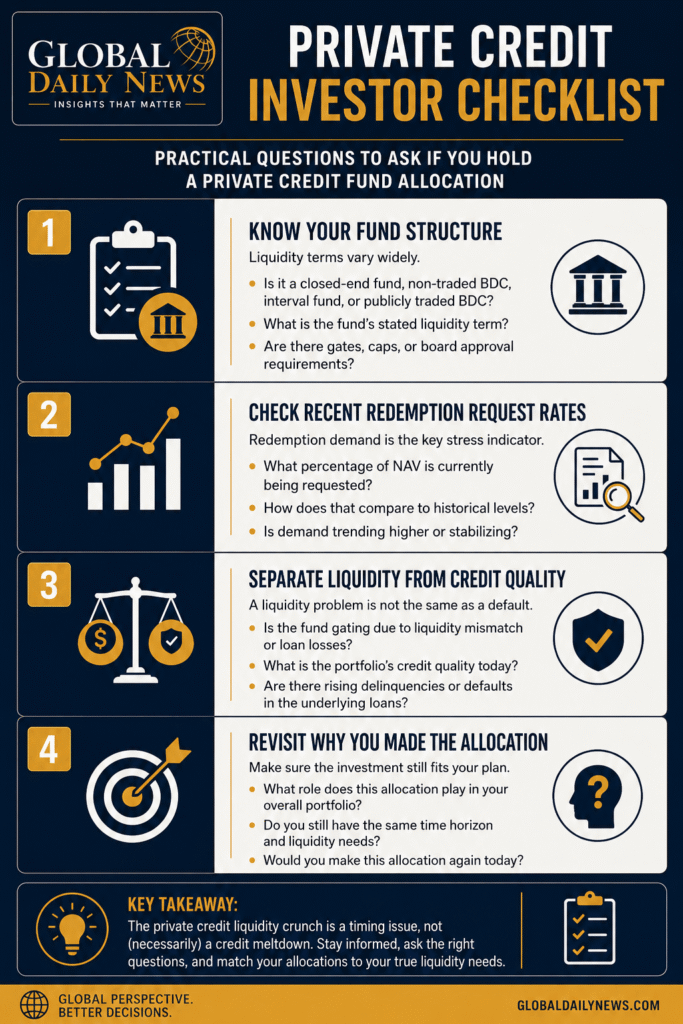
If you or your advisor have money in a non traded BDC or interval fund, a few things are worth checking rather than assuming.
Since a publicly traded BDC, an interval fund, and a non-traded BDC behave very differently under stress and have significantly different redemption rules, it is important to first understand exactly which structure you own. Second, inquire about the fund’s actual redemption request rate over the previous two to three quarters rather than just whether it is currently gated. This is because a fund that has been gated once after years of regular operations differs from one that has been consistently oversubscribed. Third, instead of depending just on headlines, ask specific questions about non-accrual rates, leverage levels, and portfolio concentration. Keep the liquidity and credit questions apart.
What to watch next
Financial Stability Board: link from “Financial Stability Board” in the “is this comparable to 2008” section, https://www.fsb.org
The course of this story will probably be shaped by a few factors. The biggest funds, including Blackstone’s BCRED, Blue Owl’s flagship cars, Apollo’s ADS, and Ares’ offerings, will provide quarterly redemption data to determine whether request volumes continue to rise or begin to decline. Credit rating agencies’ default and non-accrual rates will indicate whether this remains a liquidity story or turns into a credit quality story. The degree to which policymakers take systemic risk seriously will be demonstrated by regulatory attention, such as additional reporting from the Financial Stability Board and the Federal Reserve’s recurring financial stability assessments. Additionally, broader macro conditions will affect borrower performance overall, especially the direction of interest rates and the state of the software industry given its disproportionate weight in many portfolios.
Frequently asked questions
What is the shortage of private credit liquidity? It describes a spike in withdrawal requests from private credit funds, primarily interval funds and non-traded BDCs, that has exceeded the amount those funds are contractually able to pay out at once. As a result, several major managers have decided to cap or gate redemptions throughout 2026.
Is private credit the same as a bank loan? No. Private credit refers to loans made to mid-sized businesses by asset managers and specialized funds as opposed to banks. Although it has significantly less liquidity and regulatory oversight than public bonds or traditional bank lending, it typically offers higher yields.
Does a redemption gate indicate problems with the fund? Not always. Based on guidelines incorporated into the fund from the outset, a gate restricts the amount of money a fund pays to departing investors. It does not necessarily indicate that the underlying loans are defaulting; rather, it represents investor demand to withdraw.
In a private credit fund, is my money secure? Generic reassurance isn’t helpful in this situation because it completely depends on the particular fund, its structure, its leverage, and its portfolio. Instead of depending solely on broad headlines, discuss your fund’s recent redemption and non-accrual data with your advisor if you’re worried.
Why was BCRED gated by Blackstone? In June 2026, Blackstone capped BCRED redemptions after investors asked for billions of dollars back in a single quarter—much more than the fund’s structure permits it to pay out all at once. Since its inception, the fund had never gated withdrawals.
Is this comparable to the financial crisis of 2008? Not very closely, at least according to data up until the middle of 2026. Widespread mortgage defaults and an overly leveraged banking system were the main causes of the 2008 crisis. Although regulators have pointed out that the industry hasn’t been put to the test by a significant downturn, the current private credit situation appears to be primarily a liquidity and sentiment issue, with default rates remaining relatively contained thus far.
Do ordinary investors need to stay away from private credit? Since it depends on your unique financial situation, timeline, and risk tolerance, this article is unable to provide an answer. It’s important to realize that these products trade higher yield for actual liquidity constraints. This trade-off should be a conscious decision made in consultation with a financial advisor rather than an unexpected discovery made during a redemption gate.
Conclusion
Fundamentally, the private credit liquidity crisis is a tale of a discrepancy between how investors anticipated receiving their money and how these funds were constructed to disburse it. For anyone who added private credit to a portfolio without fully comprehending its liquidity terms, this mismatch is real and should be taken seriously. However, it’s not the same as a wave of defaults or a systemic credit collapse, and the most frequent error in how this story is presented is to confuse the two. Checking the details of what you actually own is a better course of action than panicking if you have private credit.
[…] crypto investment risks […]
thank you
thank you
[…] The private credit liquidity crunch, explained for regular investors […]
[…] crypto investment risks […]