
Regulation Crypto Assets primarily used enforcement actions and unofficial guidance to regulate cryptocurrency for almost ten years, requiring cryptocurrency offerings to adhere to disclosure regulations designed for stocks and bonds. On August 18, 2026, the agency proposed Regulation Crypto Assets, its first independent framework created especially for cryptocurrency investment offerings. Before more of these products hit the market, it is important to understand this if you invest in cryptocurrency or are considering doing so.
What Are the SEC’s New Crypto Rules?

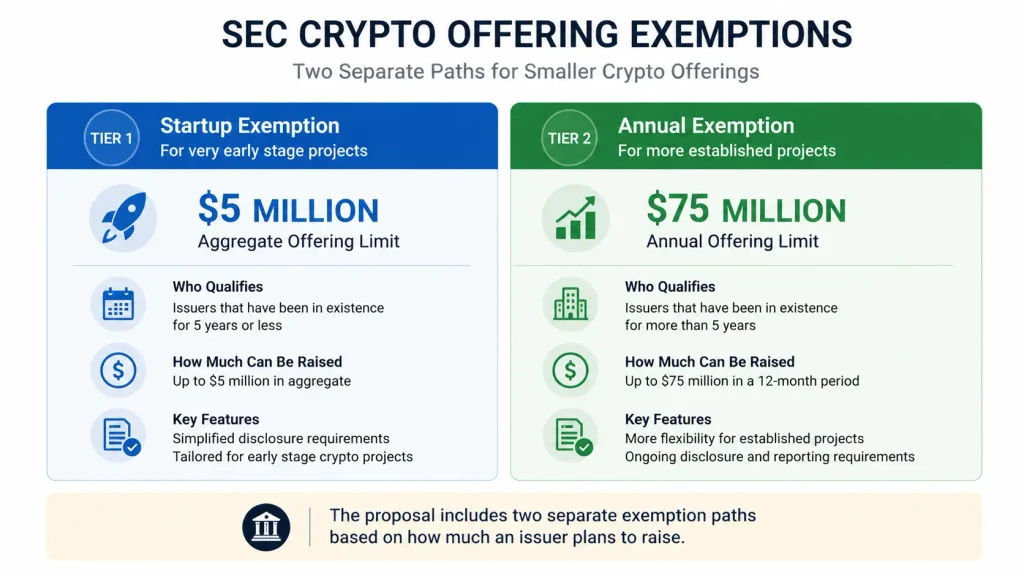
For what the Regulation Crypto Assetsrefers to as covered investment contracts—crypto offerings that would otherwise have to go through the entire conventional securities registration process—Regulation Crypto Assets would provide a customized route. Two primary exceptions to the standard registration requirements are included in the proposal.
The first is a one-time startup exemption that permits a cryptocurrency issuer to raise up to $5 million over a four-year period without registering under the Securities Act. In return, issuers are required to make public disclosures at the beginning and end of that time frame and give investors what the SEC refers to as principles-based narrative disclosures, which are explanations in plain language as opposed to the complex, standardized filings required for traditional securities. Under a different set of requirements, a second exemption permits larger offerings of up to $75 million in each 12-month period.
Why Is the SEC Creating New Crypto Regulations?
This directly builds upon an SEC announcement on March 17, 2026, which established a five-part classification system for cryptocurrency assets and clarified a long-standing issue for issuers and investors: the precise point at which a cryptocurrency asset ceases to be an investment contract covered by securities law. According to the agency’s logic, a token may begin as an investment contract, linked to a team’s proactive efforts to develop and market a project, but it may cease to be one if investors can no longer reasonably depend on that team’s continuous efforts to determine the asset’s value. The formal rule proposal this month was made possible by that earlier interpretation.
In order to give domestic investors access to these offerings with more uniform protections than the current patchwork of enforcement-based regulations, the SEC has declared its intention to lessen the incentive for cryptocurrency companies to specifically structure themselves offshore in order to avoid US securities law.
What Do the New SEC Crypto Rules Mean for Investors?

Instead of completely avoiding US registration or operating in a legal limbo, more cryptocurrency offerings should be marketed directly to US investors using these new, lighter disclosure exemptions if this rule is finalized. For an investor, that isn’t always a good or bad thing. Faster access to new projects is made possible by laxer disclosure requirements, but less standardized information is needed than in a traditional securities filing. Instead of depending on a strict, uniform disclosure format across offerings, the principles-based narrative disclosure format allows issuers greater latitude in how they explain risk, placing greater responsibility on investors to actually read and assess what they are being told.
A second deadline this week worth knowing about
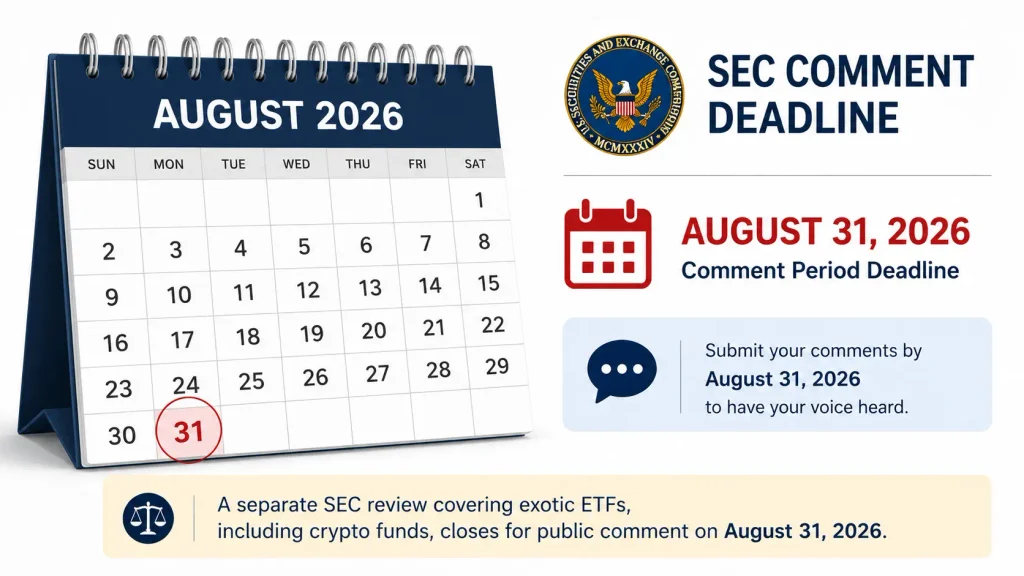
On June 30, 2026, the SEC initiated a more comprehensive review that addresses whether exchange-traded funds with unconventional assets—such as cryptocurrency, leveraged and inverse products, single stock funds, and even funds linked to event outcomes—should be permitted to enter the market. The public is asked 27 specific questions in this review, and the deadline for comments is August 31, 2026. This is significant because the result may influence the speed at which new, more unusual ETF products are approved in the future, possibly without the same case-by-case review that each new fund currently needs.
In addition, Nasdaq’s options exchange submitted a proposal in July to extend options trading regulations for cryptocurrency ETFs that include Bitcoin, Ethereum, Solana, XRP, Chainlink, and Hedera. This is another indication that the infrastructure for cryptocurrency investing is being developed concurrently on several fronts this year.
What to actually watch going forward
Regulation Crypto Assets is still a proposal rather than a final regulation. There is no assurance that the rule will be finalized in its current form, and the public comment period lasts for 60 days after it is published in the Federal Register. As a result, the rule may still undergo significant changes before going into effect. For the time being, the most helpful thing an investor can do is understand that the disclosure requirements for new cryptocurrency offerings are being actively rewritten and that a lighter registration exemption does not imply a lower risk profile; rather, it means that you will be more responsible for understanding what you are purchasing.
FAQs
What is Regulation Crypto Assets?
Regulation Crypto Assets Instead of incorporating cryptocurrency investment contracts into conventional stock and bond disclosure regulations, the SEC proposed a new framework on August 18, 2026, creating the first independent US securities offering regime.
Does this mean crypto investments are now safer?
Regulation Crypto Assets Not always. Although the rule gives issuers a clearer legal path, investors still need to carefully consider offerings rather than assuming standardized protection because the disclosure exemptions are less stringent than in traditional securities filings.
What is the startup exemption in the SEC’s crypto proposal?
In exchange for simple public filings and straightforward investor disclosures, it would allow a cryptocurrency issuer to raise up to $5 million over a maximum of four years without having to register under the Securities Act.
Is this rule already in effect?
No. Before any final version goes into effect, it is currently a proposal that is available for public comment for 60 days after it is published in the Federal Register.
What is the separate SEC ETF review closing August 31?
Regulation Crypto Assets Opening on June 30, 2026, it is a more comprehensive public comment process that looks at how exotic ETFs—such as cryptocurrency, leveraged, single stock, and event-linked funds—should be permitted to enter the market in the future.
Why did the SEC create a five part crypto classification system?
Regulation Crypto Assets To make clear when a cryptocurrency asset qualifies as an investment contract under securities law and when it no longer does, especially as investor dependence on a project team’s continuous efforts evolves over time.
Nasdaq delisting rules for small-cap investors
what the debasement trade means for investors
awesome
thank you for commenting
very useful for financers
thanks
[…] latest finance news […]