
Search for “horse blinders for people” and you will find three very different things: a quirky office gadget from a few years ago, a hooded product you can buy online for the price of a pizza, and a growing pile of social media posts telling you to “put your blinders on” and focus on your own goals. All three point to the same underlying problem. Most of us feel more distracted than ever, and we are looking for something, anything, that shuts the noise out. Here is what horse blinders actually do, what human versions exist, what the research says about focus, and what you can do without buying anything.

What Horse Blinders Actually Do
Blinders, also called blinkers, are a piece of horse tack that limits a horse’s field of vision by blocking sight to the sides, the rear, or both. They are most common in harness driving and horse racing and are rarely used in ordinary riding. Racing versions are built as a hood with cups placed beside the eyes, and the shape varies by custom and purpose.
The idea is simple. Horses have eyes on the sides of their heads and see a very wide area, which is helpful in the wild but can be a problem on a busy racetrack or a crowded road. Blocking the sides and rear keeps a nervous horse looking at what is ahead rather than reacting to everything around it. That is the origin of the phrase people now use for a human who keeps their attention narrowed on one thing.
The Human Versions Are Real
The most famous attempt came in 2018, when Panasonic’s design studio Future Life Factory, working with Japanese designer Kunihiko Morinaga, unveiled a prototype called Wear Space. It was a bendable partition that curved around the head, paired with noise cancelling headphones, and it blocked about 60 percent of the wearer’s horizontal field of vision. It debuted at SXSW and was offered through a crowdfunding campaign, with early backers able to pay around 260 dollars. The stated goal was to create a kind of psychological personal space for people working in open plan offices and cafes. Reaction was mixed, and several tech writers treated it as a sign of how desperate open offices had made workers.

The idea has since gone more mainstream. A productivity hood sold by the company OstrichPillow, priced at about 39 dollars, is pulled over the head to block peripheral vision. At the extreme end, one Meta employee, Simon Berens, made headlines for paying around 5,000 dollars a month to have people sit behind him, watch him work, and keep him on task. On TikTok, “human horse blinders” appears in fashion design experiments and also in motivation videos that use the blinders as a metaphor for ignoring distractions and focusing on yourself.
Why Focus Feels So Hard Right Now
The demand makes more sense once you look at the research. Gloria Mark, a professor of informatics at the University of California, Irvine, has spent about two decades measuring how long people stay on a single screen. In 2004 her team found an average of about two and a half minutes. Later it fell to roughly 75 seconds. Her recent data puts the average at about 47 seconds, with a median of about 40 seconds, meaning that half the time, attention shifts in less than 40 seconds.
Mark has also found that returning to a task after an interruption is slow, taking on the order of 23 to 25 minutes to get back to the original piece of work in her studies, partly because people often move through other tasks before returning. Importantly, she and others argue that this is not simply a personal failing. Notification driven tools, open offices, expectations of instant replies, and apps designed for continuous engagement all work against sustained attention. She also notes that focus is not unlimited, since concentration drains mental resources, so claims that anyone can focus nonstop for hours are unrealistic.
Do Human Blinders Actually Work?
Here is the honest answer: the research I found for this article does not include independent studies testing these specific devices, so any claim that they raise productivity is based mostly on user impressions and marketing, not solid evidence. The logic behind them is reasonable, since reducing what you see reduces visual interruptions. But the biggest sources of distraction for most people are not coworkers walking by. They are the phone in your pocket, the notification pinging on your laptop, and the dozens of browser tabs you opened yourself. A hood does nothing about a screen that is itself a distraction machine.
There are also practical limits. Limiting your peripheral vision is a bad idea anywhere you need to be aware of your surroundings, such as walking, commuting, or in public spaces, and wearing one in a shared office can send an unwelcome signal to coworkers. For some people the sensory shutdown may feel calming, and for others it may feel isolating.
Free Blinders You Can Use Today
The good news is that the most effective versions of this idea cost nothing, and they match what attention researchers generally recommend.
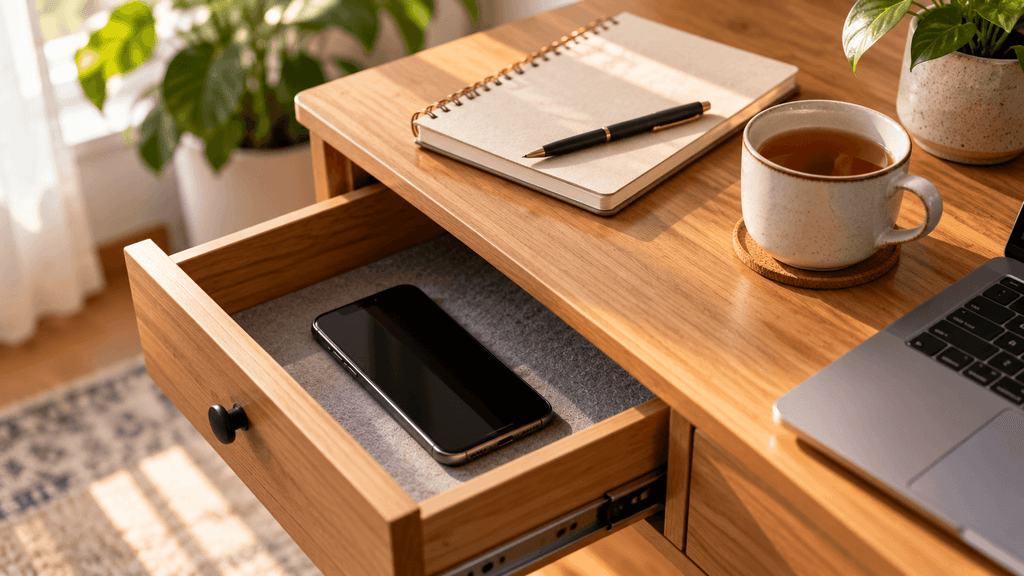
Put your phone out of sight, ideally in another room, rather than face down on the desk. Turn off nonessential notifications on your computer and phone, so interruptions are your choice rather than the device’s. Clear the surface in front of you, because visual clutter competes for attention. Use noise cancelling headphones or steady background sound to mask conversations if you work around other people. Work in a single window or full screen mode so there is only one task in view. read related articals on our issue profile
Then schedule your focus rather than hoping for it. Pick a block of 25 to 50 minutes for one task, take a real break afterward, and try to do your hardest work at the time of day when your concentration naturally peaks. Mark’s research suggests people have individual peak times, with early risers often focusing best in the morning and night owls later. Website and app blockers can also act as digital blinders by cutting off the sites you reflexively open.
When Wearing Blinders Becomes a Problem
The metaphor has a downside worth remembering. In everyday language, to wear blinders can also mean refusing to see anything outside your own narrow view, ignoring warnings, other opinions, or changing circumstances. A horse in a race has a rider and a track that someone else has designed. A person pursuing a goal needs to look around now and then to check whether the direction still makes sense.
The healthiest approach is to treat blinders as a tool, not an identity. Narrow your attention deliberately for a defined stretch of work, then take them off, check in with the people and information around you, and decide whether to put them back on.
The Bottom Line
Horse blinders for people are a clever idea responding to a real problem, but the gadgets are less important than the principle. Attention is easily broken, interruptions are expensive, and shielding yourself from them, whether with a hood or simply by moving your phone, can help. If you want to try the physical version, treat it as an experiment and keep expectations modest. If you want to start today, the cheapest blinders are already in your hands: silence the notifications, put the phone away, and give one task your full attention for the next half hour.
This article is for general informational purposes only. Product details and prices are based on public reporting and may change.
FAQ
What are horse blinders for people?
Horse blinders for people are wearable or conceptual tools meant to narrow your field of view and cut distractions, either as physical products like focus hoods or as a metaphor for ignoring distractions.
Do human horse blinders really work?
There is little independent research testing these specific products. The idea of reducing visual distractions is reasonable, but digital distractions such as phone notifications are often the bigger problem.
What was Panasonic’s Wear Space?
Wear Space was a 2018 prototype from Panasonic’s Future Life Factory that curved around the head, blocked about 60 percent of the horizontal field of vision, and included noise cancelling headphones.
How long is the average attention span on a screen?
Researcher Gloria Mark of the University of California, Irvine has found that the average time on a single screen before switching has fallen from about two and a half minutes in 2004 to about 47 seconds.
How long does it take to refocus after an interruption?
Mark’s research has found it can take roughly 23 to 25 minutes to return to the original task after being interrupted, since people often switch through other tasks first.
What is a free alternative to human horse blinders?
Put your phone out of sight, turn off nonessential notifications, clear your desk, use noise cancelling headphones or steady background sound, and work on one task in a single window for a set block of time.