
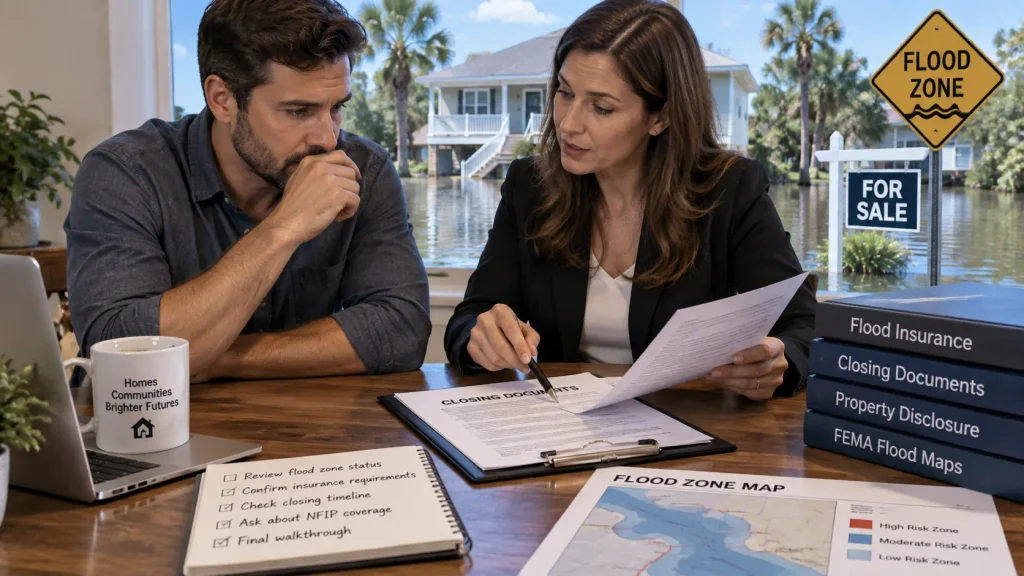
Can a flood insurance lapse delay home closing: There is a federal deadline that is important to be aware of if you are purchasing, selling, or renewing insurance on a house in a flood zone at any point in the coming months. This deadline is unrelated to your personal documentation. Nearly all residential flood coverage in the US comes from the National Flood Insurance Program, which is only authorized through December 11, 2026. This is by no means the first time this particular circumstance has arisen.
What Is the National Flood Insurance Program (NFIP)?
In more than 22,700 participating communities across 56 states and territories, the NFIP offers flood insurance coverage to about 4.5 million policyholders, totaling nearly 1.3 trillion dollars. Since private flood insurance is available but only accounts for a much smaller portion of the market, it is the main—and frequently the only practical—source of flood coverage for the majority of homeowners. The program, which is administered by FEMA and was established by a 1968 federal law, has a recurrent issue because it was last fully reauthorized in 2012, and that authorization expired in 2017. Since then, rather than a stable, long-term reauthorization, Congress has maintained the program through 36 different short-term extensions.
What Happens If the NFIP Lapses in December 2026?
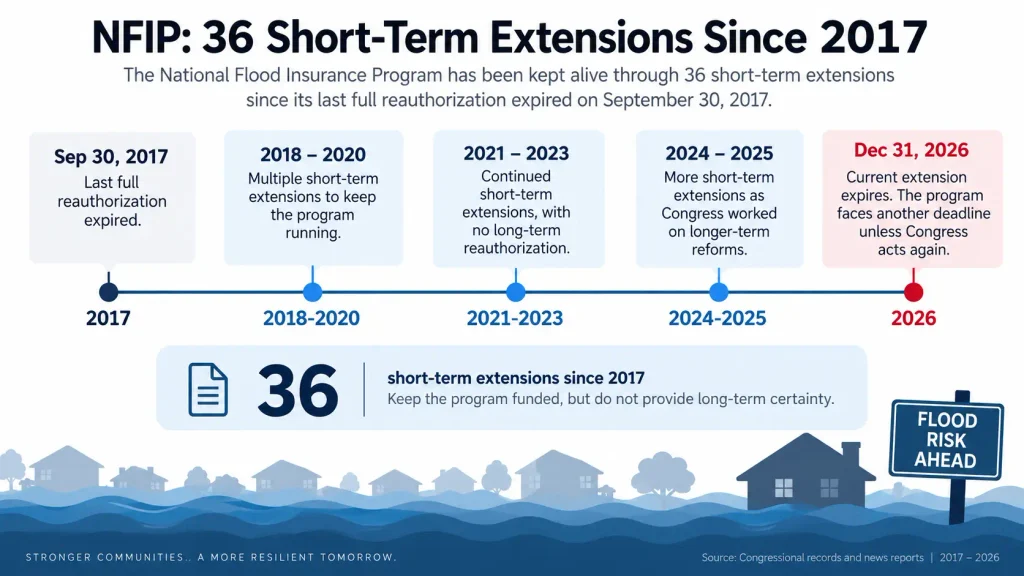
A particular and immediate set of events occurs if Congress does not take action by December 11, 2026. The moment the deadline passes, NFIP is no longer able to issue new or renewed flood insurance contracts. A lapse does not terminate your current coverage because policies that are currently in effect continue for the duration of their current one-year term, including a typical 30-day grace period. The program’s ability to borrow money from the Treasury also drastically decreases during a lapse, from slightly over $30 billion to just $1 billion. This is important if a significant flood disaster occurs during that window because it restricts the amount of money the program can use to pay claims beyond what current premium dollars provide.
This is not a hypothetical scenario. The most recent lapse lasted 43 days and coincided with a broader government shutdown, and it was resolved only after Congress passed what was at that point the program’s 34th short term extension.
Can an NFIP Lapse Delay Your Home Closing?
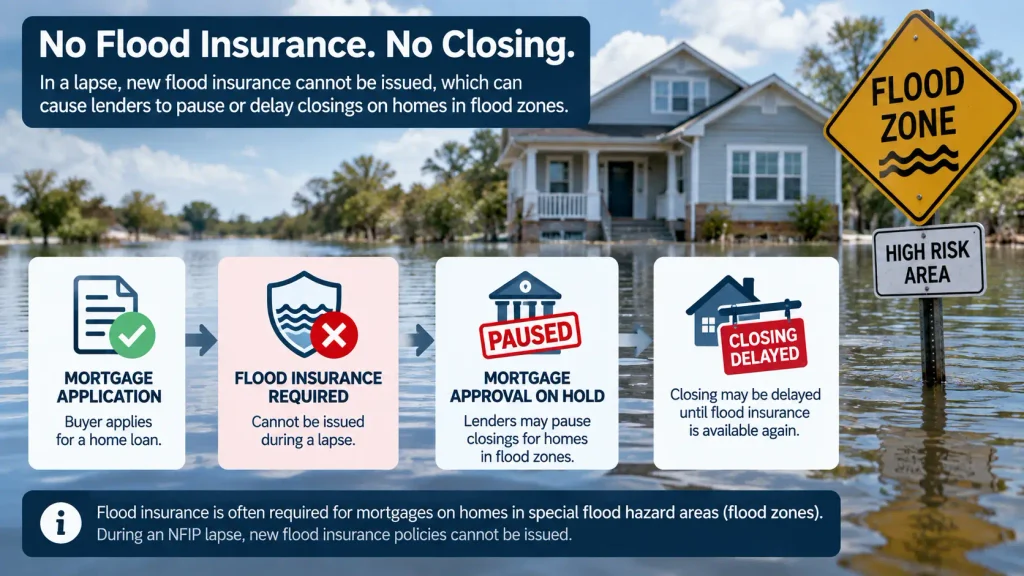
Federal law requires federally regulated lenders and government sponsored entities like Fannie Mae and Freddie Mac to require flood insurance as a condition of any mortgage on a property located in a designated special flood hazard area. During an NFIP lapse, that requirement typically gets suspended by federal lending regulators, which means the decision about whether to move forward with a loan in a flood zone without available flood insurance falls to each individual lender. Many lenders choose not to close in that situation at all, since they would otherwise be financing a property with no coverage requirement enforceable behind it. The National Association of Realtors has estimated that a lapse could affect roughly 1,300 property sales a day, translating to around 40,000 closings a month nationwide, if it stretches on for any real length of time.
What Can Homebuyers Do If Flood Insurance Is Unavailable?
There is one useful workaround that you should be aware of. Insurance companies frequently don’t need to issue a new policy if a home sale is already underway and the seller has an existing NFIP policy; instead, they can simply reassign the policy to the buyer by changing names on the current contract. This reassignment option can occasionally keep a transaction going even in situations where new coverage cannot be written because new policy issuance is precisely what stops during a lapse.
Private flood insurance, meaning coverage not backed by the federal program, is not affected by an NFIP lapse at all. For buyers in flood zones facing a deadline crunch, checking with a state insurance department about available private flood insurance options ahead of time is a reasonable contingency step, even if NFIP coverage remains the more common and often more affordable choice under normal circumstances.
It’s also worth knowing that in most past instances where NFIP has lapsed, Congress has eventually reauthorized the program retroactively, restoring coverage gaps after the fact. That retroactive fix does not undo the practical disruption of a delayed or canceled closing that happened during the actual lapse window, which is why timing still matters even with that history in mind.
What to Do Before the 2026 Flood Insurance Deadline

Since policies differ from lender to lender, it is worthwhile to ask your lender directly how they intend to handle a potential lapse if your closing date or policy renewal falls anywhere near December 11, 2026, or in the weeks immediately following. In the event that a lapse coincides with your closing date, ask your insurer directly about the name substitution option if you are the seller and already have an NFIP policy. It is worthwhile to monitor whether Congress approves a long-term reauthorization, another extension, or lets the deadline pass completely through FEMA’s own program status page because, as has been the case in previous years, the real outcome won’t be known until very close to the deadline.
Frequently Asked Questions About the NFIP and Home Closings
What happens to my existing flood insurance policy if NFIP lapses?
Nothing immediately. Existing policies remain in effect until the end of their current one year term, including a standard 30 day grace period, regardless of a lapse in the program’s authorization.
Can I still close on a home purchase if NFIP lapses during my transaction?
It depends on your lender. Federal flood insurance purchase requirements are typically suspended during a lapse, leaving individual lenders to decide whether to proceed with financing in a flood zone without new coverage available.
Has the National Flood Insurance Program lapsed before?
Yes, multiple times. The most recent lapse lasted 43 days and was resolved through what was then the program’s 34th short term extension since its last full reauthorization expired in 2017.
Is there a workaround if I am buying a home with an existing NFIP policy during a lapse?
Often yes. Insurers can frequently reassign the seller’s existing NFIP policy to the buyer by substituting names, since this does not require issuing a brand new policy, which is what actually stops during a lapse.
Does a lapse affect private flood insurance too?
No. Private flood insurance, meaning coverage not backed by the federal program, is unaffected by an NFIP authorization lapse.
When is the current NFIP deadline, and what happens after that?
The program is authorized through December 11, 2026. Unless Congress passes another extension or a long term reauthorization before that date, the same disruptions seen in past lapses could recur.
[…] Other Forces Adding to the Noise […]