

This summer, a legal requirement that has been in place for almost 50 years changed if you are applying for a mortgage or any other type of credit. A new CFPB rule that eliminated disparate impact as a foundation for lending discrimination claims under federal law went into effect on July 21, 2026. Here’s what that really means, what safeguards are still in place, and why this is being contested in court right now.
What Did Disparate Impact Mean Under ECOA?
Two distinct legal theories have been used to enforce the Equal Credit Opportunity Act since the 1970s. A lender who purposefully treats applicants differently on the basis of race, sex, age, or another protected characteristic is considered to have engaged in intentional discrimination. The other, referred to as the effects test or disparate impact, dealt with circumstances in which a lending policy seemed neutral on its face but, regardless of the lender’s intention, produced statistically unequal outcomes across protected groups. A policy that was not intended to discriminate but ended up doing so in practice could subject a lender to liability under the previous standard.
What Did the CFPB Change in Regulation B?
In order to eliminate disparate impact as a foundation for enforcement under that particular federal law, the CFPB finalized a rule on April 22, 2026, amending Regulation B, the regulation implementing ECOA. The regulation became operative on July 21, 2026. In the future, a neutral underwriting policy that results in a statistical discrepancy between groups is typically insufficient to hold a lender accountable under ECOA. Intentional discrimination and policies that serve as a purposeful stand-in for a protected characteristic are still prohibited by the ECOA. Additionally, the rule clarified regulations regarding deterring potential applicants from applying in the first place and imposed new limitations on special purpose credit programs, which are intended to increase credit access in historically underserved communities. Over 64,000 public comments were received during the review period after the CFPB proposed this change in November 2025. According to reporting on those remarks, most people were against doing away with the disparate impact standard. Since the disparate impact standard was initially based on legislative committee reports from the 1970s rather than explicit statutory language, the agency finalized the rule despite claiming it was addressing an antiquated and unduly burdensome interpretation that was not clearly supported by the actual text of the statute.
What Fair Lending Protections Still Remain?
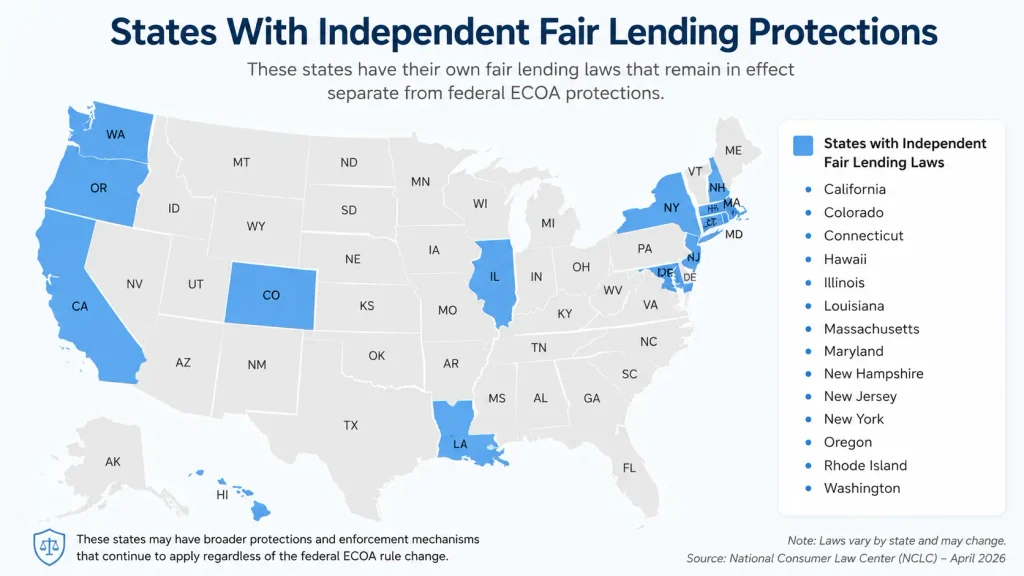
CFPB Fair Lending Rule 2026 easiest part to overlook is this one. Only federal ECOA and Regulation B enforcement is impacted by the rule. Although a related HUD proposal from January 2026 has also moved to reduce the agency’s own discriminatory effects regulations under that law, leaving some of those questions to the courts, it does not alter disparate impact liability under the Fair Housing Act for residential real estate secured lending, which remains a separate legal avenue. Despite the federal change, a number of states—including New Jersey, Massachusetts, California, New York, and Illinois—maintain their own fair lending and civil rights laws that permit claims of effects-based discrimination. According to federal law, intentional discrimination is still prohibited everyplace.
What Does the CFPB Fair Lending Rule Change Mean Going Forward?
According to the CFPB, discouraging applicants before they even submit an application is still restricted under the revised rule, and redlining is still forbidden. The National Fair Housing Alliance and other civil rights organizations sued the CFPB in May 2026 over the change, claiming it undermines decades of legal precedent and may make it simpler for lending practices that disproportionately impact minority communities to go unchallenged, possibly driving some borrowers toward more expensive lenders.
CFPB Fair Lending Rule 2026 while pointing out that depending on where they conduct business, lenders operating in several states still have to deal with a complicated, uneven patchwork of protections. The lawsuit is still pending, and its resolution may have an impact on whether or not this rule is upheld.
How Does the CFPB Fair Lending Rule Affect Mortgage Applicants?

Despite this change, intentional discrimination is still prohibited and enforceable under federal law if you think you were the victim of discrimination during a lending decision. Your best options now are probably the Fair Housing Act, your state’s fair lending laws, if your state has any, or both, rather than a federal ECOA disparate impact claim, which is no longer available as a legal theory, if your concern is a lending pattern that appears to disproportionately affect a specific neighborhood or group without clear evidence of intent. It is worthwhile to directly verify whether your state upholds its own fair lending protections, as these can differ greatly depending on where you reside.
CFPB Fair Lending Rule 2026 FAQs
Is lending discrimination still illegal after this rule change?
CFPB Fair Lending Rule 2026 According to federal law, intentional discrimination is still prohibited. What has changed is that, absent proof of intent, a lender can no longer be held accountable under ECOA merely because a neutral policy results in a statistical disparity across protected groups.
Does this rule affect the Fair Housing Act too?
CFPB Fair Lending Rule 2026 No, not directly. Disparate impact liability under the Fair Housing Act for residential real estate lending is still a separate legal standard, although a related federal proposal has also sought changes there. The CFPB’s rule only modifies enforcement under ECOA and Regulation B.
Do all states still allow effects based discrimination claims?
CFPB Fair Lending Rule 2026 No, it varies. Some states might not provide the same protection, but states like New Jersey, Massachusetts, California, New York, and Illinois have their own fair lending laws that permit these claims regardless of the federal change.
Why did the CFPB make this change despite most public comments opposing it?
The agency claimed that eliminating the disparate impact standard addressed what it saw as an antiquated and unduly onerous regulatory interpretation because it was based on legislative history rather than explicit statutory text.
Is this rule being challenged in court?
Indeed. As of this writing, a lawsuit filed against the CFPB in May 2026 by the National Fair Housing Alliance and other civil rights organizations is still pending.
When did this rule actually take effect?
The final rule went into effect on July 21, 2026, after being published by the CFPB on April 22, 2026.
What should I do if I think I experienced lending discrimination?
Since federal ECOA disparate impact claims are no longer a legal option, keep a record of the specifics of your application and the lender’s stated justification. You should also think about whether your situation may fall under the Fair Housing Act, intentional discrimination, or your state’s fair lending laws.
US Treasury Buys Yen for the First Time in Over a Decade
The private credit liquidity crunch, explained for regular investors
[…] consumer protection news […]