
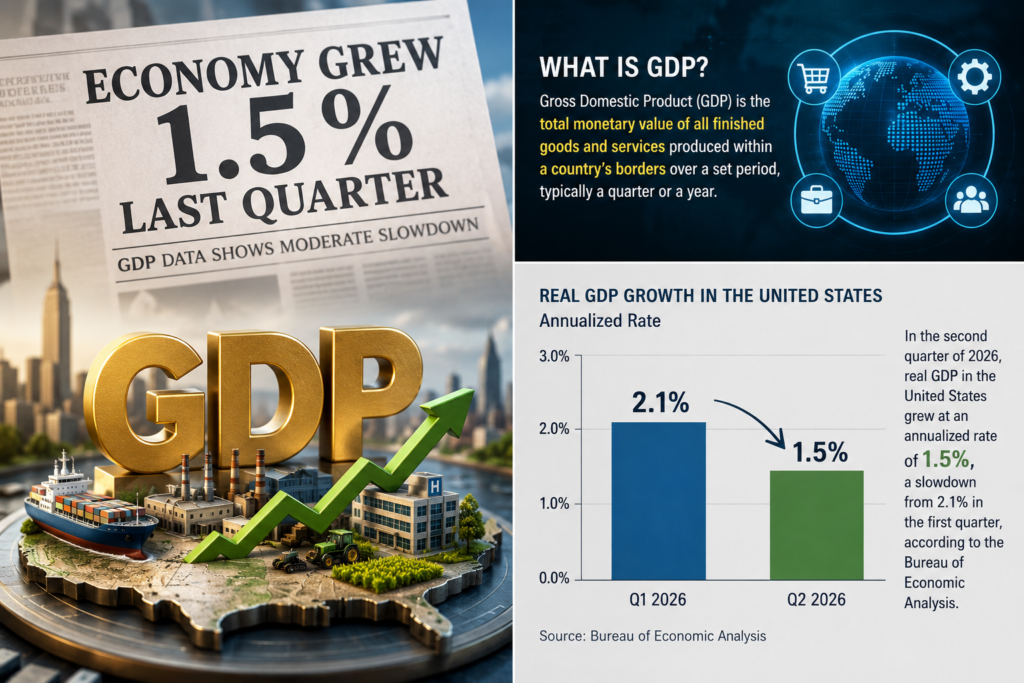
What is GDP, then? When the news reports that “the economy grew 1.5% last quarter,” GDP is being discussed. In order to determine whether an economy is growing, stagnating, or approaching trouble, economists, investors, and policymakers keep a close eye on this one statistic.
The total monetary value of all completed goods and services produced inside a nation’s borders over a predetermined time frame, usually a quarter or a year, is known as the gross domestic product. It serves as a common indicator of an economy’s size and rate of expansion or contraction. According to the Bureau of Economic Analysis, real GDP growth in the United States slowed to an annualized rate of 1.5% in the second quarter of 2026 from 2.1% in the first.
What GDP actually measures
GDP adds up the value of everything a country produces, from cars and smartphones to haircuts and legal advice, over a given stretch of time. It’s worth being clear about what GDP doesn’t capture. It doesn’t measure wealth, it doesn’t measure how evenly income gets shared, and it doesn’t count unpaid work like caregiving. A country can have rising GDP while most of that growth stays concentrated among a small share of the population. GDP tells you the size of the economic pie. It says nothing about how the pie gets sliced.
It is used by governments to determine monetary and fiscal policy, by central banks to monitor inflation when setting interest rates, and by investors to assess the potential for corporate profits. A slowing GDP growth rate is frequently an early warning sign for the labor market, sometimes months before layoffs make headlines because GDP growth tends to follow job creation.
How GDP is calculated
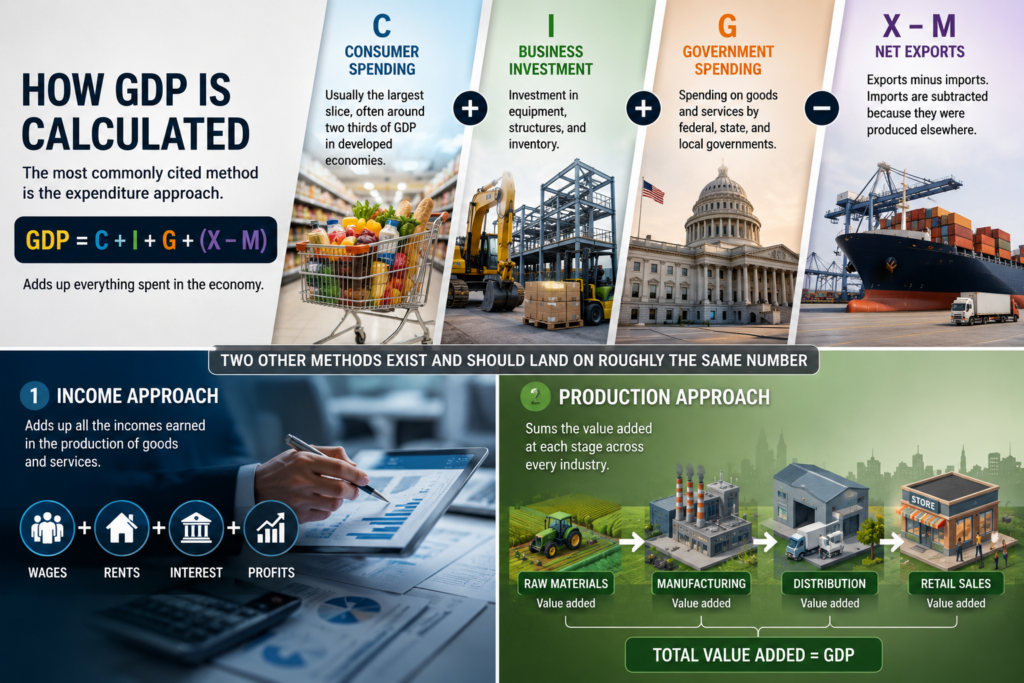
The expenditure approach, which totals all economic expenditures, is the most often used method:
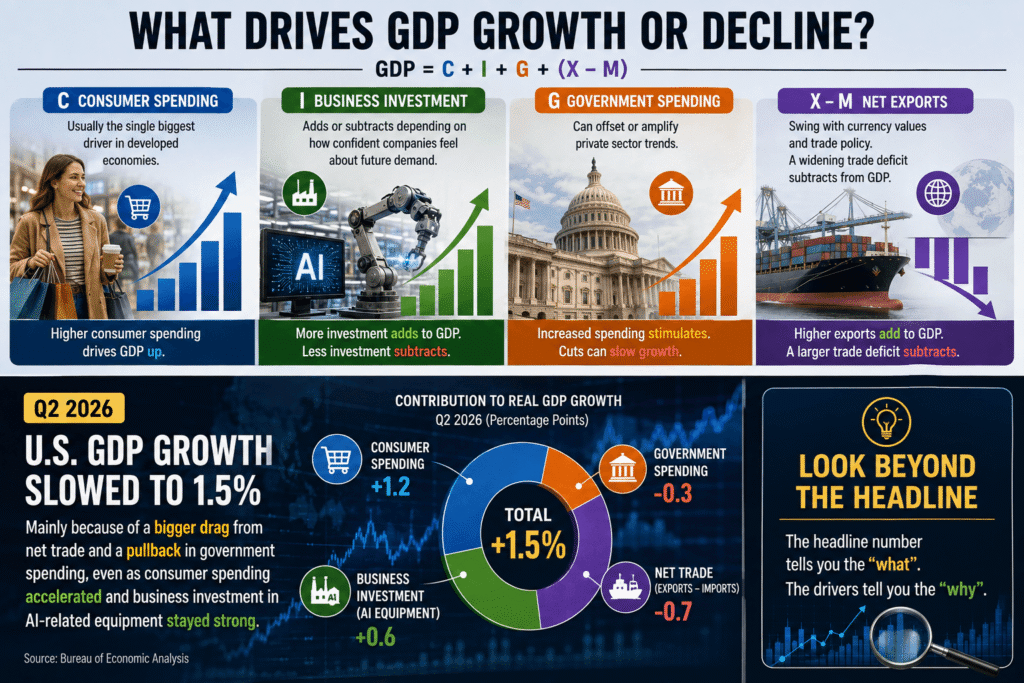
GDP is equal to C + I + G + (X minus M).
C stands for consumer spending, which typically makes up the largest portion of GDP in developed nations—roughly two thirds. I am a company investment in machinery, buildings, and stock. G stands for government expenditure. Since imports are deducted because they were manufactured elsewhere, net exports are equal to X minus M.
The income approach, which adds up wages, rent, interest, and profits, and the production approach, which adds up the value added at every stage across all industries, are two other approaches that should arrive at about the same figure.
Real GDP vs nominal GDP
| Term | What it means | Why it matters |
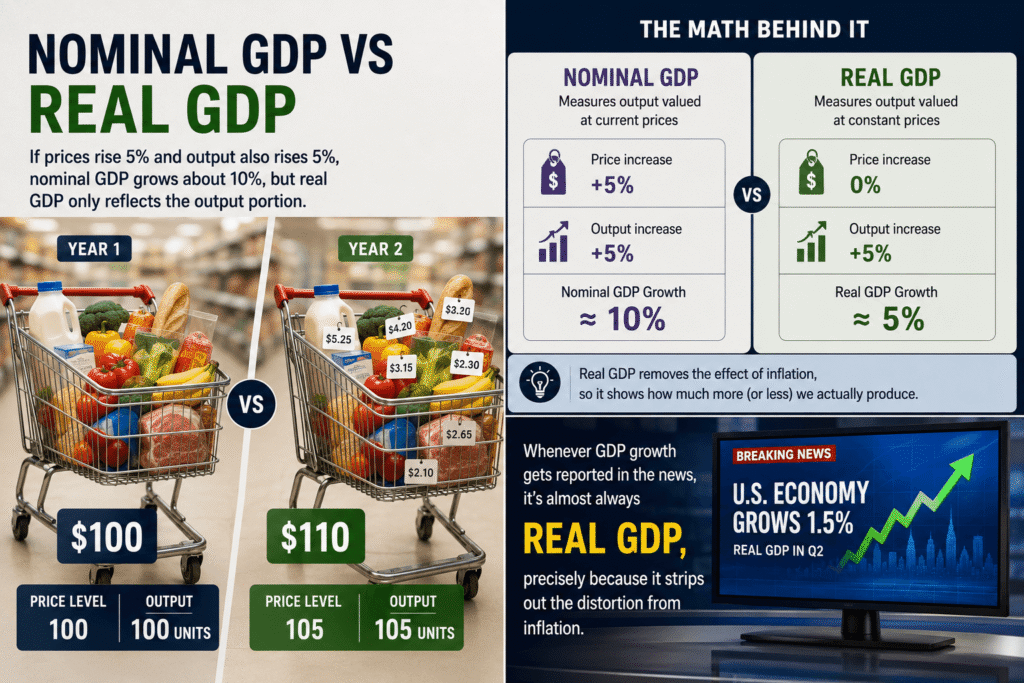
| Nominal GDP | Total output measured in current prices | Can rise just because prices rose, even without more actual production |
| Real GDP | Total output adjusted for inflation | Reflects genuine growth in goods and services produced |
Nominal GDP increases by roughly 10% if prices and output both increase by 5%, but real GDP only accounts for the output component. Real GDP is nearly always used when GDP growth is reported in the media because it eliminates inflation-related distortion.
GDP vs GNP vs GNI
| Term | What it measures |
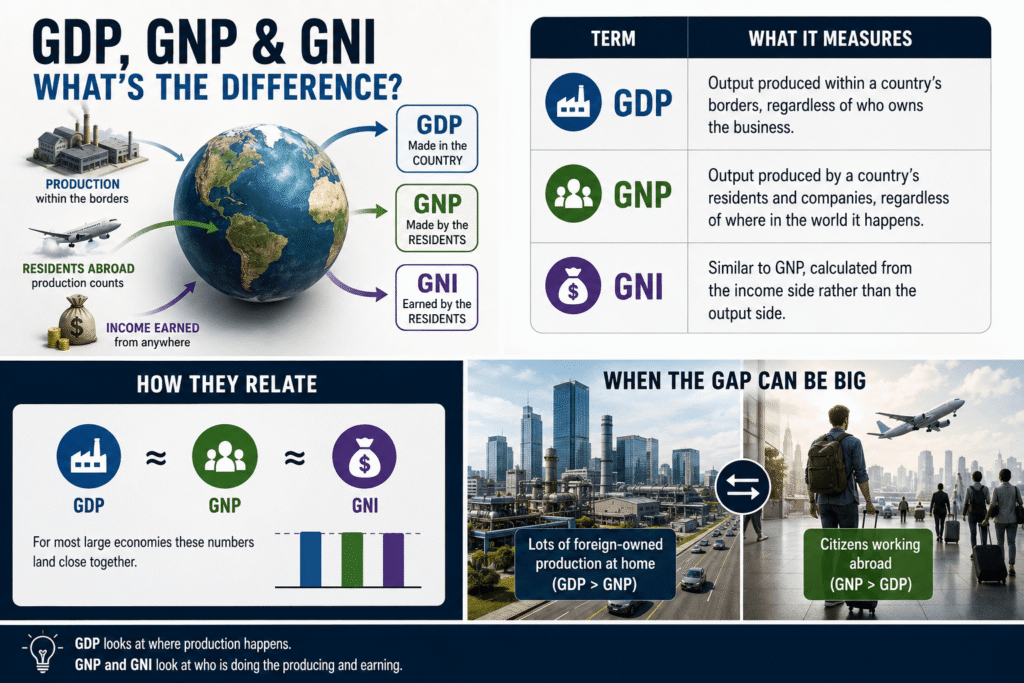
| GDP | Output produced within a country’s borders, regardless of who owns the business |
| GNP | Output produced by a country’s residents and companies, regardless of where in the world it happens |
| GNI | Similar to GNP, calculated from the income side rather than the output side |
These figures fall within a narrow range for the majority of large economies. The disparity increases for nations where a large amount of domestically owned production occurs or where citizens are employed overseas.
How GDP compares across countries in 2026
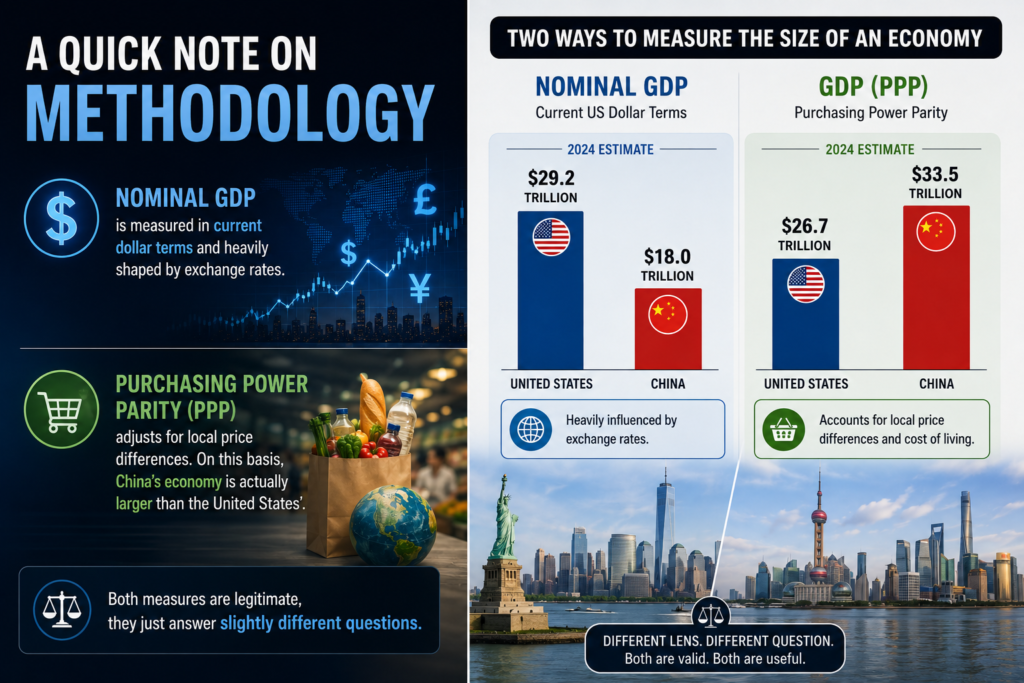
Based on IMF projections, the world’s largest economies by nominal GDP in 2026 look like this.
A brief word about methodology. Exchange rates have a significant impact on nominal GDP, which is measured in current dollars. China’s economy is actually bigger than the US economy when measured using purchasing power parity, which accounts for regional price variations. Although they provide somewhat different answers, both measures are valid.
| Rank | Country | Projected 2026 GDP |
| 1 | United States | around $31.8 trillion |
| 2 | China | around $20.6 trillion |
| 3 | Germany | around $5.3 trillion |
| 4 | India | around $4.5 trillion, now ahead of Japan |
What drives GDP growth or decline
Consumer spending is usually the single biggest driver in developed economies. Business investment adds or subtracts depending on how confident companies feel about future demand. Government spending can offset or amplify private sector trends. Net exports swing with currency values and trade policy, and a widening trade deficit subtracts from GDP even when it reflects a healthy economy simply buying more from abroad.
In Q2 2026, U.S. GDP growth slowed mainly because of a bigger drag from net trade and a pullback in government spending, even as consumer spending accelerated and business investment in AI related equipment stayed strong. TIn developed economies, consumer spending is typically the single largest driver. Depending on how confident businesses are about future demand, business investment increases or decreases. Spending by the government can either amplify or counteract trends in the private sector. A growing trade deficit reduces GDP even when it indicates a robust economy simply purchasing more goods from overseas. Net exports fluctuate with currency values and trade policy.
The U.S. GDP growth slowed in Q2 2026, mostly due to a greater drag from net trade and a retreat in government spending, even though consumer spending rose and corporate investment in AI-related equipment remained strong. That is a useful reminder to look past the headline number and look into the underlying reasons.This serves as a helpful reminder to look past the headline figure and investigate the underlying causes.
Recession, expansion, and the business cycle
A period of increasing real GDP, typically accompanied by declining unemployment and increased investment, is referred to as an expansion. Two consecutive quarters of negative real GDP growth are generally considered to be a recession, at least informally. However, the National Bureau of Economic Research in the US makes the official definition, which takes into account a number of factors other than GDP. The time following a downturn when GDP returns to its prior peak is known as a recovery.
The limits of GDP as a measure of wellbeing
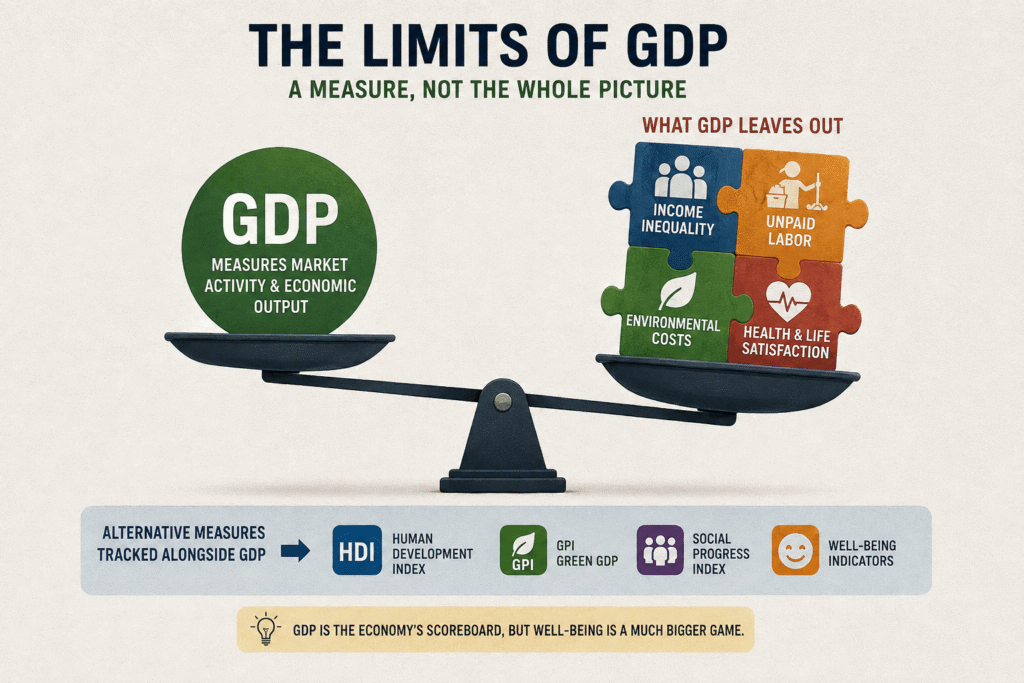
GDP is rightly criticized for the things it omits. It makes no mention of health or life satisfaction, and it disregards environmental costs, unpaid labor, and income inequality. While some economists monitor other metrics in addition to GDP, such as the Human Development Index, none have taken its place as the main economic scoreboard.
What GDP means for you
GDP growth usually takes a while to manifest in your life. Since corporate profits typically follow economic output over time, strong, sustained growth typically correlates with increased hiring, rising wages, and improved stock market performance. Layoffs and lower investment returns are typically preceded by weak or negative growth. Nevertheless, GDP is an aggregate figure that looks backward. A weak national print does not imply that every sector is having difficulties, and a strong national print does not ensure that your particular household or industry is prospering.
Frequently asked questions
To put it simply, what is GDP? GDP, which is typically reported quarterly or annually, is the total value of all goods and services produced in a nation over a given time period. It is the primary metric used to assess the size and growth of an economy.
How is GDP determined? The most popular approach totals net exports, government spending, corporate investment, and consumer spending. The expenditure approach is this.
What distinguishes nominal GDP from real GDP? Since nominal GDP is calculated using current prices, it may increase just as a result of price increases. Because real GDP accounts for inflation, it represents a real increase in output.
How much did the US GDP grow in 2026? The Bureau of Economic Analysis reports that the real U.S. GDP grew at an annualized rate of 1.5% in the second quarter of 2026 compared to 2.1% in the first.
Which nation has the biggest GDP? With an estimated nominal GDP of $31.8 trillion in 2026, the United States leads the world, followed by China with $20.6 trillion. China’s economy is bigger in terms of purchasing power parity.
Does a growing GDP indicate a robust economy? Not always, but usually. Growing GDP typically indicates growth, but it should be interpreted in conjunction with indicators like unemployment and wage growth because it doesn’t account for inequality, environmental costs, or wellbeing.
Conclusion
The closest thing the world economy has to a single scoreboard figure is GDP. The quarterly headlines cease to feel like noise and begin to provide you with useful information about whether the overall economy is growing, stagnating, or approaching trouble once you understand what it measures and what it excludes.
Related articles
What is inflation? How the stock market works What is Bitcoin? What is artificial intelligence? How the Federal Reserve works What is a recession?
check out more high quality graphics images on our 500px profile.