
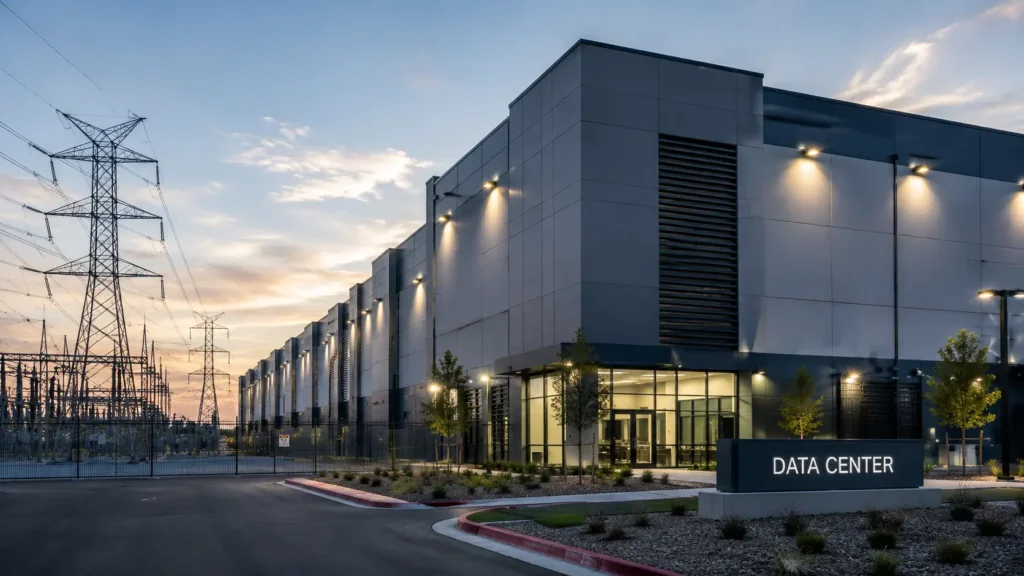
The real reason your electric bill may data center that opened forty miles away could cause your electric bill to increase or stay the same. A large load tariff, a particular rate rule that most people are unfamiliar with, is typically what makes the difference. States are implementing these at a rate that hardly existed two years ago, and the strength of your state’s one is likely to have a greater impact on your bill than the actual growth of data centers.
What a large load tariff actually is
A large load tariff is a special rate class that utilities set up for very large electricity customers, primarily data centers, requiring them to pay the full cost of the infrastructure and power they require instead of sharing that cost with other grid users. In the absence of one, a utility can construct new transmission lines and substations to service a data center and recoup that expenditure by charging rates to all consumers, including households that receive no benefits from the new facility.
A few common features are usually included in the tariffs. high upfront costs for a load analysis prior to building. Regardless of whether the customer uses all of their contracted capacity or not, minimum monthly payments are linked to a portion of it. lengthy contract durations, frequently eight years or longer. requirements for collateral. as well as consequences for early withdrawal.
Why states are moving fast on this now
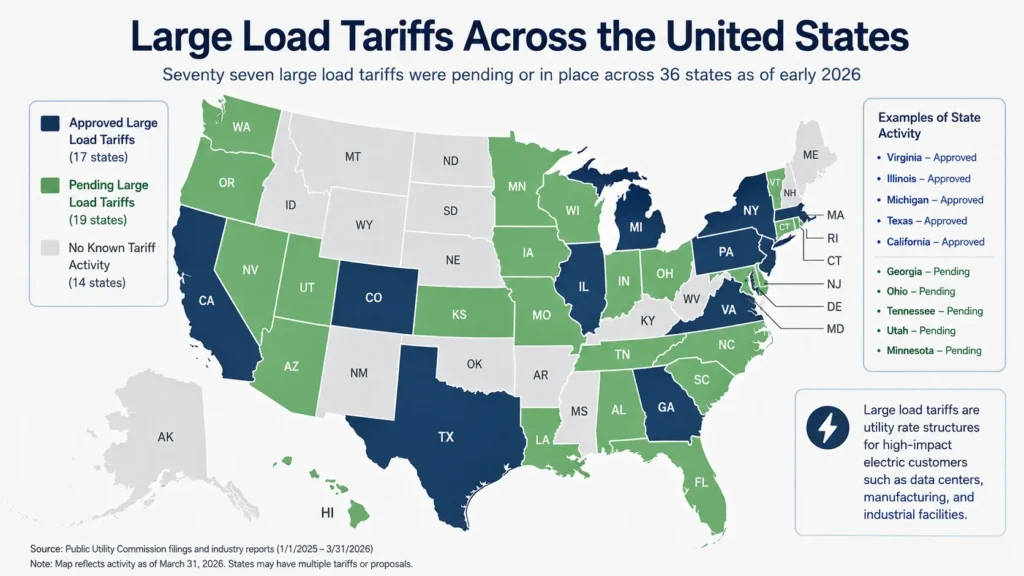
The real reason your electric bill may go AI data centers Adoption has accelerated dramatically. According to tracking by the Smart Electric Power Alliance, state regulators approved 29 large load tariffs in 2025 as opposed to just 14 in total between 2018 and 2024. According to a Utility Dive count from March 2026, 77 of these tariffs were either pending or in effect in 36 states.
Beginning in 2024, Ohio and Indiana were early adopters. Michigan, Kansas, and Virginia came next. Wisconsin and Illinois are currently debating their own versions. Regulators in Pennsylvania are developing a model tariff that might be implemented statewide as opposed to utility-by-utility.
The Ohio example that shaped the national debate
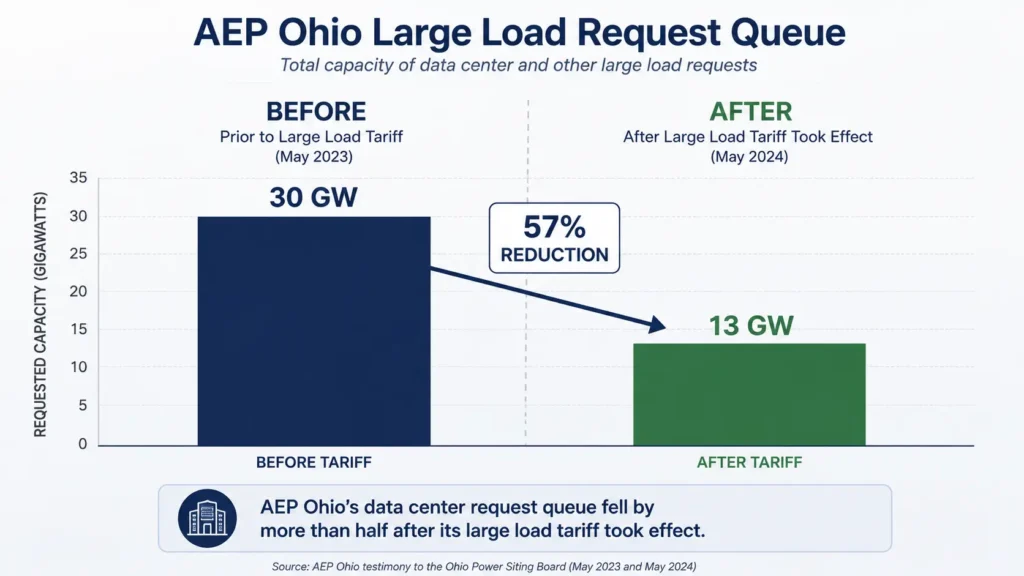
AEP Ohio is now used as a model case by other states. Its tariff requires a minimum eight-year contract with early termination fees, demand charges equal to 85% of the customer’s average monthly bill over the preceding eleven months, and a load study fee of up to $100,000 for a 100 megawatt facility.
The effect was immediately felt. According to reports from Utility Dive and Canary Media, AEP Ohio’s enormous load request queue shrank from about 30 gigawatts to about 13 gigawatts after the tariff went into effect. Developers’ simultaneous requests to multiple utilities to secure a spot without committing to any of them accounted for a large portion of that disparity. Because of the tariff, that strategy became
What Virginia is doing differently
With a large concentration in Northern Virginia, Virginia has the most data center capacity of any state. GS-5, Dominion Energy’s new rate class for large loads, will go into effect in January 2027. Regardless of how much power is actually used, it applies to customers with 25 megawatts or more and has a take-or-pay structure that requires payment for at least 85% of contracted transmission and distribution capacity and 60% of contracted generation demand. Although specific terms may change as the rule is put into effect, some reporting on the rule has mentioned collateral requirements as high as $1.5 million per megawatt of contracted capacity. For the final numbers, it is worthwhile to review Dominion’s most recent filings.
Why this determines your bill more than the data center boom itself
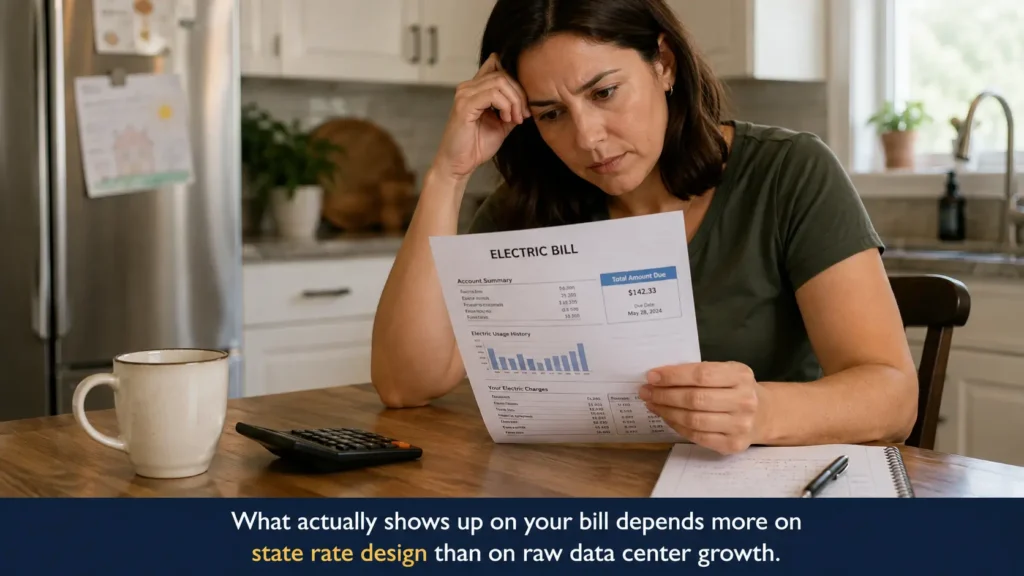
Regardless of what any one state does, the AI buildout is taking place. Who ultimately pays for the infrastructure that supports it varies greatly. The data center operator bears that expense when a state has a high load tariff. A state that doesn’t have one or has a weak version with lots of exceptions ends up using general rate increases to spread at least some of that cost among regular ratepayers.
This explains why household electric bills can differ significantly between two states with comparable levels of new data center construction. The decision is frequently made by the tariff design rather than the quantity of AI infrastructure being constructed..
What to actually check if you are worried about your bill
To begin, find out if your state has a large load tariff that has been approved and how it handles both new data center load and current utility customers. This is typically available on the website of your state’s public utility commission, and publications such as Utility Dive and Canary Media regularly report on which states have proposed or adopted one.
When you read about this subject, there are two different numbers. The kind of increases in wholesale electricity prices that researchers project using grid simulations are not the same as what appears on your actual monthly bill, which is largely dependent on how regulators allocate costs and the unique rate design of your state. A study that predicts a 20 percent increase in wholesale prices does not guaranty that your bill will increase by that much. step-by-step visual breakdown on Pinterest
What happens next
As Virginia’s GS-5 rule and similar frameworks in other states move from approval to actual implementation, more states are anticipated to implement large load tariffs or update current ones during the remainder of 2026 and into 2027. In state proceedings across the nation, regulators, utilities, and consumer advocates continue to actively contest whether these tariffs hold up as intended, with data centers paying their true share and ratepayers actually protected.
FAQs
To put it simply, what is a large load tariff?
Utilities apply a unique category of electricity rates to very large customers, such as data centers, in order to force them to pay for the infrastructure and power they require rather than passing that expense on to ordinary households.
Will AI data centers cause my electricity bill to increase?
Whether or not your state has enacted a robust large load tariff is a major factor. Compared to states with more stringent cost allocation regulations, states with laxer regulations are more likely to see some infrastructure costs transferred to regular ratepayers.
Which states currently have the highest large load tariffs?
The AEP tariff in Ohio and the Dominion Energy GS-5 rate class in Virginia, which is set to go into effect in January 2027, are frequently mentioned as prime examples.
Does the demand for data centers really decrease as a result of these tariffs?
Yes, in the case of Ohio. After its tariff was approved, AEP Ohio’s massive load request queue shrank by more than half, primarily as a result of developers being deterred from making speculative requests at several utilities at once.
Does the rise in electricity prices caused by AI data centers occur everyplace?
No, studies simulating the effects of wholesale prices have revealed a wide range depending on the region, and those wholesale projections differ from what actually appears on a household bill, which is dependent on local rate design. How can I determine whether one of these tariffs exists in my state?
Look for coverage from energy trade publications like Utility Dive and Canary Media, which track the adoption of large load tariffs state by state, or visit the website of your state’s public utility commission.
[…] hidden fees and consumer rights […]
[…] What’s the Difference? […]