
A far greater variety of investments will be available for your 401(k). Private equity and cryptocurrency are on the horizon. The majority of retirement plans stuck to mutual funds made up of publicly traded bonds and stocks for decades. This is beginning to change, which may eventually have an impact on tens of millions of American workers’ retirement accounts.
The shift is still ongoing and did not occur overnight. This is what has really occurred thus far, what is still up for debate, and how it could impact your individual account.

What changed and when
Private Equity and Crypto Are Coming
President Trump issued an executive order on August 7, 2025, with the title “Democratizing Access to Alternative Assets for 401(k) Investors.” In addition to traditional stock and bond funds, the order instructed the Department of Labor to facilitate the inclusion of private equity, private credit, real estate, infrastructure funds, and digital assets like cryptocurrency in retirement plans.
These assets have long been invested in by sovereign wealth funds, large pensions, and university endowments. The majority of typical 401(k) savers haven’t, primarily due to plan sponsors’ fear of legal action in the event that those investments underperform or incur excessive fees.
The Department of Labor directly addressed that matter on March 30, 2026. It suggested a new regulation that provides plan fiduciaries with a predetermined procedure to adhere to when choosing investment options. The rule establishes a legal presumption that a fiduciary acted responsibly if they adhere to the six necessary steps: evaluating performance, fees, liquidity, valuation methods, and complexity. Lawyers refer to this as a “process-based safe harbor.” The rule’s public comment period ended on June 1, 2026. A final version may be released later this year, but actual implementation is more likely to occur in 2027.
Why a Supreme Court case matters just as much
Regulation is one aspect of the situation. The Supreme Court will hear Anderson v. Intel Corp. on January 16, 2026. In this case, former Intel employees claimed that the company’s 401(k) plan acted irresponsibly by investing in hedge funds and private equity within custom target date funds. They said that as a result, fees increased and returns were less than those of a typical mutual fund.
Both the district court and the Ninth Circuit Court of Appeals ruled in favor of Intel, citing the plaintiffs’ inability to provide a pertinent benchmark—a comparable fund—to support their claims. The Supreme Court will now decide whether these cases can proceed without that benchmark requirement.
Even outside of Intel, the result is significant. Regardless of what the Department of Labor’s rule says on paper, analysts at TD Cowen have stated that companies are unlikely to add alternative assets to their 401(k) menus in significant quantities until courts resolve the litigation risk. Put differently, the Supreme Court determines the actual swing of the regulation.
What this does not mean for your account right now
It’s easy to assume that you will soon be choosing individual private equity funds from a dropdown menu next to your index funds when you see headlines like these. What is being proposed is not that.
According to employment benefits lawyers who reviewed the DOL proposal, most savers would be indirectly exposed to alternative assets through diversified vehicles like target date funds or multi-asset funds rather than through standalone private equity or cryptocurrency funds sitting on the menu by themselves. Your plan administrator, not you, decides whether and to what extent to include alternative asset exposure in those blended funds.
Thus, for example, if your 401(k) offers a 2055 target date fund, a small percentage of that fund may eventually contain private credit or real estate without your direct choice.
The genuine tradeoffs
Traditional index funds are not inherently superior to alternative assets. Before adding them to your plan, it’s important to understand the true trade-offs involved.
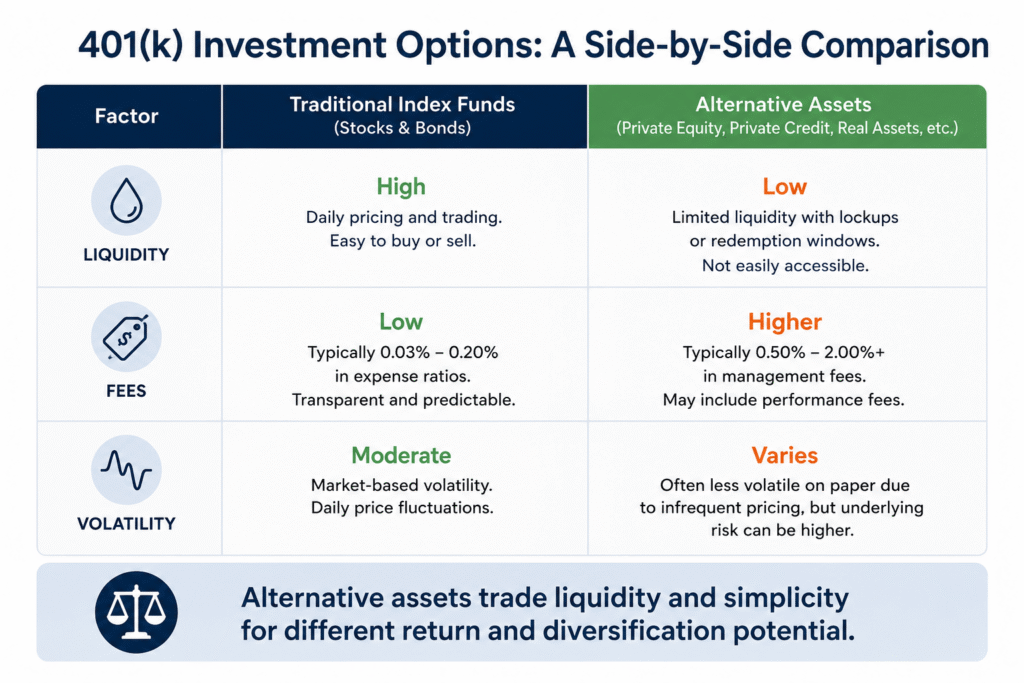
Because private credit and equity are not traded on public exchanges, they can provide greater long-term return potential and less correlation to the daily fluctuations of the stock market. Savings can be shielded from inflation by commodities and real estate.It might be more difficult to sell these assets quickly if you need the money because they are usually much less liquid. Compared to a basic index fund, fee structures are frequently more complicated and expensive. valuing these assets because there isn’t a public market price that is updated every second, in contrast to stocks.
According to retirement industry data gathered by the Investment Company Institute, Americans had about 48.1 trillion dollars in retirement assets as of the start of 2026. As a result, even a tiny reallocation toward industry alternatives amounts to a substantial amount of money shifting into more complicated, less liquid investments.
Private Equity and Crypto Are Coming! What to actually do about it
You don’t have any choices to make today. This news hasn’t affected your current plan menu, and there isn’t a rule in place just yet. It is worthwhile to keep an eye on things over the coming year.
Watch for updates from your plan administrator about any changes to your target date fund or the introduction of new alternative asset options. If you find one, ask directly about the portion of the fund allocated to digital assets, private equity, or private credit, as well as the overall cost in comparison to your current fund, which is usually shown as an expense ratio. A fiduciary needs to be able to clearly answer that question.
Conclusion
The regulations governing what can be included in your 401(k) are being rewritten in real time through an executive order, a proposed Department of Labor regulation, and a Supreme Court case that will determine how much legal risk employers are willing to take on. Nothing is finalized. Nonetheless, the route is sufficiently obvious that it is beneficial to understand it now, before the first alternative asset quietly shows up in your target date fund.
Frequently Asked Questions
Can I already use my 401(k) to invest in private equity or cryptocurrencies? Some plans were already able to do this before 2025 because ERISA never explicitly forbade it, but very few did because of fee and legal issues. Rather than creating a brand-new legal right, the 2025 executive order and the 2026 DOL proposal aim to remove that reluctance.
Is this regulation final yet? No. The Department of Labor proposed the rule on March 30, 2026, and the public comment period ended on June 1, 2026. A final rule might be published later in 2026, with actual adoption by plans more likely in 2027, according to legal analysts who keep an eye on the rulemaking process.
Can I choose specific private equity funds on my own? Probably not directly. Attorneys who examined the proposal anticipate that alternative assets will primarily come from target date funds and multi-asset funds selected by your plan sponsor, as opposed to options you choose on your own.
What is Anderson v. Intel and why is it significant? The Supreme Court’s 2026–2027 term will address the issue of whether 401(k) plan participants suing over underperforming private equity and hedge fund investments must identify a specific comparable fund in order to prove their case. The ruling will affect the degree of legal risk that employers face when integrating alternative assets, which will affect how quickly plans are actually put into action.
Are alternative assets riskier than a standard index fund? They carry different risks rather than just greater ones. They are often more difficult to value on a daily basis, have higher fees, and are less liquid. They can also offer diversification and inflation protection that a straightforward stock and bond portfolio cannot.
What impact will this have on my 401(k) fees? It might. Standard index funds typically have lower management fees than private equity, private credit, and similar assets. Asking your plan administrator how the blended fee stacks up against your current option makes sense if your plan includes them in a target date fund.
Right now, what should I do? Nothing urgent. The current plan does not need to be altered in light of this news. You should read any notifications your plan sends about changes to your target date fund and ask questions if new asset types appear.
Where can I check on the status of the DOL rule? Benefits for Department of Labor Workers The Security Administration updates its rulemaking on its official website, and the proposed rule is available through the Federal Register.