

H-1B Wage Weighted Lottery: Employers used to pay between $2,000 and $5,000 per petition, but the $100,000 H-1B fee that was announced in September of last year garnered almost all the attention, and for good reason. However, new research from the Penn Wharton Budget Model, which was released in early August 2026, discovered that the majority of the change in who is chosen is actually caused by a different modification to the way the visa lottery operates, rather than the fee that garnered media attention.
What the $100,000 H-1B Fee Actually Applies To
Since September 21, 2025, a fee of $100,000 has been imposed on new H-1B petitions for workers who are currently abroad, which accounts for approximately 60% of registrations. Current H-1B holders who extend their status domestically are not subject to it, and many change of status petitions submitted from within the US are also exempt. Additionally, employers are not allowed by immigration law to transfer this fee directly to employees, so the employer must bear the entire expense. This is a significant and real cost increase for a business that sponsors multiple foreign hires in a given year, but it only affects a portion of the program as a whole.
How the H-1B Wage Weighted Lottery Changes Selection Odds
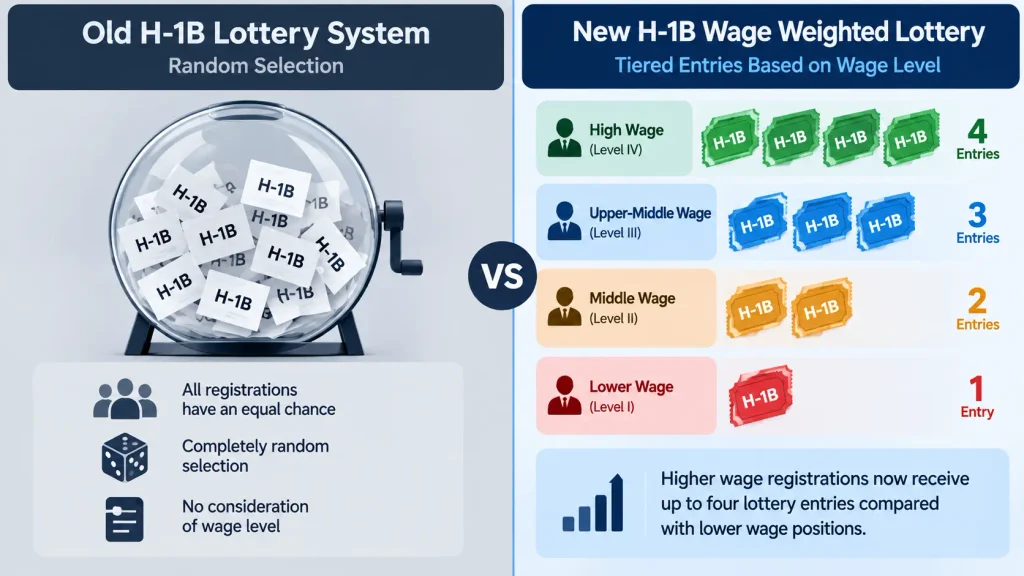
Starting with the lottery for the fiscal year 2027 cap, which covers the 85,000 cap subject H-1B visas available, the selection process switched from a random lottery with equal odds for each registration to a wage level weighted lottery. Higher wage positions receive multiple chances in the draw, while lower wage positions receive fewer, according to the new system, which assigns each registration one to four lottery entries based on its prevailing wage level.
In comparison to the purely random lottery used prior to this year, Wharton’s modeling revealed that the combination of the fee and the wage weighting would increase the average pay of chosen applicants by 7,551 to 18,799 dollars, or 6.7 to 16.7 percent. The analysis’s most important conclusion is that the wage weighting, not the fee, is primarily responsible for this increase. A company’s willingness to sponsor someone is influenced by the fee. More of that reshaping is being done by the lottery weighting, which modifies who initially wins the draw.
Who Benefits and Loses Under the H-1B Wage Weighted Lottery
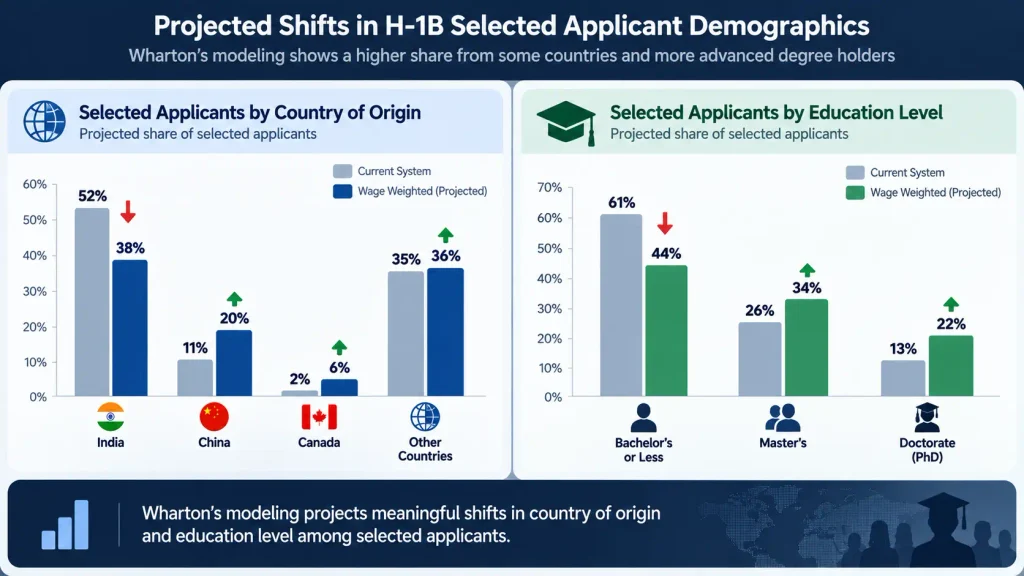
Wharton predicted specific and important demographic effects. Under the new system, India would make up between 55.7 and 63.5 percent of the chosen H-1B workers, down from 66.8 percent under the previous random lottery. The percentage of chosen employees with a PhD would increase from 5.7% to 9.5%. The percentage of chosen workers who had no prior US visa history would decrease from 44.5 percent to between 26.1 and 33.9 percent, while the percentage of chosen workers who had F-1 student status—that is, were enrolled in classes in the US prior to applying—would increase from 43.3 percent to between 48.5 and 50.8 percent.
To put it simply, the new system favors higher-paid, more credentialed applicants—many of whom are already in the US on a student visa—over first-time foreign applicants and lower-paying jobs, which critics have long linked to outsourcing-style staffing arrangements.
Why the Wage Weighted Lottery Matters More Than the $100,000 Fee
The stated objective of the policy was to address what the administration called abuse of the program as a tool for cost-cutting, especially with regard to information technology staffing. Regardless of whether an employer is willing to pay the new fee at all, Wharton’s research indicates that the lottery redesign is the mechanism that is actually achieving that goal at scale because it structurally lowers the odds for lower wage registrations. Theoretically, a company could easily absorb the $100,000 fee, but its lower-paid candidates would still lose out because the new weighting would result in fewer lottery entries.
What the New H-1B Lottery Means for Employers and Applicants

H-1B Wage Weighted Lottery: The wage level assigned to a position now has a more direct impact on whether that position is chosen at all, but if your company sponsors H-1B workers, the fee is a real budget line item worth planning around. Regardless of the cost, structuring jobs at higher prevailing wage levels where truly applicable can significantly increase selection odds under the new system. Prior US visa status, especially F-1 student status, and higher wage offers now have more weight in the actual selection process for applicants than they did under the previous random system. This change is likely to continue reshaping the applicant pool as this lottery structure goes through more cycles.
Frequently Asked Questions About the H-1B Wage Weighted Lottery
Does the $100,000 H-1B fee apply to every H-1B worker?
No. It particularly pertains to newly filed petitions for workers who are presently abroad, which account for about 60% of registrations. Many change of status petitions and current H-1B holders who are extending their status domestically are exempt.
Can my employer make me pay the H-1B fee myself?
No. Generally speaking, employers are not allowed by immigration law to demand that workers pay for visa petition fees; instead, the employer is responsible for covering these expenses.
What is the wage weighted lottery?
Starting with the fiscal year 2027 cap, each H-1B registration will receive one to four lottery entries based on their prevailing wage level. This will replace the previous system in which all registrations had equal odds regardless of wage.
Which change is actually having the bigger effect on who gets selected?
The wage weighted lottery, rather than the $100,000 fee itself, is primarily to blame for the change in selected applicant pay, according to Penn Wharton Budget Model research released in August 2026.
How does this affect applicants from India specifically?
According to Wharton’s modeling, under the new wage weighted system, India’s share of chosen H-1B workers would drop from 66.8 percent under the previous random lottery to between 55.7 and 63.5 percent.
Does this change favor certain types of applicants?
ndeed. According to the modeling, candidates with doctorates and former F-1 students who are already in the US have higher selection shares, while those without any prior US visa history have lower shares.
Does the $100,000 H-1B fee apply to every worker?
No. Not all H-1B employees are subject to the $100,000 fee. While many domestic change-of-status cases and extensions are handled differently, it mainly applies to specific new H-1B petitions for workers who are currently outside the United States.
What is the H-1B wage weighted lottery?
The selection method for the FY2027 cap season is the H-1B wage weighted lottery. USCIS allocates one to four entries based on the relevant OEWS wage level rather than giving each registration the same odds. Level I receives one entry, Level II receives two, Level III receives three, and Level IV receives four.
Does the new H-1B lottery favor higher-paid applicants?
Indeed. Higher wage levels are given more entries by the system, which raises their chances of being chosen in comparison to lower wage levels. According to its modeling, DHS calculated selection probabilities of roughly 15.29% for Level I, 30.58% for Level II, 45.87% for Level III, and 61.16% for Level IV.
How does the new H-1B lottery affect Indian applicants?
India’s share of chosen H-1B workers may decrease from 66.8% under the previous random system to roughly 55.7%–63.5% under the modeled new system, according to Penn Wharton Budget Model modeling. These are forecasts, not assured results.
Does F-1 student status matter under the new H-1B lottery?
According to Wharton’s modeling, the percentage of selected applicants with no prior U.S. visa history may decrease, while the percentage of selected applicants with prior F-1 student status is expected to increase.
Can an employer increase H-1B selection odds by offering a higher salary?
A registration receives more entries in the weighted selection process if the higher OEWS wage level is truly applicable. Instead of artificially inflating compensation or classification in order to get more lottery entries, employers should report the correct wage level for the actual position.