

Buy now pay later was supposed
If you looked up anything about buy now, pay later, and credit scores in the last year, you most likely came across articles stating that this would begin to impact your score in the fall of 2025. The deadline has passed. A Senate Banking Committee letter from May 2026 explains why, for the majority of users of Affirm, Klarna, or Afterpay, not much has changed.
What FICO actually announced
FICO announced in February 2025 that it had developed a system to add BNPL loan information to credit scores for the first time. Working with BNPL provider Affirm, the company conducted a 12-month study using data from about 500,000 consumers to simulate what would happen to people’s scores if their pay in four loans were taken into account. FICO intended to launch the FICO Score 10 BNPL and FICO Score 10 T BNPL models at some point in the fall of 2025.
The outcomes of the simulation were rather mild. The majority of customers reported a change of about 10 points, which is roughly equivalent to what occurs when a new credit account is opened. That is not the sharp swing that many of the early headlines suggested, but rather a slight change.
Why the fall 2025 timeline did not really deliver

The current scoring models only tell half the story. The credit bureaus must first receive enough BNPL data into their systems in order for a new FICO score to appear when a lender pulls your credit. Things slowed down during that handoff.
Several BNPL companies had directly informed Equifax that they were not currently sharing any BNPL data with credit reporting agencies as of the Senate Banking Committee’s investigation in May 2026. Although individual businesses have taken some action since Equifax formally announced in December 2021 that it would include BNPL information in credit reports—Affirm reports to Experian and TransUnion, while Klarna reports to TransUnion—broad, uniform reporting across the industry has yet to occur.
On May 4, 2026, Equifax CEO Mark Begor received a letter from the Senate Banking Committee asking directly how the company is integrating BNPL data and how it intends to close that gap. The letter cited the growing size of the BNPL market and the number of providers still not sharing information.
Why lenders and BNPL companies have been slow to move
A portion of the delay is technical. The two conventional credit categories do not adequately describe BNPL loans. Depending on the particular product, FICO categorizes them as either revolving credit, akin to a credit card, or installment credit, which is a fixed loan repaid in predetermined installments. It is more difficult to standardize the reporting of the loans because of this discrepancy.
A question about business incentives is also present. According to survey data cited by Empower, 40% of BNPL users list not affecting a customer’s credit score as one of the product’s top benefits. Several BNPL providers have built their appeal around this feature. Providers are aware that if BNPL significantly altered a customer’s credit profile, some customers might use it less.
What this means if you use BNPL right now
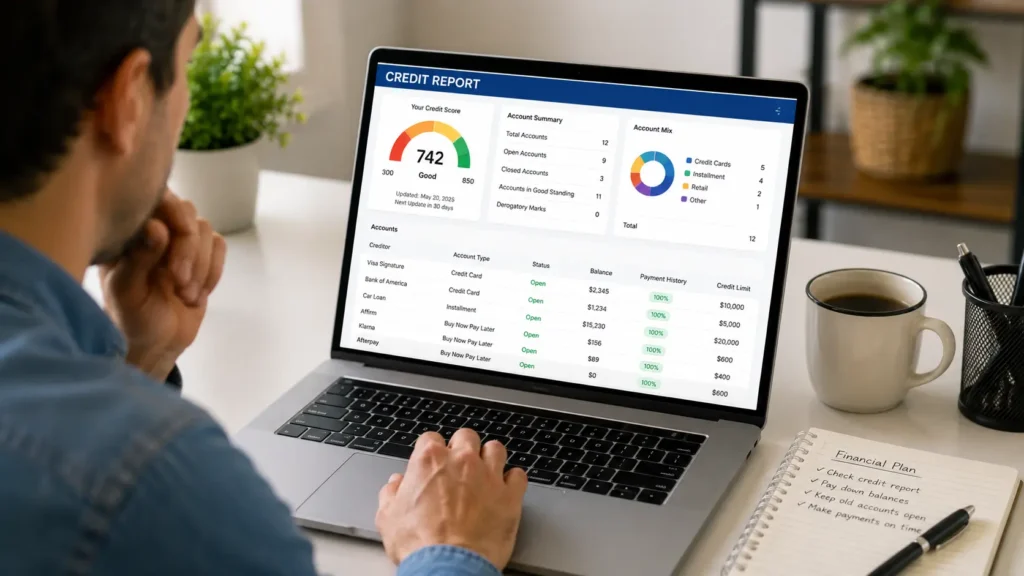
Because most BNPL data still does not reach the bureaus in a way that feeds into your score, the impact on credit scores is currently negligible for the majority of people who use pay-in-four loans on occasion and make timely payments. Saying it never will is not the same as that. The FICO models are available and prepared technically. The data pipeline from BNPL companies to the bureaus is what is lacking, and rather than merely being discussed by the industry, this gap is now receiving direct congressional attention.
Regardless of whether a provider reports regular on-time activity, missed payments are a different matter.
What to watch for next

Since congressional investigations like this frequently precede either voluntary industry changes or subsequent regulatory action, the Senate Committee’s letter to Equifax is a real pressure point worth keeping an eye on. Since the product’s growth spike around 2022, the Consumer Financial Protection Bureau has also pushed for standardized BNPL reporting, so this is not a new priority; rather, it is receiving more attention now that the initial fall 2025 timeline has obviously slipped.
Rather than depending on general timelines that might not apply to the specific BNPL company you use, the most dependable method to determine whether a particular provider is currently reporting your account is to check your credit reports directly from Equifax, Experian, and TransUnion.
Conclusion
FICO actually developed a system to score BNPL activity, so the headline from the previous year was accurate. The fact that developing the model and implementing it throughout the industry are two distinct issues was overlooked along the way, and the latter is still unsolved well after the initial deadline. The same question that many customers have been silently posing for months is now being asked by a Senate committee. The honest answer to the question of whether your pay-in-four habit is impacting your score is, for the most part, no, until BNPL companies actually begin providing the bureaus with consistent data. if you read more info about these artical visit our official blogspot porfile.
FAQs
Does buy now pay later currently affect my credit score?
Not much for the majority of users just yet, as most BNPL providers continue to fail to regularly report routine payment activity to credit bureaus, despite the fact that FICO’s scoring models are already in place to handle that data.
What happened to the fall 2025 deadline for BNPL affecting credit scores?
The Senate Banking Committee’s May 2026 letter to Equifax focused in part on the lack of broad data reporting from BNPL companies to the credit bureaus, despite the fact that FICO’s scoring models were technically ready.
Will a missed BNPL payment hurt my credit score right now?
Yes, perhaps. Even in situations where they are not reporting regular on-time payments, a number of BNPL providers already report missed or delinquent payments to bureaus like Equifax.
Which BNPL providers currently report to credit bureaus?
Although the amount and consistency of that reporting varies, Affirm reports to Experian and TransUnion, Klarna reports to TransUnion, and several other providers have informed regulators that they do not currently share BNPL data at all.
How much could my score change once BNPL reporting becomes standard?
Although individual results will differ, FICO’s simulation using Affirm data found that most consumers would see a change of about plus or minus 10 points, similar to the effect of opening a new credit account.
Why did the Senate get involved in this issue?
After discovering that several BNPL companies were not providing information to credit reporting agencies despite years of expected change, the Senate Banking Committee wrote to Equifax’s CEO in May 2026 inquiring about the company’s handling of BNPL data.
Is buy now pay later classified as installment or revolving credit?
Depending on the particular product, yes. Standardized reporting has been challenging because FICO categorizes BNPL loans as either revolving credit or installment credit based on how each provider structures the loan.