
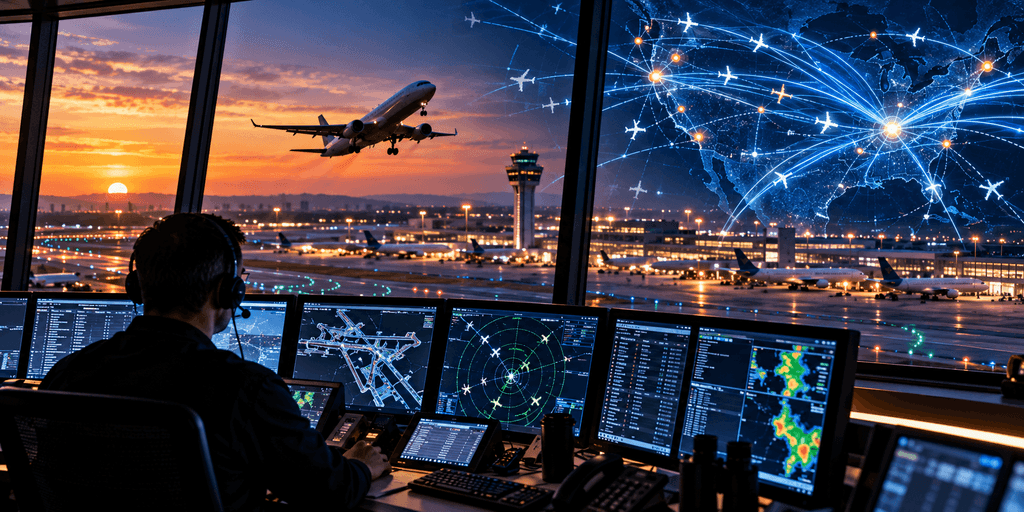
FAA AI air traffic control, The Federal Aviation Administration is rolling out new artificial intelligence software this week at some of the country’s busiest airports, a central piece of its effort to modernize an air traffic control system that, in places, still depends on technology dating back decades. The timing is notable. The rollout is landing at a moment when public anxiety about AI generally has been climbing, and when a string of high profile aviation incidents has already left many travelers more nervous about flying than they were just a year or two ago.
A System Still Running on Decades Old Technology
To understand why the FAA is turning to AI at all, it helps to understand just how outdated parts of the current system actually are. Some facilities involved in managing American airspace have relied on technology including floppy disks and radar systems dating back to the 1980s, infrastructure that long predates the smartphones most travelers now use to check their own flight status.
Those aging systems have already caused real problems. Technical failures knocked out radar for air traffic controllers managing planes around Newark Liberty International Airport on two separate occasions last year, disruptions that led to thousands of flight cancellations and delays at one of the country’s busiest hub airports. Those failures, combined with a series of higher profile incidents, including a deadly collision involving an American Airlines flight near Washington and a Delta Air Lines crash landing in Toronto, have left many flyers increasingly uneasy, and have added real political pressure on regulators to show visible progress on modernizing the system rather than simply managing it as is.
What the New AI Software Actually Does
The centerpiece of the FAA’s current push is a program called SMART, short for Strategic Management of Airspace, Routes, and Trajectories. Built under an $875 million, twelve year contract with a company called Air Space Intelligence, SMART began piloting this week at three major airports in the Washington, D.C. area.

According to the agency’s own description, SMART is a cloud based platform designed to enhance the FAA’s existing air traffic management systems rather than replace them outright. The software uses AI to analyze airline schedules, weather conditions, airport capacity, airspace conditions, and a range of other operational constraints, with the goal of predicting traffic flows and flagging potential conflicts before they actually happen, rather than forcing controllers to react to problems only after they emerge. The FAA has described the broader contract as providing the new technological backbone for a modernized Air Traffic Control System Command Center going forward.
Humans Still Make the Final Calls
Given how much public anxiety already exists around AI systems acting unpredictably, the company behind the software has been careful to frame SMART’s role narrowly. Phillip Buckendorf, co founder and chief executive of Air Space Intelligence, has stressed in recent interviews that the tool is not about automating air traffic control itself. Human controllers, he has said, remain firmly in charge of the actual job of keeping aircraft safely separated in the sky. SMART’s role, in this framing, is closer to that of an early warning and planning assistant, surfacing useful predictions and flagging likely bottlenecks, while leaving every real time safety decision in human hands.
Buckendorf has also acknowledged that public fears about mixing AI with something as safety critical as air traffic control are legitimate rather than simply a matter of public misunderstanding, a notably candid admission for an executive whose company stands to benefit from the technology’s success.
FAA AI air traffic control, Not Everyone Is Convinced
Skepticism has come from multiple directions. Representative Don Beyer, whose district includes major air traffic facilities in the Washington area, publicly objected to the pace of the roll-out, arguing that his constituents should not effectively serve as test subjects for an AI based air traffic control system that has not yet been fully proven at scale.
The National Air Traffic Controllers Association, the union representing the controllers who would actually work alongside the new system, struck a notably cautious tone of its own. In a public statement, the union said it had not been involved in the design, testing, or implementation of SMART, and said it was therefore not in a position to speak to what effect the tool might ultimately have on the air traffic control workforce.
Outside experts have raised a different kind of skepticism, one focused less on safety risk and more on how much the new software will actually change. John Gradek, an aviation risk management expert at McGill University, noted that SMART is not a particularly novel concept in global terms, pointing out that the European Union, Canada, the United Kingdom, and other countries have already been testing comparable AI based air traffic management tools of their own. Some critics have gone further, suggesting that attaching the AI label to the software mostly serves to attract attention rather than reflecting any especially groundbreaking technical leap.
The Deeper Problem Software Alone Can’t Fix
Even among those cautiously open to the new technology, a recurring concern is that software improvements alone will not solve the system’s most fundamental weakness, a persistent shortage of trained air traffic controllers. Nick Daniels, president of the National Air Traffic Controllers Association, has said a system that reduces the burden on individual controllers would be welcome, but has also been clear that the underlying need is for more controllers, not simply better tools for the ones already stretched thin across an overburdened system.
That staffing gap has not gone unaddressed. The FAA separately announced what it described as a bold new hiring plan earlier this year, intended to close the agency’s longstanding controller shortage over time. But hiring and training new controllers takes years, meaning any relief on that front is unlikely to arrive as quickly as a new piece of software can be installed and switched on.
The Price Tag Keeps Growing
Whatever the merits of SMART specifically, it represents only one piece of a much larger and increasingly expensive modernization effort. The initial $12.5 billion allocated toward the air traffic control overhaul came through legislation signed into law in mid 2025. By December, the agency was already describing that amount as merely a down payment, estimating it would need roughly $20 billion more to complete the broader modernization effort.
That figure has climbed again. The FAA is now asking Congress for an additional $30 billion, 10 billion dollars more than the Department of Transportation had previously indicated it would need. Senator Eric Schmitt introduced legislation this week called the Modern Skies Act, laying out a plan that includes building a common automation platform and shared cloud computing infrastructure across the system. The bill has drawn support from nearly sixty organizations, including Airlines for America, the National Air Traffic Controllers Association, and the General Aviation Manufacturers Association, a notably broad coalition for a piece of infrastructure legislation. Under the funding plan, roughly a third of the money would go toward upgrading the safety separation tools controllers rely on and building more resilient telecommunications systems, while another significant portion is earmarked for replacing aging control towers, airport facilities, and runways. More info visit the our academia pdf file.
Timeline and What Comes Next
Transportation Secretary Sean Duffy has set an ambitious target for the broader effort, aiming to have what he has described as a brand new air traffic control system in place within three and a half to four years. He has been careful to frame the pace of that rollout as a balance between moving quickly and maintaining the safety standards the current, admittedly outdated, system has nonetheless managed to uphold, noting at one point that the existing analog system may be old, but it has still proven safe.
For now, SMART’s roll-out remains limited to a handful of airports in the Washington, D.C. region, giving regulators, controllers, and outside observers a real world test case to watch closely before any decision is made about expanding the tool nationally. How that pilot performs, both in terms of measurable efficiency gains and public trust, is likely to shape how willing Congress and the flying public end up being to support a modernization effort that, between funding requests and new technology rollouts, shows no sign of slowing down anytime soon.
For now, SMART’s rollout remains limited to a handful of airports in the Washington, D.C. region, giving regulators, controllers, and outside observers a real world test case to watch closely before any decision is made about expanding the tool nationally. How that pilot performs, both in terms of measurable efficiency gains and public trust, is likely to shape how willing Congress and the flying public end up being to support a modernization effort that, between funding requests and new technology rollouts, shows no sign of slowing down anytime soon.
FAQ
What is the FAA’s new AI air traffic control software called?
It’s called SMART, short for Strategic Management of Airspace, Routes, and Trajectories, an $875 million program built under a 12 year contract with Air Space Intelligence.
Will AI replace human air traffic controllers?
No. The company building the software has said SMART is not intended to automate air traffic control, and human controllers remain responsible for keeping aircraft safely separated.
Where is the FAA’s AI air traffic control software being tested?
SMART began piloting this week at three major airports in the Washington, D.C. area as part of a broader national modernization effort.
Why does the air traffic control system need to be modernized?
Parts of the current system rely on decades old technology, including radar systems from the 1980s, which has contributed to real failures such as radar outages at Newark Liberty International Airport that caused widespread delays and cancellations.
How much is the FAA’s air traffic control modernization expected to cost?
The FAA originally received $12.5 billion for the effort, later said it needed $20 billion more, and is now asking Congress for an additional $30 billion through the proposed Modern Skies Act.
Are air traffic controllers worried about the new AI software?
The National Air Traffic Controllers Association has said it was not involved in designing or testing SMART and cannot yet speak to its effect on the workforce, while separately emphasizing that the system’s deeper problem is a shortage of controllers rather than a lack of software.