
AI has been cited by tech companies as a reason for job cuts at a rate that has increased dramatically this year, and some of the same companies that are making record profits are also among those making the biggest layoffs. A straightforward legal fact is overlooked in the coverage of these figures. An employer is not required by the primary federal law governing layoff notice to reveal that AI or any other particular reason led to your termination. Here are what is still merely a proposal and what the law actually mandates.
What Does the WARN Act Actually Require?
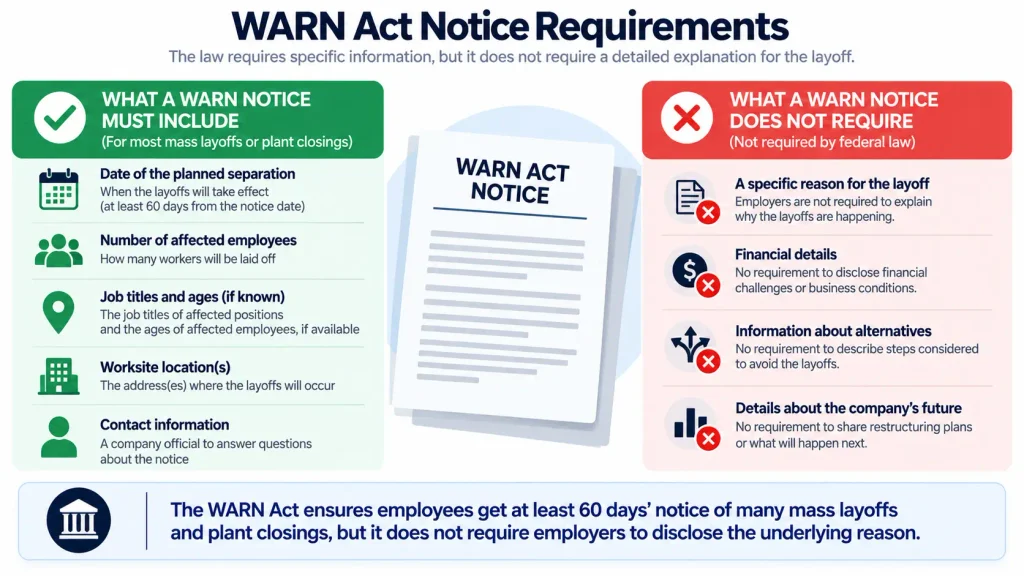
A 1988 federal law known as the Worker Adjustment and Retraining Notification Act mandates that employers with 100 or more workers provide written notice of a covered plant closure or mass layoff within 60 calendar days. The notice must specify whether the action is anticipated to be temporary or permanent, the anticipated date of separation, whether seniority-based bumping rights are available, and a company official’s contact details. The law does not require an employer to provide an explanation of the underlying business reason for the layoff, be it cost-cutting, AI adoption, or anything else.
Additionally, there are significant gaps in the scope of this law. The 100 employee threshold that initially triggers the law does not apply to part-time employees, those who work fewer than 20 hours per week, or those who have worked fewer than six of the previous twelve months. Since many AI-related job losses are manifesting as steady attrition and smaller, rolling cuts rather than a single large announced layoff, it is important to avoid triggering WARN obligations entirely by spreading out layoffs rather than announcing them as a single mass event.
What Happens if an Employer Violates the WARN Act?
Workers may be eligible for back pay and benefits that cover the notice period they should have received if a covered employer fails to give adequate notice. Instead of requiring an initial filing with a federal agency, these claims go straight to federal court. They are frequently filed as class actions on behalf of all impacted parties, which can significantly lower the legal expenses for any individual employee involved. Employers may shorten or forego notice under certain exceptions, such as the faltering company exception and the unforeseeable business circumstances exception, which are both assessed on an individual basis rather than using a set formula.
Which States Have Stronger Layoff Notice Laws?
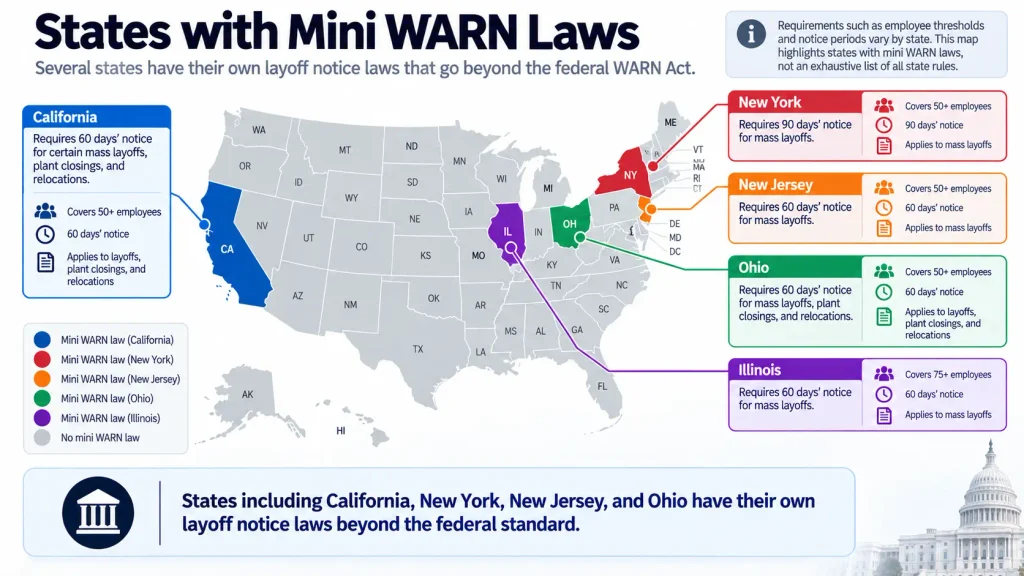
California, New York, New Jersey, Illinois, Maryland, Delaware, and, as of September 2025, Ohio are among the states that have enacted their own mini WARN laws that build upon the federal version. Some of these state laws require extra information in the notice itself, lower the employee threshold that initiates coverage, or, in the case of New Jersey and Maine, mandate severance pay that is not required by federal law. Senate Bill 617, which was signed in October 2025 and went into effect on January 1, 2026, updated California’s own legislation once more by requiring employers to provide more details in mass layoff notices.
Additionally, none of these current state laws expressly mandate that AI be disclosed as a reason for layoffs. That is a separate, more recent type of proposal that is currently being considered by legislatures.
Which AI Layoff Disclosure Laws Are Still Pending?
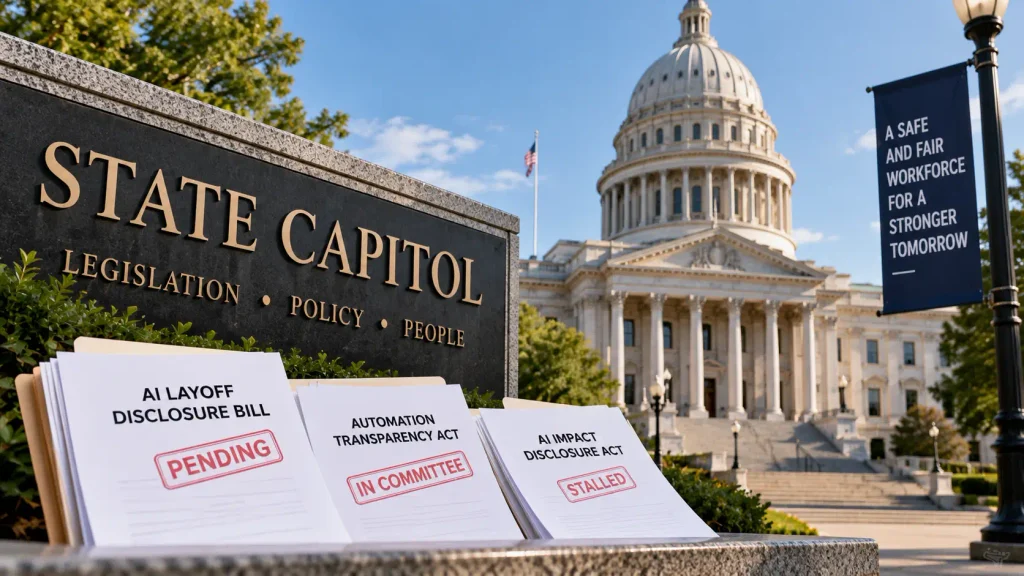
Senate Bill 951 in California would specifically mandate 90 days’ written notice prior to AI-driven layoffs that impact 25 or more employees. This is a stricter and more stringent requirement than any currently in place. That bill is not yet a law because it has stalled in the state Assembly as of this year. The No Robot Bosses Act, a federal proposal that is still pending in Congress, would mandate human oversight whenever AI tools are used in employment decisions, including layoffs. At least seven states have introduced similar AI employment disclosure laws this legislative session, but none of them have been passed to date. Colorado’s The AI governance law was supposed to go into effect in the middle of 2026, but it was delayed until January 2027 and replaced with a more restrictive, disclosure-only version that would only be enforced by the state attorney general and would not allow individual employees to file direct lawsuits.
In a separate move, House Democrats proposed the Fair Warning Act, which would amend the federal WARN Act for the first time since it was first enacted and include new clauses pertaining to short-term compensation plans and temporary layoffs. Additionally, that bill has not been passed.
What This Means if You Are Facing an AI-Related Layoff
The fundamental protection of the WARN Act—the 60-day notice period when applicable—applies whether your employer uses AI, restructuring, or any other reason for a layoff. Because state-level protections differ greatly, the size of your employer, whether the layoff is structured in a way that triggers the law, and which state you work in will all determine whether you actually receive that notice. It is worthwhile to check both the federal WARN law and the mini WARN law in your particular state if you think your employer neglected to provide a required notice. This is because state versions of the law may offer more protection or a lower threshold for coverage than the federal law alone.
Frequently Asked Questions About AI Layoffs and the WARN Act
Does the WARN Act require my employer to tell me AI caused my layoff?
No. The law does not require revealing the precise underlying business reason, such as the adoption of AI, but it does require notice regarding the timing and nature of the layoff itself.
How much notice does the WARN Act actually require?
Before a covered mass layoff or plant closure, covered employers with 100 or more workers are typically required to give 60 calendar days’ written notice.
Are part time workers covered under the WARN Act?
Not entirely. The 100 employee threshold that sets off the law does not apply to workers who put in less than 20 hours per week or who were employed for fewer than six of the previous twelve months.
Has any state passed a law requiring companies to disclose AI as a layoff reason?
Not just yet. California’s SB 951, which would mandate 90 days’ notice for layoffs of 25 or more employees due to AI, has stalled in the state Assembly.
A federal bill would mandate human supervision when AI tools are used to make employment decisions, including layoffs. It has not been passed by Congress and is still pending.
What can I do if my employer skipped required WARN notice?
You might be eligible for benefits and back pay for the time you were supposed to receive notice. WARN claims are frequently brought as class actions and are filed directly in federal court.
Do all states have the same layoff notice protections?
No. States with their own mini WARN laws, such as California, New York, New Jersey, Illinois, Maryland, Delaware, and Ohio, can provide more protection than the federal law alone.
[…] Blame AI for Layoffs AI has been cited by tech companies […]
[…] Blame AI for Layoffs AI has been cited by tech companies […]
[…] Blame AI for Layoffs AI has been cited by tech companies […]
[…] Blame AI for Layoffs AI has been cited by tech companies […]
[…] Blame AI for Layoffs AI has been cited by tech companies […]
[…] Blame AI for Layoffs AI has been cited by tech companies […]
[…] Blame AI for Layoffs AI has been cited by tech companies […]
[…] Blame AI for Layoffs AI has been cited by tech companies […]
[…] Blame AI for Layoffs AI has been cited by tech companies […]
[…] Blame AI for Layoffs AI has been cited by tech companies […]
[…] Blame AI for Layoffs AI has been cited by tech companies […]
[…] Blame AI for Layoffs AI has been cited by tech companies […]
[…] Blame AI for Layoffs AI has been cited by tech companies […]
[…] Blame AI for Layoffs AI has been cited by tech companies […]
[…] Blame AI for Layoffs AI has been cited by tech companies […]
[…] Blame AI for Layoffs AI has been cited by tech companies […]
[…] Blame AI for Layoffs AI has been cited by tech companies […]
[…] Blame AI for Layoffs AI has been cited by tech companies […]
[…] Blame AI for Layoffs AI has been cited by tech companies […]