
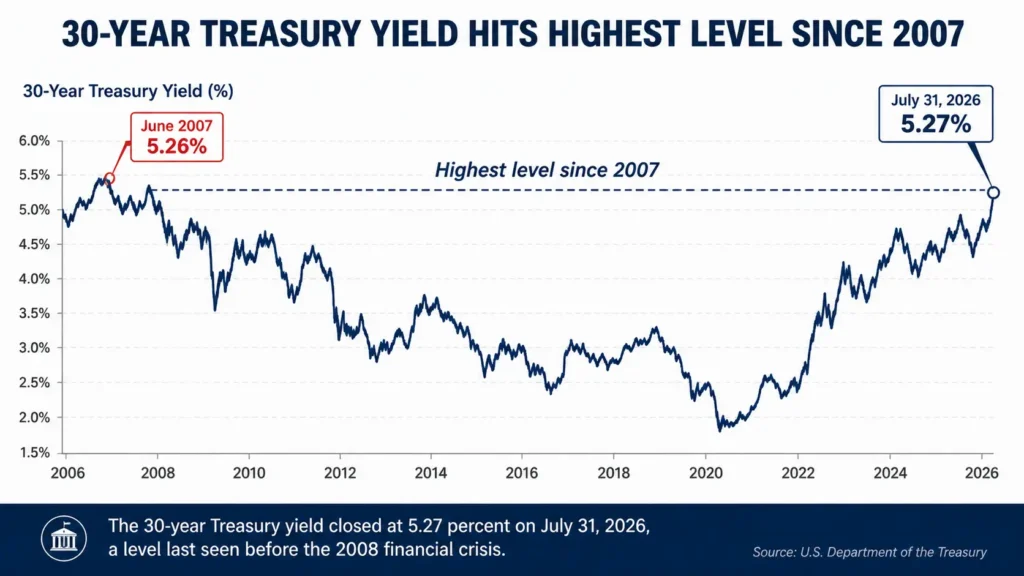
Short-term interest rates have been lowered by the Federal Reserve. The general consensus was that this would eventually result in lower borrowing costs overall. Rather, on July 31, 2026, the yield on a 30-year Treasury bond closed at 5.27 percent, a level not seen since 2007, just prior to the financial crisis. This explains why your 401(k) bond fund or mortgage quote do not appear to be following the Fed’s lead.
What actually happened
According to Chase’s own market commentary, the 30-year Treasury yield increased above 5 percent twice this year, in May and July. Long-term government borrowing costs are at their highest level since before the 2008 financial crisis. In early August, the yield on a 10-year Treasury bond, which is even more crucial for mortgage pricing, was at 4.7%.
The Fed’s rate hikes prevented this from happening. The Fed cut them, but it still happened in large part. The Fed cut its benchmark rate by three quarters of a percentage point in 2025. In any case, long-term yields went in the opposite direction.
Why the Fed cutting rates did not bring long term rates down

The rate that banks charge one another overnight for short-term borrowing is directly controlled by the Fed. Investors’ demands to lend the government money for ten, twenty, or thirty years are not directly under its control. Supply, demand, and investors’ desire for additional compensation for the risk of holding debt for such a long time determine those longer rates.
Investors are currently requesting more of that additional compensation, which bond markets refer to as a term premium. It is being driven by a few forces. As the national debt increases, the federal government’s borrowing requirements continue to rise, necessitating the purchase of more long-term bonds. Even tho inflation expectations have improved from their lowest points, investors’ concerns about locking in a fixed rate for thirty years have not entirely subsided. Additionally, demand from long-term buyers who have historically been dependable, such as some foreign central banks, has become less consistent.
As a result, the difference between the long-term rates that the market determines on its own and the short-term rates that the Fed sets is larger than usual.
What this means for your mortgage

Compared to the Fed’s benchmark rate, mortgage rates closely follow the yield on a 10-year Treasury. According to Freddie Mac’s weekly survey data, the 30-year fixed mortgage rate has remained stable at 6.7 percent for the majority of this year despite the Fed’s cuts.
Additionally, there is a growing gap that is important to be aware of. The yield on a 30-year fixed mortgage has historically been roughly 1.5 percentage points higher than that of a 10-year Treasury bond. According to tracking from the real estate research publication First Tuesday Journal, that spread is currently closer to two percentage points. Mortgage rates have felt stubborn even during times when Treasury yields have slightly decreased because of this additional gap, which reflects lenders pricing in additional risk and uncertainty on top of already high Treasury yields.
The majority of forecasts for the remainder of 2026 predict that this will continue rather than swiftly reverse. The Mortgage Bankers Association predicted that 30-year mortgage rates would remain close to 6.5 percent thru 2027 and 2028, while Fannie Mae’s June 2026 forecast predicted that rates would remain around 6.4 percent thru the end of the year more info about these artical visit our official blogspot proile
What this means for savings accounts and CDs
The Fed’s cuts have had a more direct effect on savings account and CD rates because they are more directly correlated with the Fed’s short-term rate than with the yield on a 30-year Treasury. This indicates that the same environment that is causing mortgage rates to remain stubborn is also progressively causing savings product yields to decline, creating a squeeze in both directions. While a new mortgage is not, anyone locking in a new CD is likely to find rates slightly lower than they were a year ago.
What this means for your 401k
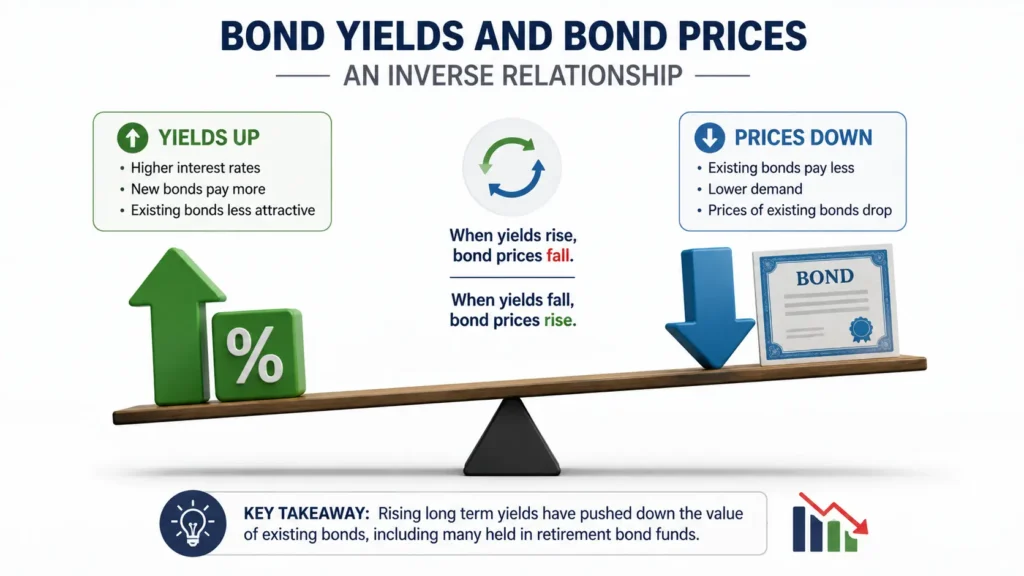
Bond prices fluctuate in opposition to yields. Existing long-term bonds lose value when long-term yields rise as they have this year because new bonds are now paying more, making older, lower-paying bonds less appealing in comparison. Over the past few months, anyone who owns a target date fund with significant bond exposure, a long-term Treasury fund, or a total bond market fund has probably experienced some of that pressure.
Bond funds are not a bad investment because of this. Bond funds typically profit from the same relationship in reverse once yields stabilize or eventually decline. It does indicate that bond-focused portions of retirement portfolios have recently faced a headwind rather than a tailwind due to the rising yield environment.
What to actually do with this information
The relationship between the Fed’s rate cuts and mortgage rates has been weak this year, and most forecasts predict that rates will remain in a similar range thru 2026 and into 2027. Therefore, if you are looking for a mortgage, don’t wait for the Fed’s rate cuts to translate into significantly lower mortgage rates on their own.
When deciding between a fixed rate mortgage and an adjustable rate mortgage, keep in mind that some borrowers find ARMs to be more competitive due to the wider than usual gap between Treasury yields and fixed mortgage rates. However, ARMs still carry some risk in the event that rates rise in the future.
If you have bond funds in a retirement account, be aware that recent volatility is related to this same yield move and does not necessarily indicate a problem with the fund.
What happens next
How investors interpret the government’s borrowing trajectory and inflation trends in the upcoming months will have a significant impact on whether the 30-year yield continues to rise, stays close to current levels, or declines. The 10-year Treasury yield is expected to settle closer to 4.1 percent by the end of 2026, according to the Congressional Budget Office. However, actual market yields have been exceeding that estimate for the majority of the year, serving as a reminder that official forecasts and current market pricing do not always coincide.
FAQs
Why did the 30 year Treasury yield hit its highest level since 2007?
30 year Treasury yield Growing federal borrowing needs, persistent inflation concerns, and less consistent demand from some traditional long-term buyers are all contributing factors to investors’ demands for higher compensation, or a term premium, for holding long-term government debt.
If the Fed is cutting rates, why are mortgage rates still high?
Compared to the Fed’s short-term benchmark rate, mortgage rates closely follow the yield on a 10-year Treasury. Mortgage rates have remained high because long-term yields have increased while the Fed has lowered short-term rates.
Does a rising 30 year Treasury yield affect my savings account?
Not directly. Fed rate cuts have a greater impact on savings accounts and CDs than on the rising long-term Treasury yield because they track short-term rates more closely.
How does this affect my 401k if I hold bond funds?
Bond funds, especially long-term Treasury funds, have probably recently experienced some pressure due to this yield move because rising long-term yields drive down the price of existing bonds.
Will mortgage rates come down later in 2026?
30 year Treasury yield Instead of sharply declining, the majority of current forecasts, including those from Fannie Mae and the Mortgage Bankers Association, predict that 30-year mortgage rates will remain in a similar range throughout the remainder of 2026 and into 2027.
What is a term premium in simple terms?
In addition to what they anticipate from inflation and short-term rate fluctuations, it is the additional return that investors require for taking on the risk of making long-term loans. One of the main causes of this year’s increase in long-term yields is a growing term premium.
Should I choose an adjustable rate mortgage instead of a fixed rate right now?
30 year Treasury yield Your personal risk tolerance and timeframe will determine that. ARMs are comparatively more affordable for some borrowers due to the exceptionally large difference between Treasury yields and fixed mortgage rates, but there is a chance that their payments will increase if rates rise in the future.