
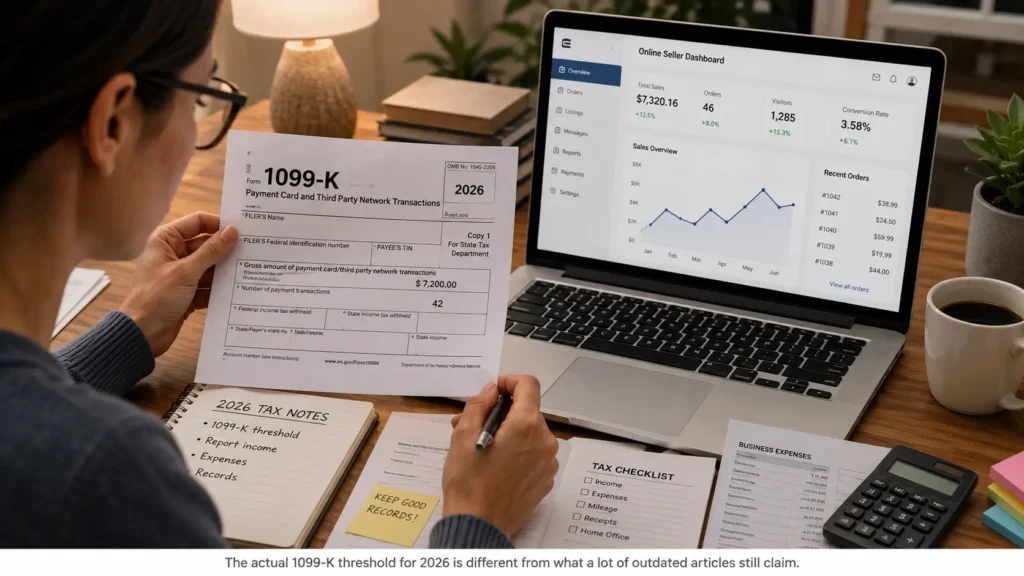
If you sell things online or get paid through Venmo, PayPal, or a similar app, you have probably come across at least three different numbers claiming to be the current 1099-K threshold. Some say 600 dollars. Some say 2,000. Some say 20,000. Only one of those is actually correct for the form that matters most to casual sellers, and the confusion comes from real changes to a different tax form getting mixed in with it.
The actual rule for Form 1099-K
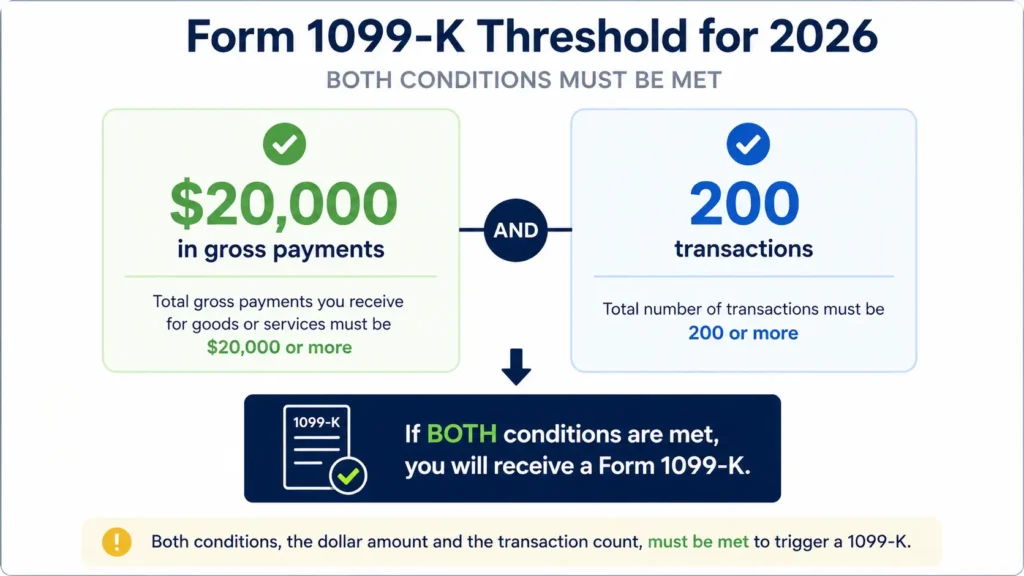
For tax year 2025, the return most people file in 2026, and for every year after that, a payment app or online marketplace only has to send you a Form 1099-K if you received more than 20,000 dollars in payments for goods or services and had more than 200 transactions in a calendar year. Both conditions have to be true. Someone with 50,000 dollars in sales spread across 150 transactions does not trigger the form. Someone with 500 small transactions totaling 9,000 dollars does not trigger it either.
This is the original threshold that applied for over a decade before 2021, and it is back in place permanently under Section 70432 of the One Big Beautiful Bill Act, which President Trump signed on July 4, 2025. That law repealed a much lower threshold that had been scheduled to phase in and specifically restored the original 20,000 dollar, 200 transaction rule, applying it retroactively to the 2025 tax year and removing the scheduled step down that a lot of older articles still describe as coming.
Why so much content out there still says something different
For a few years starting in 2021, there was genuine reason for confusion, because the rule really was scheduled to change. The American Rescue Plan Act dropped the threshold all the way to 600 dollars with no transaction minimum at all. The IRS delayed that change multiple times, first pushing it to 2024 with a temporary 5,000 dollar threshold, and further delays after that. A lot of articles written during that multi year stretch of delays and revised plans are still online, and search engines do not always surface the most current version first. That is the root of most of the wrong information still circulating.
The separate change that actually is real for 2026
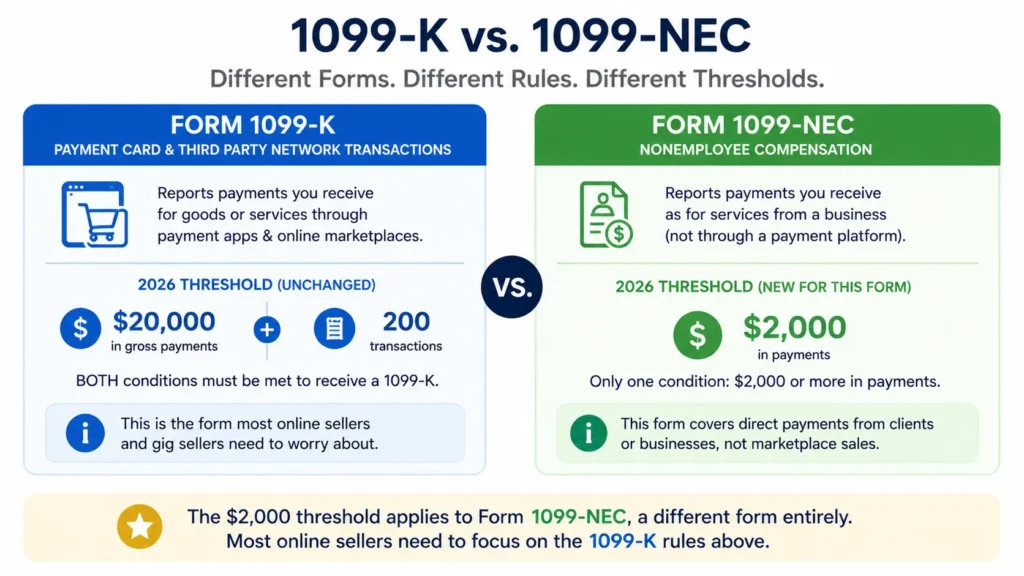
Here is where the genuine confusion comes in, because there is a real threshold change taking effect in 2026, just not for Form 1099-K. Starting with payments made in 2026, the threshold for Form 1099-NEC and Form 1099-MISC is rising from 600 dollars to 2,000 dollars. Those forms cover a different situation entirely, direct payments a business makes to an independent contractor or freelancer, not payments processed through a third party app or marketplace. Starting in 2027, that 2,000 dollar figure will adjust annually for inflation.
If you are a freelancer who gets paid directly by a client through a check or direct deposit, this 2,000 dollar threshold is the one that applies to you. If you sell on eBay or get paid through Venmo for goods or services, the 20,000 dollar and 200 transaction rule for Form 1099-K is what applies instead. A lot of the confusing content online blends these two separate changes together as if they were the same update.
What has not changed
Credit and debit card processing sits outside all of this and always has. If a payment is processed through a card network rather than a peer to peer app or marketplace settlement system, a 1099-K is required for any amount at all, even a single cent, with no threshold. This distinction matters for businesses using card readers or point of sale systems, though it rarely affects casual individual sellers directly.
It is also worth remembering something that has never changed regardless of any threshold. Not receiving a 1099-K does not mean income is tax free. The form is an informational document the IRS uses to cross check reported income. Your obligation to report taxable income exists independently of whether a form shows up in your inbox or mailbox.
What to actually check for your own situation
1099-K Threshold 2026 If you sell casually and stay under both 20,000 dollars and 200 transactions on a single platform in a calendar year, you should not receive a 1099-K from that platform under the federal rule. If you are close to either number, it is worth checking your account’s transaction history directly rather than guessing, since platforms track this automatically and can usually show you where you stand.
One genuine wrinkle worth knowing is that some states set their own, lower 1099-K reporting thresholds for state tax purposes, separate from the federal rule. If your state has a lower threshold, you could still receive a 1099-K even while staying under the federal 20,000 dollar mark. Checking your specific state’s rule directly, or asking the platform you use, is the most reliable way to know for certain, since this varies by state and can change.
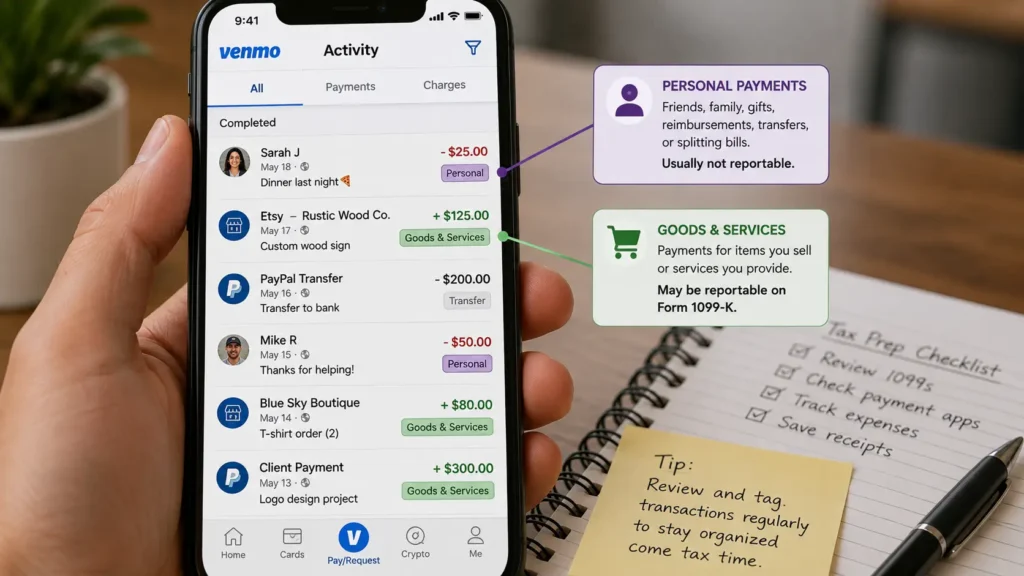
Also double check that any personal payments, splitting a bill, paying back a friend, are correctly tagged as personal or friends and family rather than goods and services in apps like Venmo and PayPal. Only goods and services payments count toward the reporting threshold, and mislabeling a personal payment can create a confusing form for something that was never actually income.
Conclusion
The number that matters for most casual sellers and gig workers using payment apps is 20,000 dollars and 200 transactions, not 600 and not 2,000. That figure is not a temporary phase in step, it is the restored, permanent federal rule as of the 2025 tax year. The 2,000 dollar figure is real, but it belongs to a different form entirely, for direct contractor payments rather than marketplace or payment app sales. Knowing which rule actually applies to your situation is the difference between correctly ignoring outdated warnings and missing a real reporting obligation.
FAQs
What is the actual 1099-K threshold for 2026?
A payment app or marketplace must send you a Form 1099-K only if you received more than 20,000 dollars in payments for goods or services and had more than 200 transactions in a calendar year. Both conditions must be met.
Is the 1099-K threshold really dropping to 600 dollars in 2026?
No. That lower threshold was scheduled under a 2021 law but was repealed by the One Big Beautiful Bill Act in July 2025, which permanently restored the original 20,000 dollar and 200 transaction threshold.
What is the 2,000 dollar threshold I keep seeing then?
That applies to a different form, 1099-NEC and 1099-MISC, used for direct payments a business makes to an independent contractor or freelancer, not for payments processed through apps like Venmo or PayPal or marketplaces like eBay.
Will I owe taxes on income even if I do not receive a 1099-K?
Yes. The form is informational and helps the IRS cross check reported income, but your obligation to report taxable income exists whether or not a 1099-K arrives.
Does selling personal items at a loss count as taxable income?
No. Selling a used personal item for less than you originally paid does not create taxable income, even if the transaction happens to trigger a 1099-K.
Can I still get a 1099-K even if I stay under the federal threshold?
Possibly, if your state sets its own lower reporting threshold for state tax purposes. Checking your specific state’s rule or asking your payment platform directly is the most reliable way to know.
Do personal payments between friends count toward the threshold?
No, as long as they are correctly tagged as personal or friends and family rather than goods and services within the payment app. 1099-K Threshold 2026