
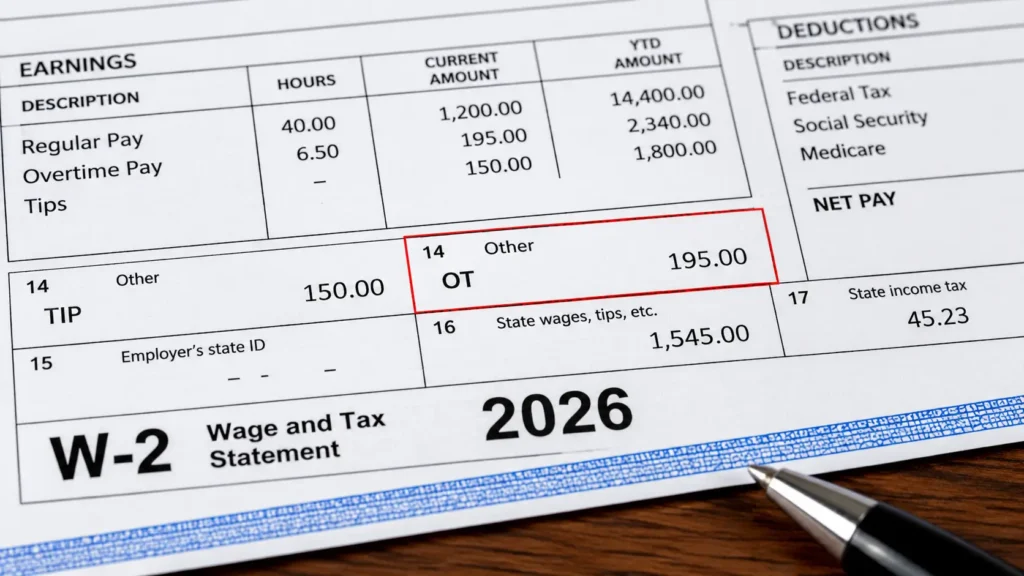
No tax on tips and overtime You have undoubtedly heard the phrase “no tax on tips” or “no tax on overtime” if you work overtime or receive tips. A detailed explanation of how that actually appears on your paycheck and tax return, as well as the reasons why your actual savings may be less than the slogan implies, has been lacking. As recently as August 2026, the IRS released new guidance on this, and before you assume you understand how it operates, there are a few things you should be aware of.
What the deductions actually are
The One Big Beautiful Bill Act, which was signed into law on July 4, 2025, provided these tax breaks. It is important to note that they are federal income tax deductions rather than tax exemptions. Employes who receive tips on a regular basis are eligible to deduct up to $25,000 in qualified tip income from their taxable income. Employes who work qualifying overtime may deduct up to $12,500 if they are filing alone or $25,000 if they are filing jointly. Both deductions are only available for tax years 2025 thru 2028; unless Congress takes action to extend them, they phase out for individuals whose modified adjusted gross income exceeds $150,000 or $300,000 for joint filers.
The overtime detail almost everyone gets wrong

No tax on tips and overtime Many people believe that their overtime pay is now tax-free in its entirety. It isn’t. Only the premium portion of overtime pay—that is, the additional amount above your regular rate that employers are required by federal law to pay for overtime hours—is deductible; the entire overtime paycheck is not. Only the additional $10 per overtime hour, not the full $30, is deductible if your regular rate is $20 per hour and overtime pays time and a half. Since expecting an entire overtime check to be untaxed creates an unpleasant surprise at filing time, the small business advocacy group NFIB has specifically identified this as a point of confusion worth clearing up with employes directly.
What is now showing up on your W-2
The IRS released Notice 2025-69 in November 2025 to clarify how employes could compute their deductions even in the absence of specific reporting fields because W-2 forms for the 2025 tax year did not yet have distinct boxes for this information. That time of transition is now over. According to IRS guidance that was updated as recently as this month, employers must separately report qualified tips using Box 12 code TP and qualified overtime compensation using Box 12 code TT beginning with the 2026 tax year. This explains why your year-end tax documents or pay stub may not look the same as they did the previous year.
What still gets taxed no matter what
FICA taxes, the 7.65 percent combined Social Security and Medicare tax that is deducted from every paycheck regardless of these new provisions, are unaffected by either deduction. FICA continues to deduct from your paycheck as it always has, even if the deduction on your federal income tax return fully covers your tip income. The benefit only appears as a deduction when you actually file your return, not as an instant adjustment to your take-home pay. Regular federal income tax withholding also continues throughout the year.
Whether your job even qualifies
In April 2026, the Treasury Department released a final list of 71 occupations that typically receive tips; only employes in those particular occupations are eligible for the deduction. Only overtime that is actually required by the Fair Labor Standards Act is eligible for the deduction; therefore, some exempt workers who put in extra hours without FLSA overtime protection are not eligible, even if their employer pays them more for those hours.
Why your state might tax this anyway
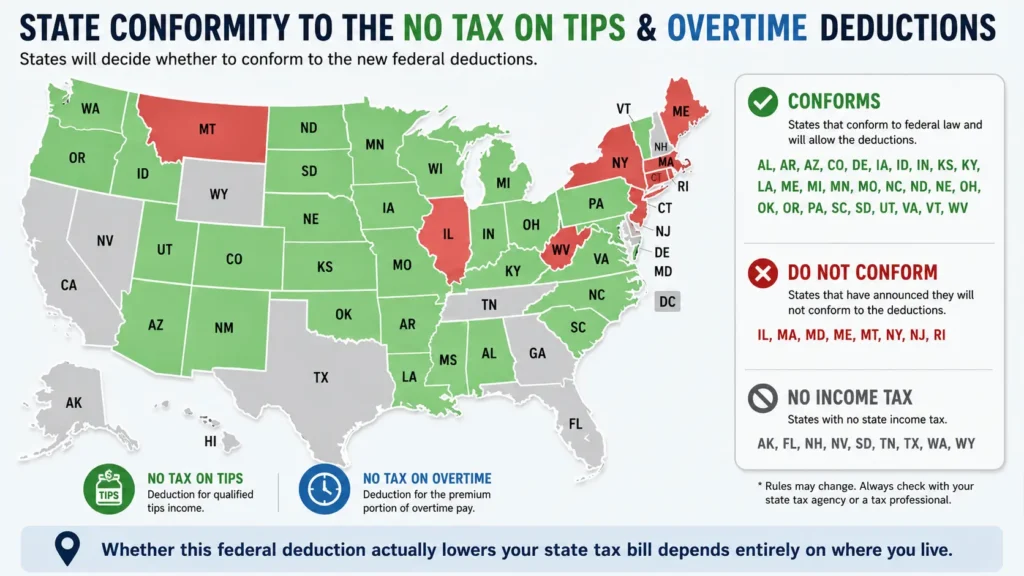
Most people are surprised by this part. Each state is free to choose whether or not to match these federal deductions on its own tax return. Numerous states have opted not to. As of this year, the Associated Press reported that a number of states, including California, New York, and Illinois, do not comply with these federal deductions. As a result, employes in these states are still required to pay full state income tax on tips and overtime earnings even tho the federal government no longer taxes them. Colorado went one step further and actively passed legislation that expressly excluded the overtime provision from state taxable income. According to state officials, this action preserved approximately $119 million in anticipated state revenue.
This state-level question has no bearing on employes in eight states: Alaska, Florida, New Hampshire, Nevada, South Dakota, Tennessee, Texas, and Wyoming. It did not apply retroactively to 2025 income even for residents of a few other states, such as Michigan, Indiana, and Georgia, which passed their own legislation to comply beginning with the 2026 tax year specifically.
This image is still changing. The honest answer to the question of how your particular state handles this income is to check directly with your state’s department of revenue rather than making assumptions based on general reporting, as several states had not yet finalized their positions as of the most recent tracking available. read more of our globle daily news artical on our medium profile
What to actually do with this

Since accurate tracking now makes filing much easier later, check your most recent pay stub or ask your payroll department if qualified tips and overtime are being tracked separately. If you are planning your budget around this deduction, keep in mind that FICA taxes are still due even tho it lowers your taxable income at filing time and does not immediately increase your paycheck. Additionally, make sure your state is in compliance. If you assume your state will automatically match the federal treatment, you may be underpaying state taxes without realizing it.
FAQs
Is my entire overtime paycheck tax free now?
No. The deduction is only available for the premium portion of overtime pay, which is the additional amount above your regular hourly rate mandated by federal overtime law. For those hours, your regular pay is still subject to regular taxation.
What are the new W-2 codes for tips and overtime?
No tax on tips and overtime According to IRS guidelines, qualified tips are reported using Box 12 code TP starting with the 2026 tax year, and qualified overtime compensation is reported using Box 12 code TT.
Do I still pay Social Security and Medicare tax on my tips and overtime?
Indeed. FICA taxes, which are still deducted from tips and overtime income, are unaffected by either deduction.
How much can I actually deduct?
Up to $25,000 in qualified tips and up to $12,500 in qualified overtime if filing alone, or $25,000 if filing jointly; both deductions phase out above $150,000 in modified adjusted gross income, or $300,000 for joint filers.
Does my state also exempt tips and overtime from taxes?
Your state is the only factor that matters. A few states have either never taxed wage income at all or have chosen not to comply with the federal deduction, so you still owe state tax on that income.
How long will these deductions last?
As of right now, they only apply to tax years 2025 thru 2028; further action from Congress would be necessary to extend them beyond that.
Which jobs qualify for the tip deduction?
No tax on tips and overtime The Treasury Department published a list of 71 traditionally tipped jobs in April 2026. Not all jobs that occasionally get tips are covered.
[…] AI Job Loss Statistics 2026 […]