
What actually changed

FICO 10T mortgage The Department of Housing and Urban Development and the Federal Housing Finance Agency announced on April 22, 2026, that FICO 10T and VantageScore 4.0, two more recent credit models, are now authorized for mortgage underwriting in addition to Classic FICO. Lenders are free to select the model that has been approved. While it is still available, classic FICO is no longer the only choice.
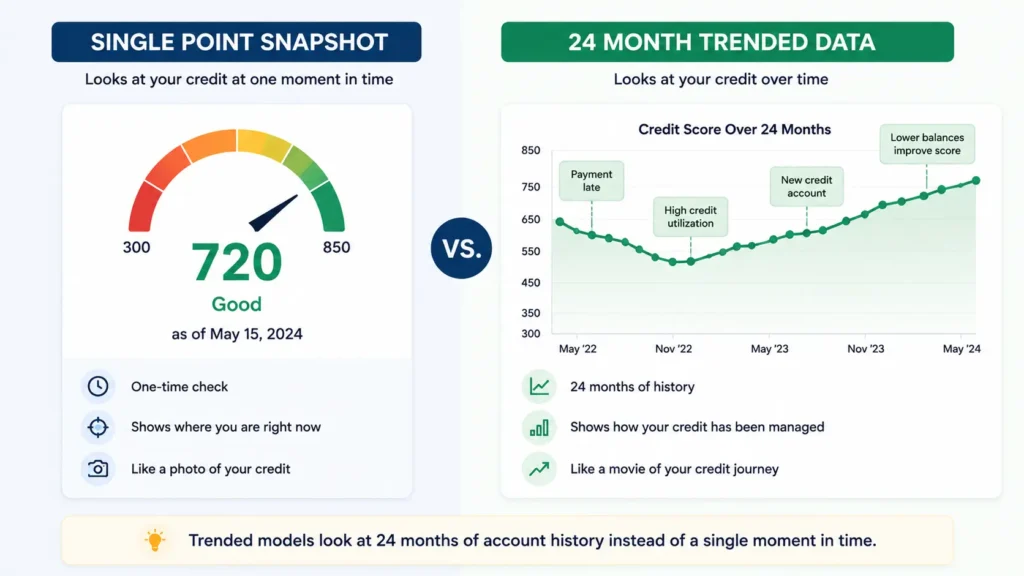
What these new models really consider is the greater change. Classic FICO assesses your credit at a single moment in time, taking into account your length of credit history, the amount you owe, and whether you have made on-time payments. It doesn’t indicate direction. VantageScore and FICO 10T 4.0 both make use of what’s known as trended data, which means that instead of focusing on a single snapshot, they examine 24 months of account history. Even if both people owe the same amount today, a person who carries a balance but has been paying it down steadily appears differently under a trended model than someone whose balance keeps rising.
Why lenders have been slow to switch until now
In fact, FHFA validated FICO 10T back in 2022. Since then, data rather than policy has caused the delay. Before using the new model to make loan decisions, lenders needed to know how it would perform in comparison to the previous model. On July 1, 2026, Fannie Mae released the historical FICO 10T data and additional VantageScore 4.0 data for loans obtained between April 2013 and September 2025. As a result of that release, more lenders are now able to use FICO 10T thru what Fannie Mae refers to as a limited rollout, which is intended to test system readiness prior to wider availability.
VantageScore 4.0 has an advantage. Lenders selling loans to Fannie Mae and Freddie Mac have had access to it since FHFA authorized it for immediate use in July 2025.
Who this could help

In certain circumstances, the models are more lenient. Rent payments and other information that older models frequently completely ignore can be used to score borrowers with thin credit files, or limited credit history. This could make about 5 million more Americans eligible for mortgages, according to an industry estimate cited by mortgage advisory firm UQUAL. However, since this estimate is based on an industry projection rather than a verified government count, it should be treated as an estimate rather than a guaranty.
Self-employed borrowers and those with seasonal or variable income may also benefit because a 24-month trended view provides more context to work with, whereas a single snapshot can make normal income fluctuation appear like financial instability.
In November 2025, Fannie Mae also eliminated its 620 minimum credit score requirement for automated underwriting. This change is independent of the new scoring models and expands the pool of applicants.
What it might mean for your actual score
According to some sources in the mortgage industry, borrowers who have been making regular payments on their balances for the past two years may see significant score increases under a trended model compared to Classic FICO, ranging from 20 to 40 points. Individual results will differ and should not be regarded as a guaranty because that range is based on commentary from the mortgage industry rather than an official FICO or FHFA figure.
It functions in the opposite direction as well. Even tho their current snapshot appears to be fine, someone whose balances have been rising over the last two years might not benefit in the same way because the model is designed to identify that kind of trend.
The timeline is genuinely uneven right now
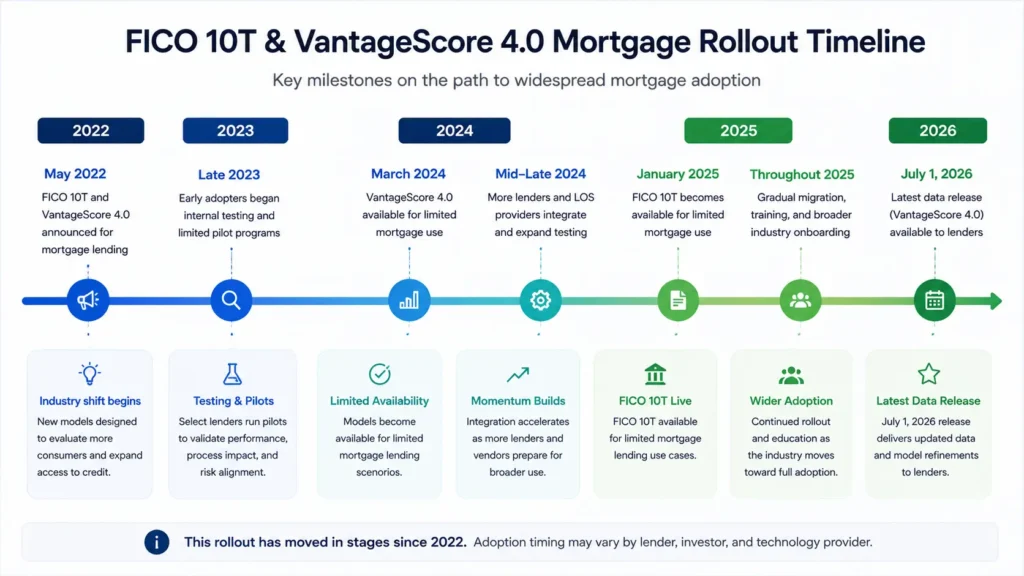
This is the part worth being clear about. Different sources describe different timelines, and that is because the rollout itself is happening unevenly across lenders. Fannie Mae has said its expanded FICO 10T access is a limited rollout meant to confirm operational readiness before wider release. Some mortgage industry blogs have described full GSE implementation as expected by late 2026, with legacy models phased out sometime in 2027, but no federal agency has published a single firm date for full mandatory adoption. HUD has said it plans to adopt both newer models for FHA loans as well, though FHA and VA timelines have lagged behind the conventional mortgage market.
The practical result is that if you apply for a mortgage right now, you genuinely do not know which model you will be scored under unless you ask.
What to actually do with this
Find out directly from your loan officer which credit score model their automated underwriting system is currently utilizing. The model that your particular lender has chosen will apply to you, not some industry average, since lenders are not allowed to combine models within a single application.
Asking a lender who has already implemented FICO 10T or VantageScore 4.0 if your balances have been declining over the previous two years might be worthwhile, especially if your Classic FICO score is barely below the qualifying threshold. Regardless of the scoring model a lender employs, tri-merged credit reports that pull information from all three bureaus are still necessary.
Conclusion
This isn’t some far-off policy modification that’s hidden away in some regulatory document. Less than six weeks have passed since Fannie Mae released the data that lenders require, and lenders are currently actively using it, albeit unevenly, lender by lender. This will probably come up for anyone looking for a mortgage in the coming year, so it’s a good idea to find out which model the lender is using before assuming you know where your application stands.
FAQs
What is the difference between FICO 10T and Classic FICO?
Your credit score is determined all at once by traditional FICO. FICO 10T incorporates trended data, examining 24 months of account history to determine whether your balances and payment habits are getting better or worse rather than just where they are right now.
Is FICO 10T required for all mortgages now?
No. Adoption is taking place on a rolling, lender-by-lender basis. There isn’t a single mandatory national deadline, and while some lenders have adopted it, many haven’t yet.
Will FICO 10T raise or lower my credit score?
Your unique payment history will determine this. Even if their current snapshot appears similar in either scenario, borrowers who have been regularly paying down their balances might see a higher score under a trended model, while borrowers with rising balances might not experience the same benefit.
What is VantageScore 4.0 and how is it different from FICO 10T?
Prior to the wider release of FICO 10T, Fannie Mae and Freddie Mac lenders have had access to VantageScore 4.0, a rival trended data model, since July 2025. Although they are constructed and computed independently, both make use of comparable trended data concepts.
Does this affect FHA and VA loans too?
Although HUD has stated that it plans to implement both of the more recent models for FHA loans, the timeline for FHA and VA has lagged behind the traditional mortgage market, and neither program has a set adoption date.
How do I find out which credit model my lender is using?
Find out directly from your loan officer what model their automated underwriting system is currently using. In a single loan application, lenders are not allowed to combine different scoring models.
Could these new models help me qualify for a mortgage I wouldn’t have qualified for before?
Perhaps, especially if you have inconsistent income or a thin credit file that is poorly represented by a single point in time snapshot. Millions more borrowers may be eligible, according to industry estimates, tho specific results depend on your credit history.
[…] mortgage market trends […]