

Under the GENIUS Act, Congress granted federal regulators until July 18, 2026, to complete the regulations governing stablecoins. There was no completed rulebook when that date arrived. This gap affects you more directly than it might seem if you own USDC, USDT, PayPal’s PYUSD, or any other dollar-pegged token. Regardless of when the other regulations are finalized, it’s important to understand one detail that regulators have already resolved.
What the GENIUS Act Actually Does
The goal of the GENIUS Act, which was passed into law in July 2025, was to provide the US with its first legitimate federal framework for stablecoins. Instead of operating in a gray area, issuers must register as a supervised entity, submit to reserve audits, and back each coin one to one with cash or short-term Treasury bonds. The law assigned the task of creating the actual operating rules that issuers must adhere to to the OCC, the Federal Reserve, the FDIC, and FinCEN.
Earlier this year, those agencies released draft proposals. In June, the OCC submitted a comprehensive plan. FinCEN and the FDIC came next. However, drafts are not final regulations, and there was no coordinated, completed regulation across the agencies as of the July deadline. Many of the remaining proposals have comment periods through late August.
Why the Delay Matters
Why the Delay Matters If agencies fail to meet the deadline, the GENIUS Act does not provide a backup plan. There are no interim guidelines or automatic default rules that take effect. As a result, while the final requirements remain unresolved, issuers and banks are forced to operate under draft language. Since exchanges and banks tend to move in the direction regulators are signaling well before rules are locked in, analysts following the rulemaking anticipate significant pressure to build around September 2026, when noncompliant coins may begin to face pushback from US platforms even without a completed rulebook.
The practical impact is currently less dramatic than it sounds for regular holders. Current stablecoins continue to operate. The degree of certainty regarding their treatment once enforcement actually starts has changed.
The One Rule That Is Already Final: No FDIC Insurance
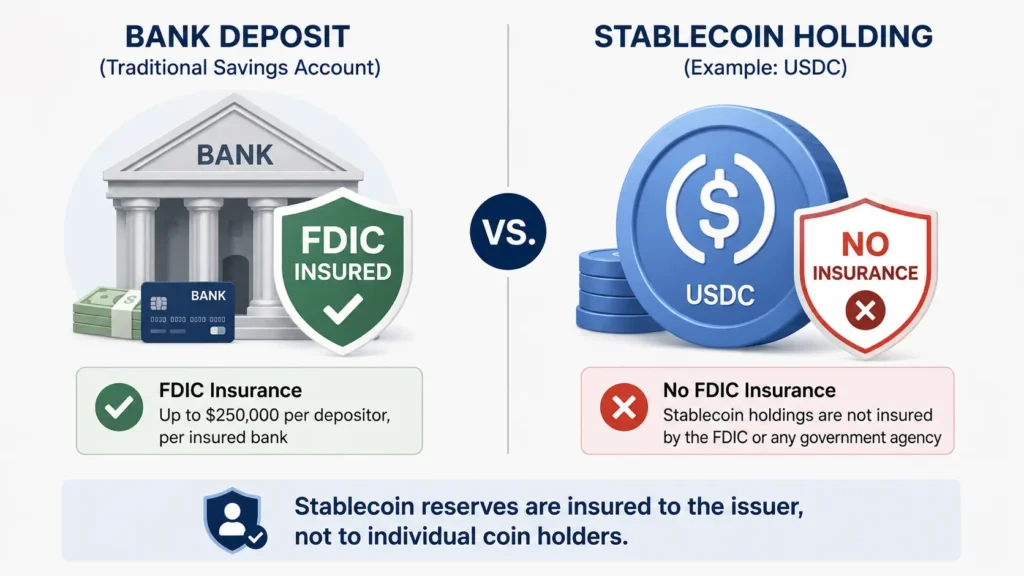
The majority of people make mistakes in this area. Stablecoin holders will not receive any type of deposit insurance, either directly or through pass-through coverage, according to FDIC Chairman Travis Hill.
Money held on your behalf by a broker or fintech app at a bank covered by the FDIC is typically protected by pass-through insurance. Since stablecoin issuers maintain reserves in actual bank accounts, many assumed that something similar would hold true for them. That door was shut by the FDIC. Stablecoin reserve deposits are insured to the issuer as a corporate account rather than to specific coin holders. In contrast to a checking account, you would not receive protection in the event that a bank holding those reserves failed.
The one-to-one reserve requirement is what gives stablecoins their safety net, not any assurance from the government. When it functions as intended, that is a significant form of protection, but it differs significantly from the security provided by a bank deposit.
What This Means If You Hold Stablecoins
All of this does not imply that using stablecoins for their intended use—mostly short-term transfers and payments—is risky. It does indicate a few things that need to be addressed.
Even though the dollar peg makes it feel that way on a daily basis, do not treat a stablecoin balance in a wallet or on an exchange as being equal to cash in a bank account. Know that your protection is based on the issuer’s reserve quality and audits rather than a federal guarantee if you have been holding a significant balance for any amount of time.
Once regulations are finalized, keep an eye on which issuers advance to the stablecoin issuer status that allows payments. In the upcoming months, the market is likely to sort itself around that line because coins linked to that framework will be subject to more stringent oversight than those that are not.
Stablecoins Missed Their Federal Deadline 2026 What Happens Next
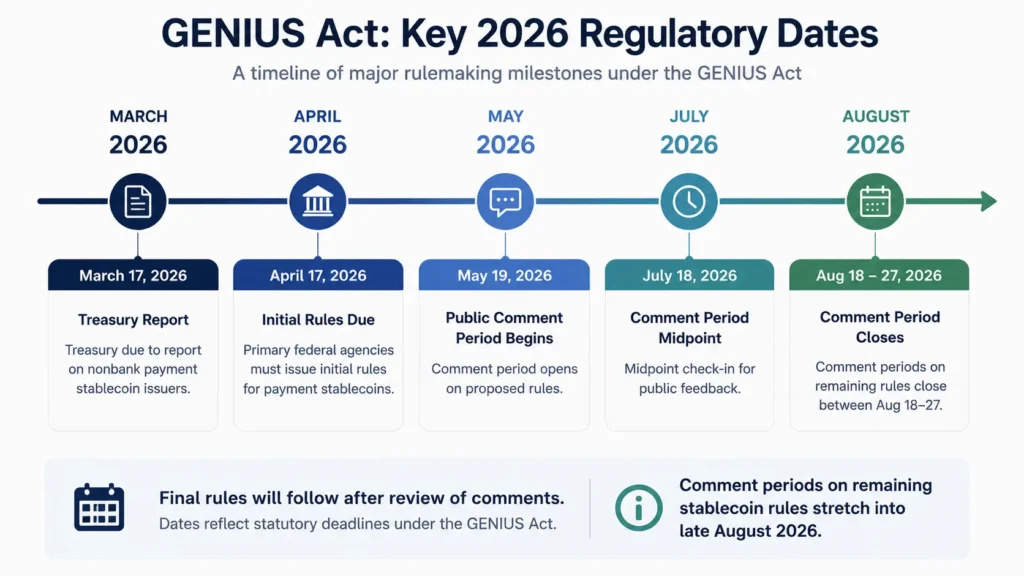
The deadline for comments on the FinCEN and interagency customer identification proposal is August 21, 2026, which is the closest specific date. A comprehensive rulebook won’t be available until agencies have finalized language in a number of overlapping proposals from the FDIC, FinCEN, and OCC. A further slip into the fall is a realistic possibility, though not guaranteed, given that similar multi-agency deadlines under previous financial laws, including Dodd Frank, were regularly missed.
Conclusion
For the average person in Washington, missing a regulatory deadline on a Tuesday typically has no effect. This one is a little different because it directly addresses a real and widespread misconception about the level of protection that stablecoin money truly offers. Eventually, the rules will be completed. The insurance response has already done so.
FAQs
Are stablecoins like USDC or USDT insured by the FDIC?
No. Even if reserves are kept at an insured bank, the FDIC has confirmed that stablecoin holders do not receive deposit insurance, either directly or through pass-through coverage.
What is the GENIUS Act?
The first comprehensive US framework for stablecoins was established by a federal law passed in July 2025 that mandates full reserve backing, audits, and supervised issuer status.
Why did regulators miss the July 2026 deadline?
By the statutory deadline of July 18, 2026, a number of agencies, including the OCC, FDIC, and FinCEN, had released draft regulations, but they had not yet completed a coordinated regulatory package. Several comment periods were still open until late August.
Does this mean my stablecoins are unsafe right now?
Not always. Current stablecoins are still subject to the law’s one-to-one reserve requirement. Rather than an immediate safety failure, the uncertainty relates to the finalized operating rules and long-term enforcement structure.
What happens if a stablecoin issuer’s bank fails?
The standard protection that an individual depositor would anticipate does not automatically transfer to you because reserve deposits are insured to the issuer as a corporate account rather than to individual stablecoin holders.
When will the final stablecoin rules be in place?
There is no confirmed date. The next major milestone is the close of a key comment period on August 21, 2026, after which agencies still need to finalize several overlapping proposals.
Should I stop using stablecoins because of this?
That is a personal choice that depends on your level of risk tolerance. Regardless of how you decide to use them, stablecoin balances should not be regarded as being on par with FDIC-insured bank deposits.