
What Is Inflation? Have you noticed an increase in your grocery bill? Is your rent going up when it renews? It used to cost $4, but now it costs $6. You are directly experiencing inflation. Whether you consider it or not, it influences your income, savings, and investment returns. It’s one of the most discussed and misunderstood concepts in economics.
This guide explains what inflation is, why it occurs, how it is measured, how it has affected actual economies over time, and what you can do about it.
The gradual increase in the average level of prices for goods and services within an economy is known as inflation. Your money becomes less valuable as prices rise. If inflation is on the rise, a hundred dollars today won’t go as far next year. According to data from the Bureau of Labor Statistics, as of June 2026, the annual U.S. inflation rate had cooled from 4.2% in May to 3.5%, its first significant decrease in five months.
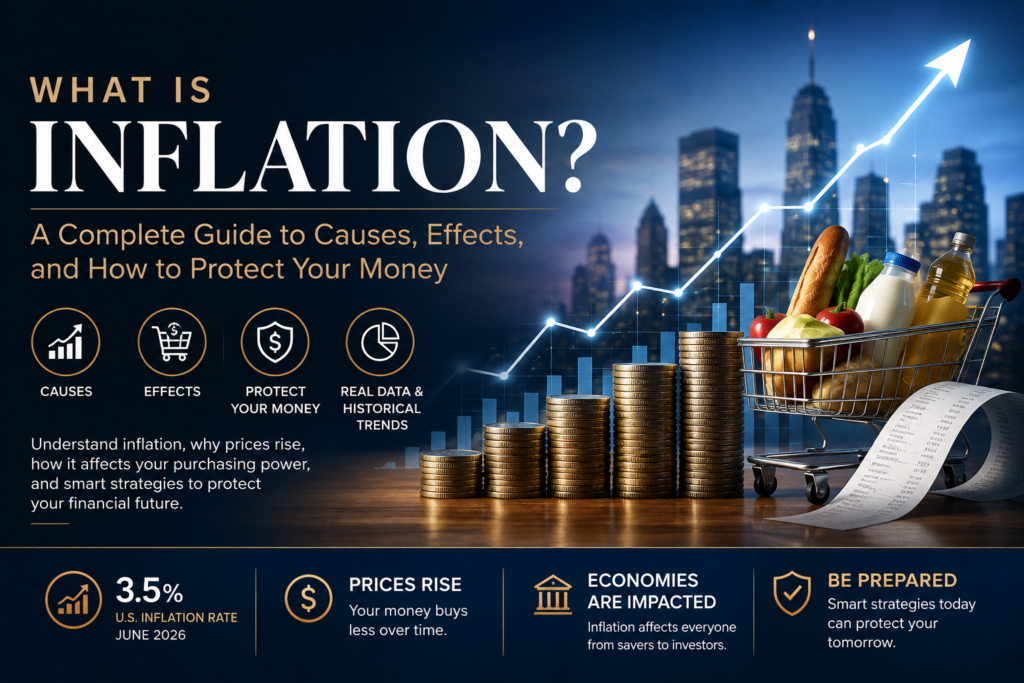
What is inflation, exactly?
The rate at which prices for goods and services increase throughout an economy over time is known as inflation, and it is typically measured annually. A dollar’s purchasing power decreases slightly when inflation is positive. This is referred to by economists as a decrease in purchasing power.
Here’s an easy way to visualize it. These days, a loaf of bread costs $3. The same loaf will probably cost about $3.15 the following year if inflation is 5% for the entire year. Your $3 is still there, but it can no longer purchase the entire loaf. It purchases roughly 95% of it.
On its own, inflation is not a negative thing. In actuality, a modest, consistent, and predictable rate of inflation—roughly the 2% that most central banks strive for—is regarded as healthy. It encourages people to invest and spend instead of hoarding money, and it allows companies to raise wages gradually rather than all at once. When inflation becomes unpredictable, falls into negative territory (deflation), or runs too high, problems arise.
A few terms worth knowing
What your money can truly purchase is known as purchasing power. The most popular indicator of inflation in the United States is the Consumer Price Index, or CPI. Prices for food and energy, which fluctuate greatly, are subtracted from core inflation. The complete, unadjusted figure is headline inflation. Additionally, when you compare “real” and “nominal,” real refers to inflation adjustment, while nominal does not.
How inflation is measured
Central banks and governments monitor inflation by tracking changes in the total cost of a set basket of goods and services over time.
The Consumer Price Index
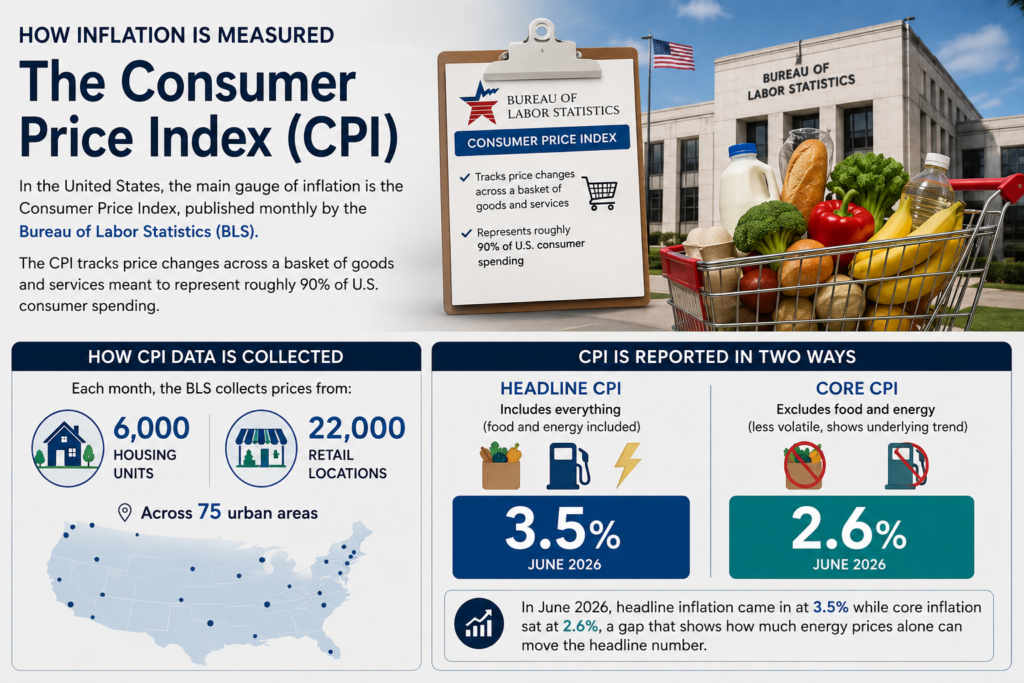
The Consumer Price Index, which is released each month by the Bureau of Labor Statistics, is the primary indicator in the United States. The CPI monitors changes in prices for a variety of goods and services that are intended to account for about 90% of consumer spending in the United States. In order to construct it, the BLS gathers monthly prices from roughly 22,000 retail locations and 6,000 housing units located in 75 urban areas.
The CPI is typically reported in two ways. Food and energy are included in the headline CPI. Food and energy are excluded from Core CPI because they are erratic and can mask the underlying trend. The difference between headline and core inflation in June 2026 was 3.5% and 2.6%, respectively, demonstrating the power of energy prices alone.
| Index | Full name | Who uses it | What makes it different |
| CPI | Consumer Price Index | BLS, the general public, Social Security cost of living adjustments | Fixed basket, the most widely cited number |
| PCE | Personal Consumption Expenditures Price Index | Federal Reserve | Basket adjusts as spending habits shift, this is the Fed’s preferred gauge |
| PPI | Producer Price Index | Businesses and economists | Measures prices at the wholesale level, often moves before CPI does |
| HICP | Harmonized Index of Consumer Prices | European Central Bank | Standardized across every EU member state |
What causes inflation
Economists generally sort the causes of inflation into three buckets.
Demand pull inflation
This occurs when the economy is unable to meet the demand for goods and services. Prices rise when more money chases the same quantity of goods. This is typically accompanied by low unemployment and high consumer spending, government stimulus, low interest rates that make borrowing affordable, and wage growth that exceeds productivity.
Cost push inflation
This occurs when companies pass on rising production costs to their clients. This includes increased labor costs, rising energy and raw material prices, supply chain disruptions (a significant factor from 2021 to 2023), and tariffs on imported goods.
Built in inflation
This one resembles a feedback loop. Businesses raise prices to cover the higher wages, workers demand higher wages to keep up with growing costs, and the cycle continues. Economists frequently frame this in terms of expectations: if consumers think prices will continue to rise, they will act in ways that contribute to the realization of that belief, such as demanding price increases and making purchases sooner rather than later.
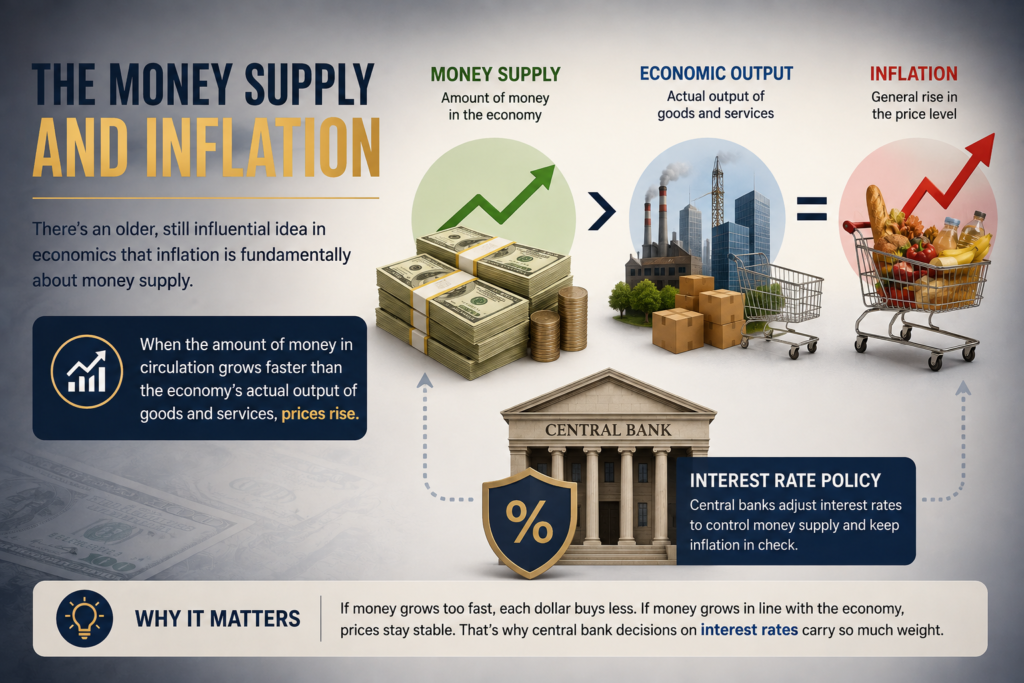
Money supply and inflation
This one is similar to a feedback loop. Workers demand higher wages to keep up with rising costs, businesses raise prices to cover the higher wages, and so on. This is often framed by economists in terms of expectations: if consumers believe that prices will continue to rise, they will take actions that help make that belief a reality, like demanding price increases and making purchases as soon as possible.
How inflation actually affects you
Inflation is more than a headline statistic. It influences actual choices.
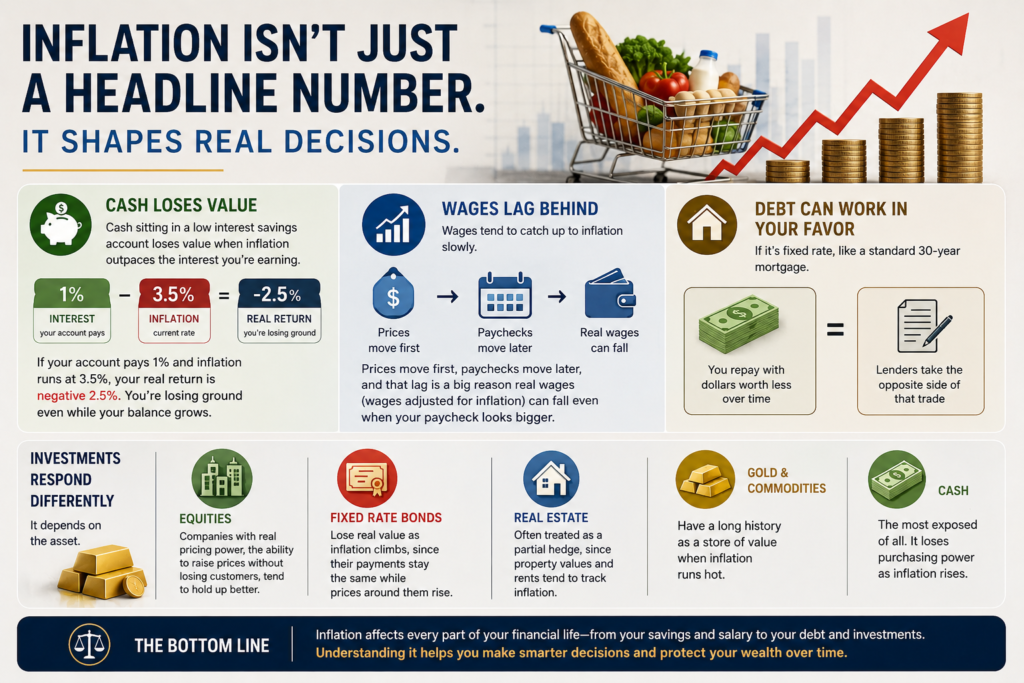
When inflation exceeds the interest you are earning, money in a low-interest savings account loses value. Your real return is negative 2.5% if your account pays 1% and inflation is 3.5%. Even though your balance technically improves, you’re losing ground.
Wages typically take a while to keep up with inflation. Even though your paycheck appears larger on paper, real wages (wages adjusted for inflation) can decline because prices move first and paychecks move later.
If your debt has a fixed rate, such as a typical 30-year mortgage, it actually helps you during inflation. You continue to pay back the loan with money that is worth less than what you borrowed.
Depending on the asset, investments react differently. Businesses that have genuine pricing power—the capacity to increase prices without losing clients—generally fare better. Since their payments remain constant while surrounding prices rise, fixed rate bonds lose real value as inflation rises. Since rents and property values typically follow inflation, real estate is frequently viewed as a partial hedge. Commodities like gold have long been used as a store of value during periods of high inflation. Of all, cash is the most vulnerable.
Where inflation stands right now
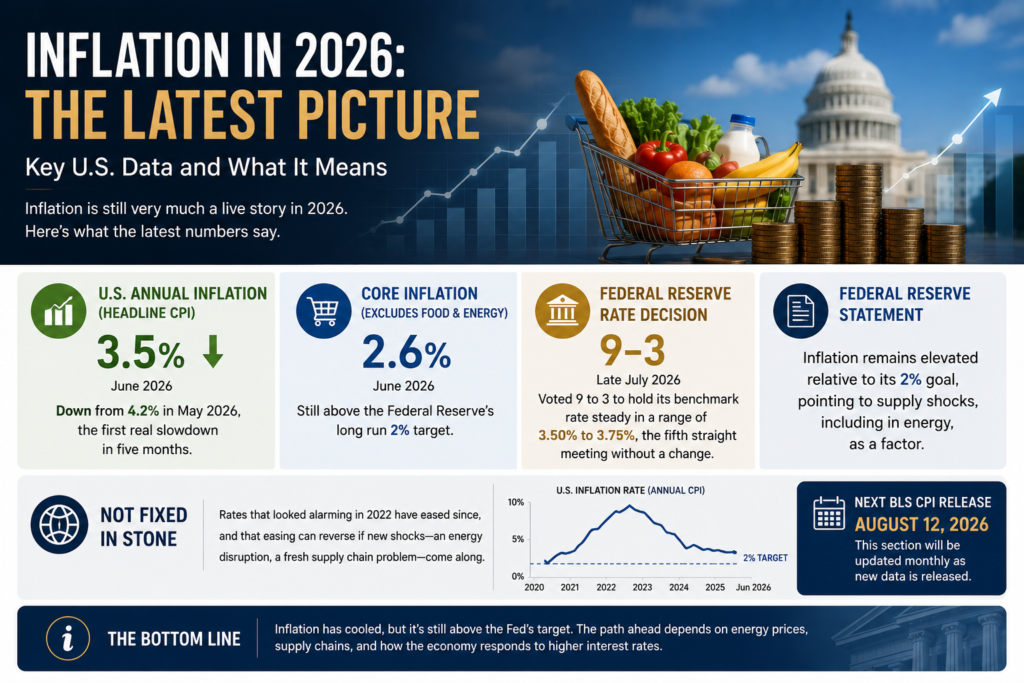
In 2026, inflation is still a hot topic. Using the latest data from the United States:
The first significant slowdown in five months occurred when U.S. annual inflation dropped to 3.5% in June 2026 from 4.2% in May. In June, core inflation—which does not include food and energy—was 2.6%, which is still higher than the Federal Reserve’s long-term 2% target. For the fifth consecutive meeting without a change, the Federal Reserve voted 9 to 3 in late July 2026 to maintain its benchmark rate in the range of 3.50% to 3.75%. According to the Fed’s own statement, supply shocks, including those in the energy sector, are one reason why inflation is still higher than its 2% target.
Nothing about this is set in stone. Rates that appeared concerning in 2022 have since decreased, but this decrease could be reversed if new supply chain issues, energy disruptions, or shocks occur. As new BLS data becomes available, this section should be updated every month; the next release is planned for August 12, 2026.
How central banks try to control inflation
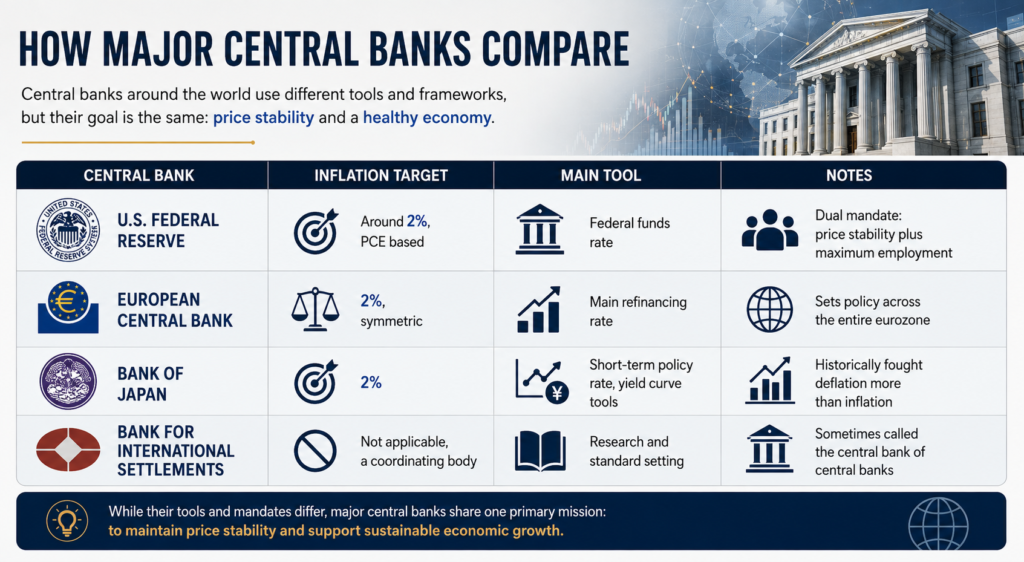
Central banks are the institutions most directly responsible for keeping inflation in check, and interest rates are their main lever.
When inflation runs too hot, central banks raise rates. That makes borrowing more expensive, which cools spending and investment and eases the demand side of the equation. When inflation is too low or the economy is slowing down, they cut rates to encourage borrowing and spending instead.
Central banks also have a second tool: buying or selling government bonds to expand or shrink their balance sheets, known as quantitative easing and quantitative tightening. This influences the broader money supply and longer term interest rates.
How to protect your money from inflation
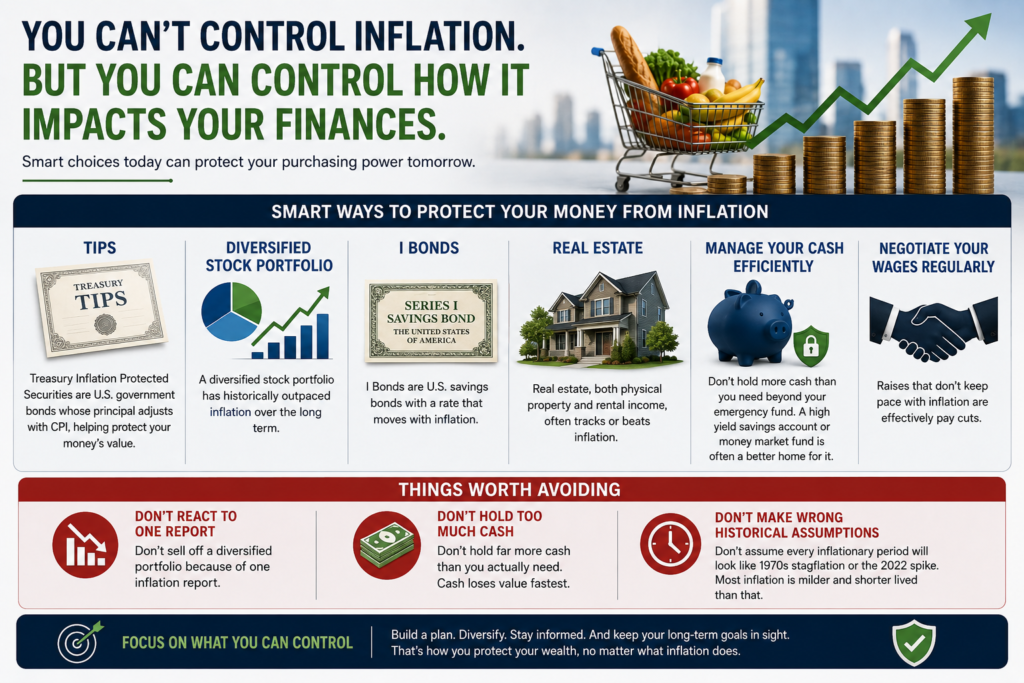
You can’t control inflation. You can position your finances so it hurts less.
Inflation is beyond your control. You can arrange your money to make it less painful.
The principal of US government bonds known as Treasury Inflation Protected Securities, or TIPS, is adjusted in tandem with the CPI. Historically, over extended periods of time, a diversified stock portfolio has outperformed inflation. I Bonds are US savings bonds whose interest rate fluctuates in line with inflation. Real estate, including both tangible assets and rental income, frequently either matches or exceeds inflation. A high yield savings account or money market fund is frequently a better place for money than a low yield account, so it’s worthwhile to check how much cash you have outside of your emergency fund. Regularly negotiating your pay is also important. Pay cuts are essentially raises that don’t keep up with inflation.
A few things to avoid are holding far more cash than you actually need, selling off a diversified portfolio due to a single inflation report, and assuming that every inflationary period will resemble stagflation in the 1970s or the 2022 spike. The majority of inflation is less severe and transient than that.
Common myths about inflation
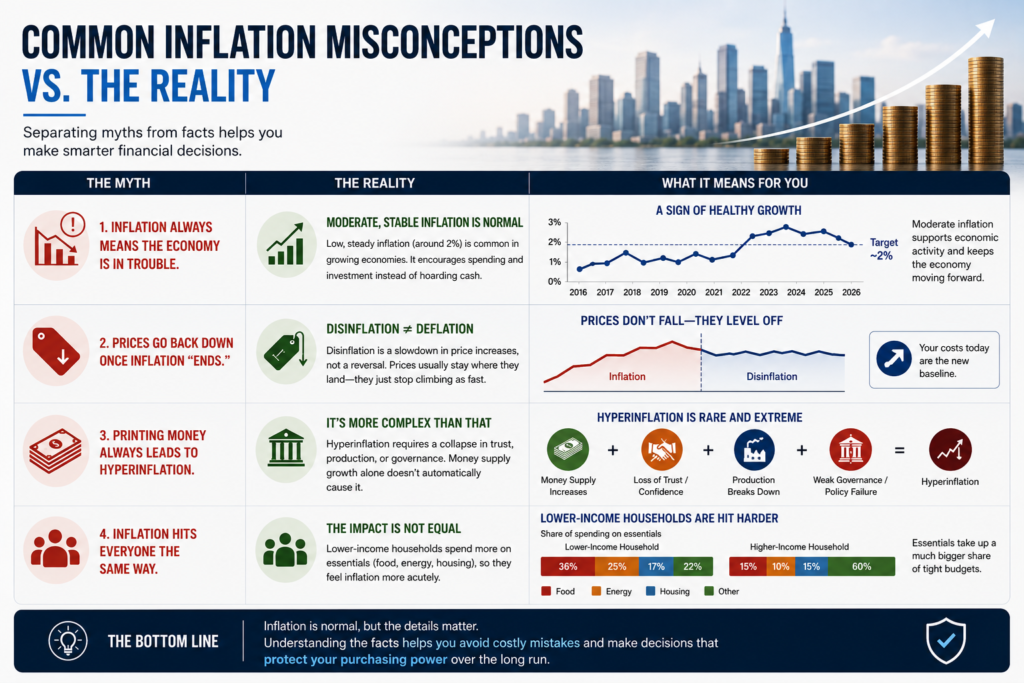
Some people believe that inflation always indicates a problem with the economy. In actuality, stable, moderate inflation is typical and frequently indicates robust growth.
Some believe that once inflation “ends,” prices will decline once more. Typically, they don’t. Deflation, in which prices actually decline, is not the same as disinflation, which is a slowdown in the rate of price increases. Most of the time, prices remain where they are. They simply cease to climb as quickly.
Some people believe that printing money will always result in hyperinflation. Although it is a significant risk factor, historically, hyperinflation also necessitates a breakdown in production, governance, or trust. Growth in the money supply by itself does not always result in it.
Additionally, some believe that everyone is affected by inflation in the same way. It doesn’t. Households with lower incomes typically experience it more because a greater portion of their expenditures go toward basic needs like housing, energy, and food.
Frequently asked questions
To put it simply, The rate at which prices for common goods and services increase over time is known as inflation, and it causes your money to buy slightly less than it did previously.
What leads to an increase in inflation? When demand exceeds supply (demand pull), rising production and energy costs are transferred to consumers (cost push), or expectations of future price increases become self-fulfilling (built in inflation), inflation usually increases.
What rate of inflation is considered healthy? For long-term growth, the majority of major central banks, such as the Federal Reserve and the European Central Bank, strive for an annual inflation rate of about 2%.
How is the rate of inflation calculated? The Consumer Price Index, which monitors price changes across a predetermined basket of goods and services, is most frequently used to measure inflation. Additionally, the Personal Consumption Expenditures Price Index is monitored by the Federal Reserve.
What distinguishes deflation from inflation? A general increase in prices over time is called inflation. A general decline in prices over time is known as deflation. Although deflation may seem positive, it typically indicates low demand, which can result in job losses and decreased investment from businesses.
Is inflation a good or bad thing? The rate determines this. In general, low, steady inflation of about 2% is regarded as healthy. Savings, purchasing power, and economic confidence are all damaged by high or erratic inflation.
Conclusion
The amount that your paycheck can cover, the true value of your savings, and the investments that make sense at any given time are all influenced by inflation. Although you have no control over it, knowing how it functions, what motivates it, and how central banks react to it allows you to prepare rather than be caught off guard.
In summary, moderate inflation is normal, even healthy, and what separates those who maintain their purchasing power from those who watch it disappear without realizing it is knowing enough to make the necessary adjustments to your investments and savings.
Good job
thanks