
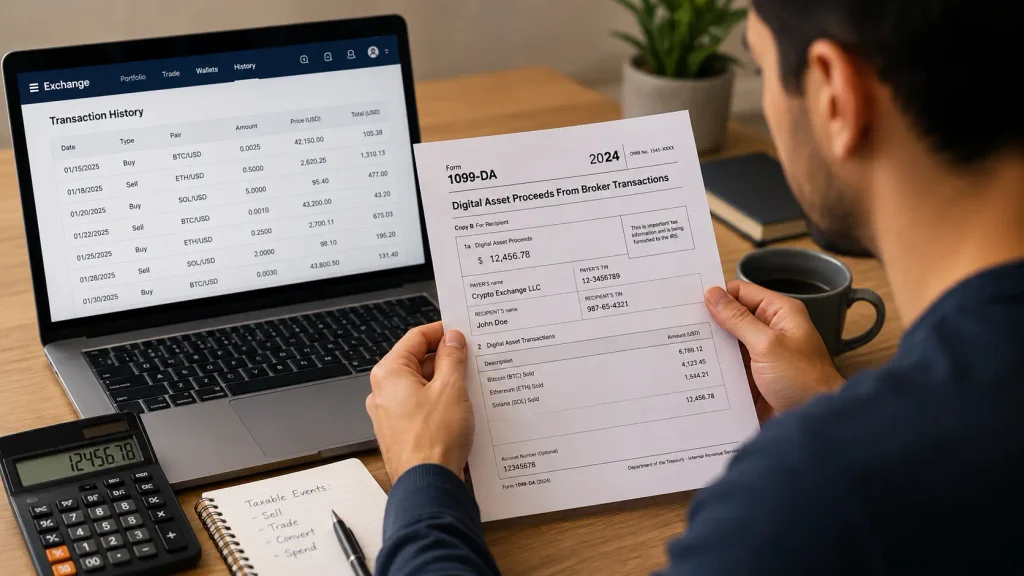
A new tax form for cryptocurrency traders first appeared in your inbox this year, and a second, more significant version is currently being developed based on how you manage your cryptocurrency for the remainder of 2026. If the timing is off, the IRS may see a sale with no purchase cost at all, which could appear to be taxable profit in its entirety.
What Is Form 1099-DA?
Digital Asset Proceeds, Form 1099-DA The IRS’s first standardized tax form created especially for cryptocurrency comes from Broker Transactions. It works similarly to Form 1099-B, which stock brokerages have been using for decades. Instead of relying solely on self-reporting, it requires brokers to report your transactions directly to the IRS. These forms, which cover 2025 transactions, were first released by major exchanges like Coinbase, Kraken, and Crypto.com and delivered by February 2026. There was no cost basis in that initial version, so it only reported gross proceeds—the total amount you received from selling—and no information about the initial payment.
Why 2026 Changes Crypto Tax Reporting
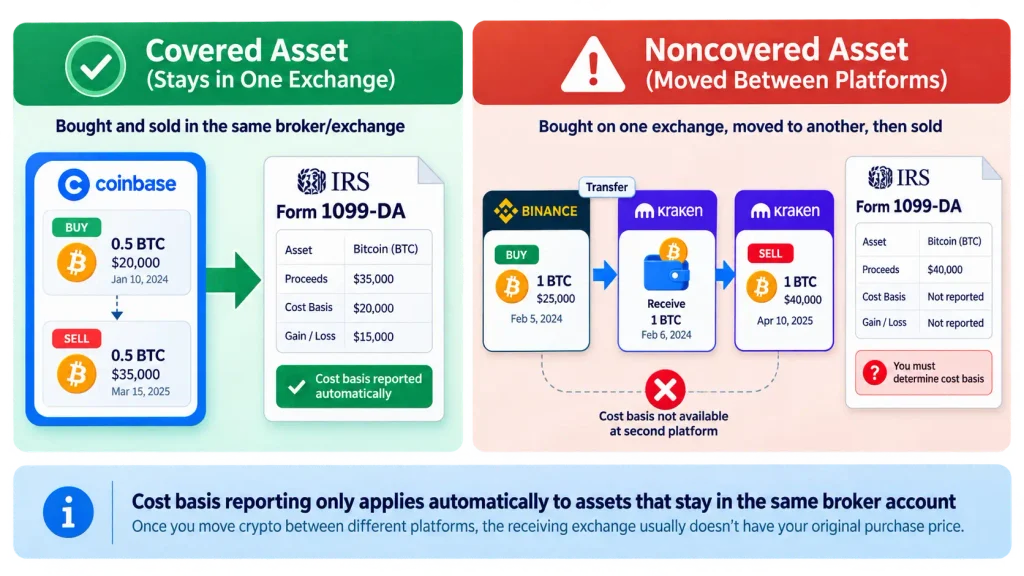
Brokers must include cost basis reporting on the form for transactions made on or after January 1, 2026. The IRS will now be able to see both what you paid and what you sold for instead of just the sale price, which is a huge improvement. The narrow wording of that requirement is the catch. Only covered securities—defined as digital assets purchased on or after January 1, 2026, and held continuously in the same broker’s account until the time of sale—are subject to cost basis reporting under the regulations.
The same treatment is not applied to anything that does not fit that specific definition. You are not covered if you purchased an asset prior to 2026. Even if the asset was purchased after January 1, 2026, it loses its covered status as soon as it is transferred from another exchange or personal wallet. Since the broker frequently lacks a trustworthy method to confirm what you actually paid somewhere else, the broker may still report your gross proceeds when you sell all of these noncovered assets, but without a cost basis attached.
What Is a Covered Digital Asset?
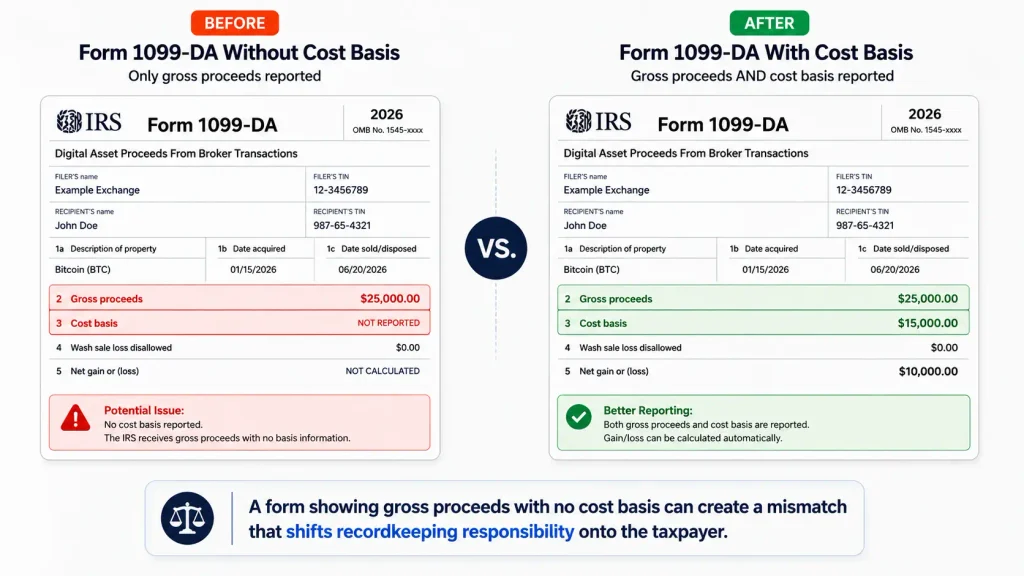
This is the real-world danger. There may be a discrepancy between what you report on your return and what the broker reported to the agency if the IRS receives a report indicating that you received, for instance, $10,000 from a cryptocurrency sale with no cost basis specified. Instead of waiting for a mismatch notice to appear after the fact, tax experts monitoring this issue have specifically cautioned businesses and individual taxpayers to take preventative measures now, before the next filing season starts.
This does not imply that the entire amount will be taxed as pure profit. Because the form itself won’t do that for you in these circumstances, the onus now rests more on you to have your own accurate records proving what you actually paid.
What Is a Noncovered Digital Asset?
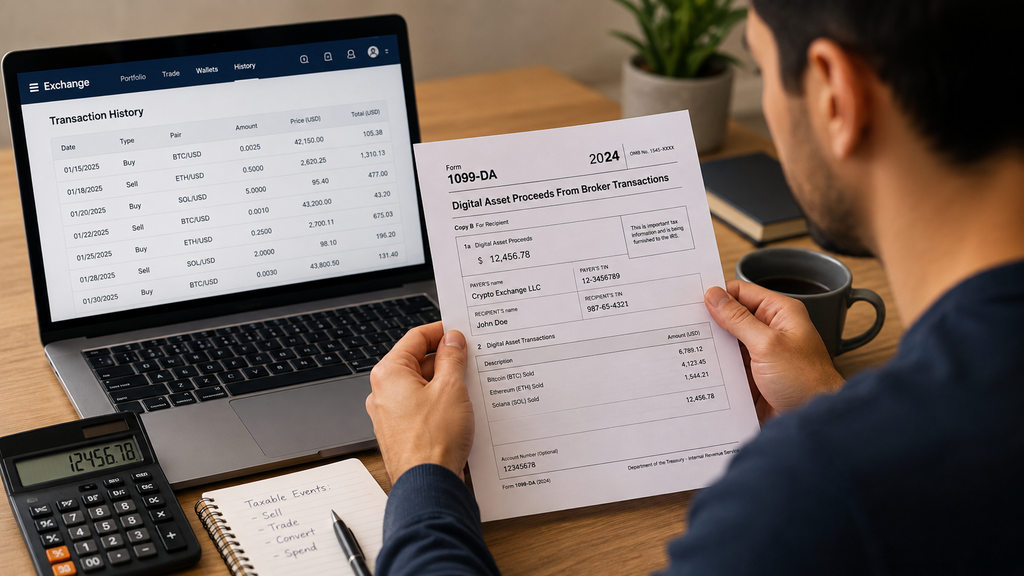
If you intend to sell cryptocurrency that you purchased in 2026, try to keep it in the same exchange account from the time of purchase until the sale. This is because transferring the cryptocurrency to a different platform or self-custody wallet disrupts the covered status that would otherwise ensure automatic cost basis reporting. Instead of assuming the broker’s form will have that information when tax season arrives, start gathering your own transaction records, purchase dates, amounts paid, and platform statements for any cryptocurrency you already owned before 2026 or that you have transferred between wallets and exchanges regardless of when you purchased it.
Since third-party tax software frequently pulls directly from exchange data that should match your own records if you have kept accurate ones, tax professionals who closely monitor this have specifically noted that taxpayers who maintain their own accurate transaction statements can file confidently even when a broker’s form is incomplete.
What happens next
With the 2027 filing season, cost basis reporting is expected to grow even more, encompassing transactions from 2026. This is the first real test of how well the new system performs in real-world scenarios. Gaps between what brokers report and what taxpayers actually owe are likely to reappear this filing season due to the narrow definition of covered assets. Therefore, it is more beneficial to organize your records now, while the tax year is still in effect, rather than after it has ended.
FAQs
What is Form 1099-DA?
Similar to how stock brokerages report trades on Form 1099-B, cryptocurrency brokers and exchanges must use this new IRS tax form to report your sales of digital assets directly to the IRS.
Does the 2025 version of this form include cost basis?
No. Only gross proceeds were reported on the first wave of Form 1099-DA, which covered transactions in 2025. Cost basis information was not included.
What counts as a covered digital asset for cost basis reporting?
Only digital assets that are purchased on or after January 1, 2026, and that are kept in the same broker’s account until they are sold, are eligible for coverage, which means that their cost basis will be automatically reported.
Does moving crypto between exchanges affect my tax reporting?
Indeed. When you transfer an asset to a personal wallet or another exchange, it loses its covered status, so when you sell it, the receiving broker might not have verified the cost basis information.
What should I do if my 1099-DA shows proceeds but no cost basis?
Since accurate personal records can support your filing even in cases where the broker’s form is incomplete, use your own transaction records, including purchase dates and amounts paid, to accurately report your cost basis on your tax return.
When does full cost basis reporting apply to all my crypto transactions?
The current system only guarantees cost basis reporting for assets meeting the covered securities definition. Broader phase in continues through the 2027 filing season for 2026 transactions.
Should I worry about this if I only bought crypto once and never moved it?
Your cost basis should be automatically tracked and reported if you made a purchase after January 1, 2026, and you have kept it in the same broker account throughout. Older holdings and any assets transferred between platforms are primarily at risk.