
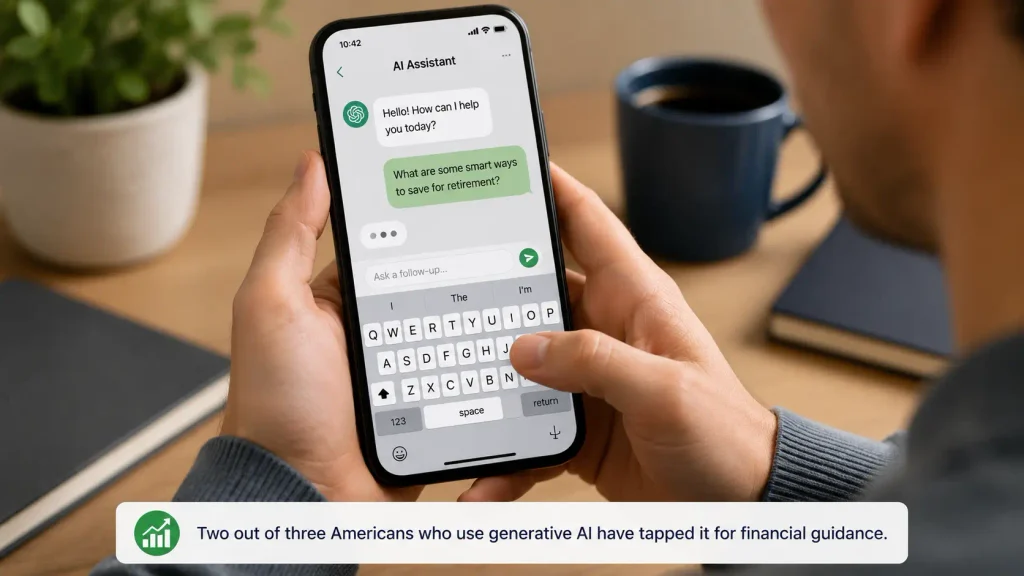
AI financial advice
According to a July CNBC report, two out of every three Americans who have used generative AI have asked it for financial advice; among Millennials and Gen Z, that percentage rises to 82%. The majority of them are unaware that the chatbot responding to their query is not required by law to answer correctly or even to act in their best interests. Although the gap is not new, the way lawmakers and regulators are beginning to address it is, and it is important to comprehend both sides of the issue.
The core problem is not intelligence, it is accountability
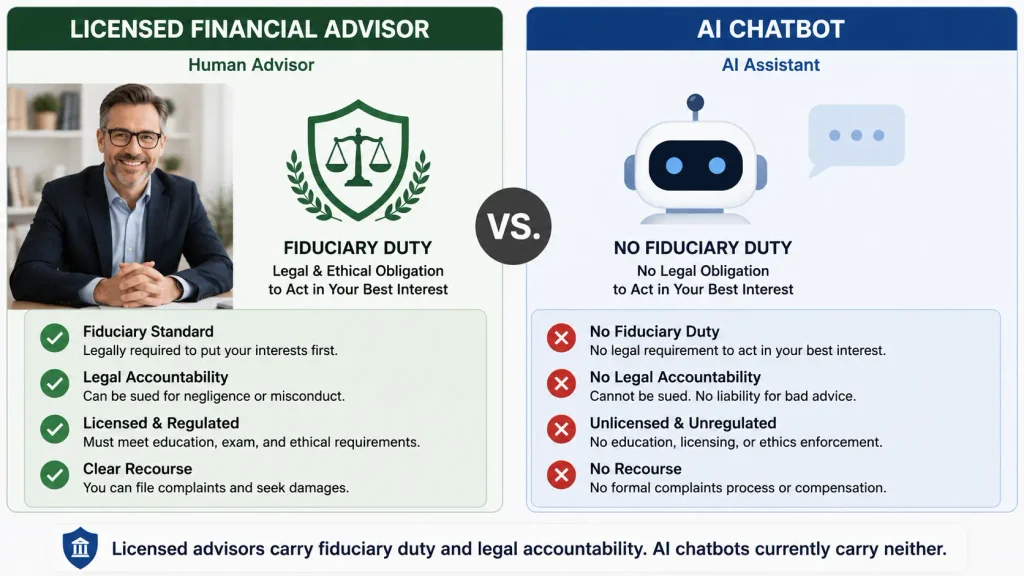
A licensed financial advisor’s fiduciary duty, which is supported by licensing, regulatory oversight, and actual repercussions if they make a mistake, requires them to act in your best interest. None of that is carried by an AI chatbot. In the words of Andrew Lo, a professor of finance at MIT Sloan, “if a large language model gives you poor advice and you wind up worse off financially, there is no legal mechanism that holds it accountable the way there would be with a licensed professional.” There is no official recourse if the advice is blatantly incorrect.
This is also not a risk that is concealed in fine print. In their own terms of service, OpenAI, Google, and Anthropic all make it clear that professional financial, legal, or medical decisions should not be made using their models. Before asking their chatbot if they should change their retirement allocation or refinance a mortgage, the majority of users never read those terms.
The advice itself has measurable problems
This goes beyond a legal nuance. Seven popular generative AI platforms were tested on identical personal finance prompts in a study published in the Journal of Financial Planning in June 2026. The results showed that the recommendations varied significantly across platforms, sometimes even depending on the gender or race of a hypothetical user. According to a different 2024 University of Pennsylvania study, ChatGPT generated erroneous financial data about publicly traded companies approximately 35% of the time when tested; in certain instances, it created fake stock tickers or cited unpublished analyst reports.
An audit by communications firm 5W with Haute Wealth, which tested five major AI engines on high-stakes estate planning questions, provided one particularly tangible example. The AI engines overwhelmingly responded in the affirmative when asked if users should take immediate action to utilize their federal estate tax exemption before it was cut in half, citing a planned sunset at the beginning of 2026. In fact, the One Big Beautiful Bill Act, which was signed in July 2025, had permanently repealed that sunset. The models were presenting out-of-date training data with complete assurance, which is precisely the kind of mistake that could lead someone to make an unnecessary and expensive financial decision.
What is actually changing right now
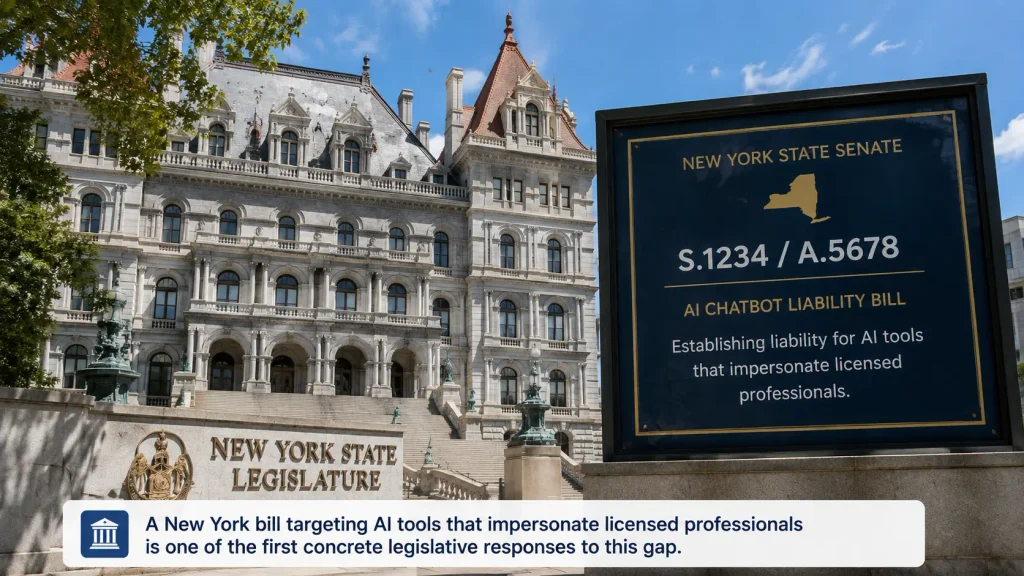
Although the regulatory response has begun, it is limited and proceeding more slowly than the actual adoption of AI. According to Fortune, New York State Senator Kristen Gonzalez introduced what has been called a “Chatbot Liability Bill,” which specifically targets AI tools that pose as licensed professionals. Although its scope is purposefully restricted to that particular impersonation issue rather than a general fiduciary standard for financial advice generated by AI, it is one of the first practical legislative attempts to give this class of tool true accountability.
The situation changed in the other direction at the federal level. The current administration decided not to file an appeal after courts overturned important parts of the Retirement Security Rule, a Biden-era regulation that had strengthened fiduciary protections, particularly with regard to retirement advice. That occurred in early 2026, just as the use of AI-driven financial advice was growing, weakening federal fiduciary protections for retirement advice at a time when more people are using unregulated chatbots for precisely that kind of advice. As of early this year, the SEC had not passed any regulations pertaining to AI specifically for investment advisers.
On paper, at least, Europe has advanced. Although the EU’s AI Act started its substantive enforcement phases in early 2026, financial advice provided by general-purpose chatbots is still in what proponents of consumer protection have described as a true regulatory gray area, acknowledged but not yet well-regulated.
Why this is getting more complicated, not less
The tools themselves are becoming increasingly integrated into people’s real financial lives at the same time that regulation is finding it difficult to keep up. ChatGPT Pro subscribers can now link their bank, brokerage, and credit card accounts directly to the platform thanks to features released by OpenAI earlier this year. This goes far beyond generic advice into tools that can view and potentially act upon actual account data. Financial products with purpose-built AI are also expanding. About 250,000 early users of Robinhood’s AI advisory service have paid an average of $250 annually, which is significantly less than what a traditional advisor charging one percent of the assets under management would cost on a comparable portfolio.
The price gap helps explain the appeal. It does not close the accountability gap.
What this means for how you actually use these tools
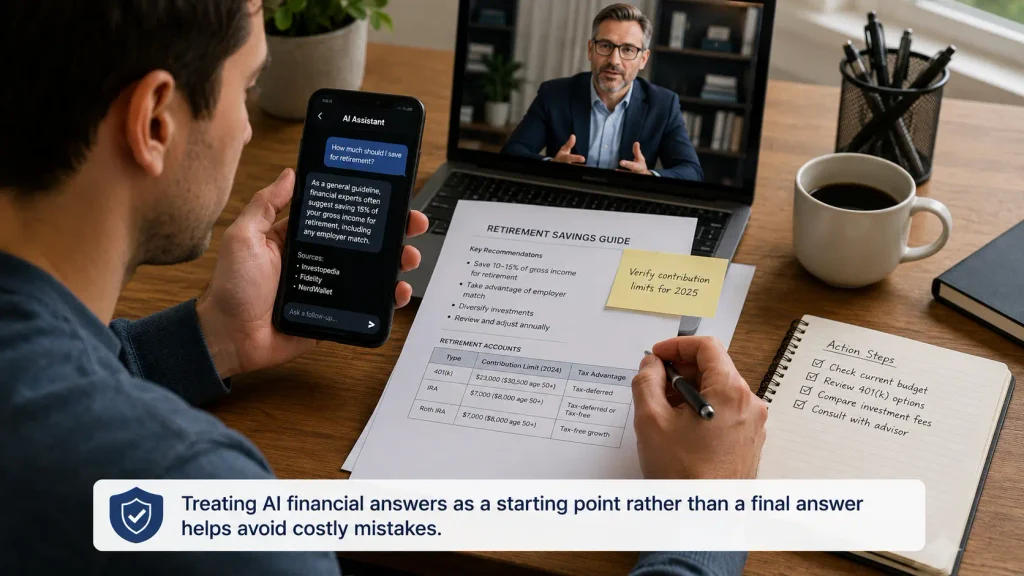
This does not imply that AI is ineffective for financial inquiries. For general education, grasping a concept, or getting oriented before making a more significant decision, it can be a good place to start. It is unable to accurately account for your unique tax circumstances, your current debt, your employer’s retirement matching plan, or whether the data it is using is up to date—exactly the same flaw that was evident in the estate tax exemption example.
A retirement account decision, a mortgage refinance, a question about estate planning, or anything else that is specific, urgent, or high stakes should be treated as a starting point for research rather than a definitive answer. Before acting on anything that has actual financial ramifications, confirm it with a current, trustworthy source or a qualified expert.
What happens next
The New York bill is still in the legislative stage, and it’s unclear how it will proceed or whether the impersonation-focused strategy will eventually lead to more comprehensive accountability requirements. This is likely to remain an unresolved, state-by-state and jurisdiction-by-jurisdiction patchwork for some time, even as usage continues to rise regardless of what protections do or do not exist, since there is no comprehensive federal fiduciary standard for and enforcement frameworks are still being developed in Europe.
FAQs
Does ChatGPT or any AI chatbot have a fiduciary duty to give me good financial advice?
No, there is currently no comprehensive regulation requiring that standard for general-purpose AI tools, and AI chatbots are not legally obligated to act in your best interest in the same manner as a licensed financial advisor.
How often do AI chatbots actually get financial information wrong?
Rates vary by study, but according to a University of Pennsylvania study, ChatGPT generated erroneous financial information about publicly traded companies about 35% of the time during testing. Other studies have discovered biased or inconsistent recommendations across various AI platforms.
What is the New York Chatbot Liability Bill?
State Senator Kristen Gonzalez introduced the legislation, which targets AI tools that pose as certified professionals. Instead of a broad fiduciary standard for AI financial advice, its scope is limited to impersonation. AI financial advice
Why did federal fiduciary protections for retirement advice get weaker in 2026?
The current administration decided not to file an appeal after courts overturned important parts of the Retirement Security Rule, a rule that had reinforced fiduciary protections for retirement advice.
Is it safe to connect my bank accounts to an AI chatbot like ChatGPT?
Since these are new integrations without a developed regulatory framework specific to AI account access, there are real risks beyond advice accuracy, such as data privacy and account security considerations. financial advice
Should I stop using AI for financial questions entirely?
Not necessarily, but use it as a starting point for general research rather than individualized advice, and cross-reference anything important or time-sensitive—such as changes to tax laws or decisions pertaining to particular accounts—with an up-to-date, trustworthy source or a qualified expert.
Are AI advisory services like Robinhood’s cheaper than traditional financial advisors?
Yes, frequently in a big way. The average annual cost of Robinhood’s AI advisory service has been around $250 per user, while a traditional advisor would charge about 1% of the assets under management, which could amount to $2,000 for a portfolio worth $200,000. AI financial advice
good artical
i appreciate your comment
thank you
thanks
[…] AI-powered financial analysis […]
[…] Can AI Replace Human Workers? […]
[…] latest finance news […]